It Worked for Me
Your aunt has a cold. On the fourth day, when she feels awful, she drinks a strong ginger and honey tea. Two days later she feels much better. "It worked for me," she says. "You should try it." She is telling the truth about what happened to her. But does her story show that the tea worked?
Myth or fact? If a remedy worked for someone you trust, it works.
Many illnesses get better on their own
A cold usually starts to get better in about 1 to 2 weeks, with or without any remedy.1 The body fights it off by itself. Getting better without any treatment is called natural recovery. So "I took it and then I got better" fits two different stories: the remedy helped, or she would have got better anyway. Your aunt's story is an anecdote: a personal story about what happened to one person. One anecdote can't tell these two stories apart.
We try things at our worst
People reach for a remedy when they feel worst. But the worst day of a cold, a sore back or a headache is often just before it starts to ease. So whatever someone takes at that moment seems to work, because the next days are better anyway.
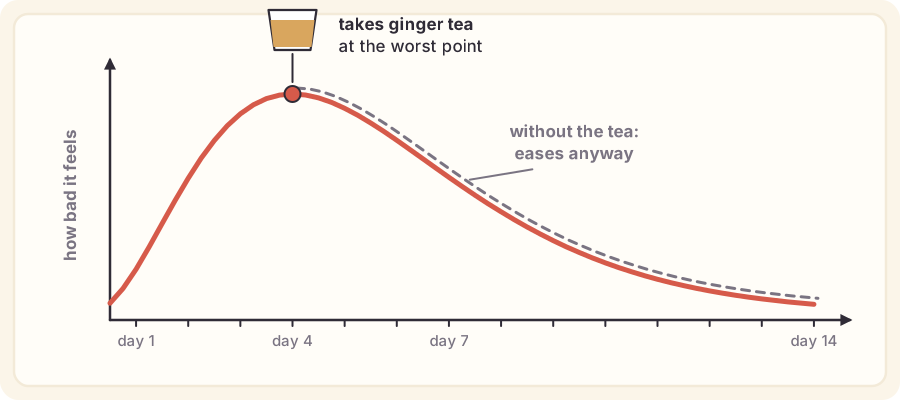
Other things change at the same time, too. While she drank the tea, your aunt also stayed home, slept more and drank more water. Any of these might have helped, or none of them.
We remember the hits
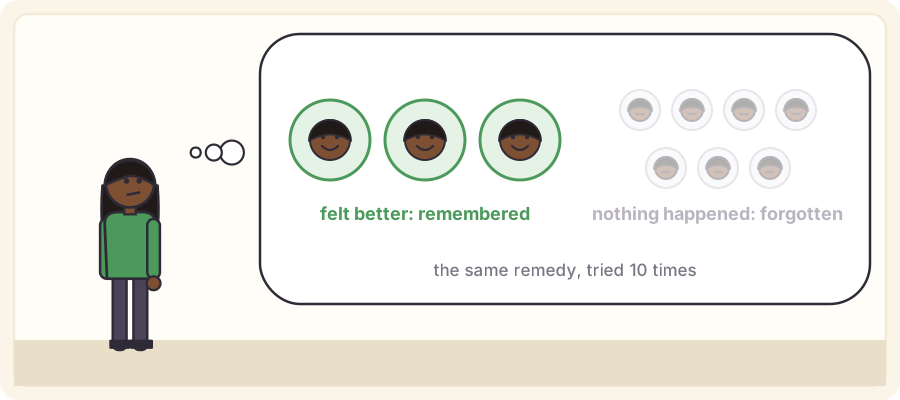
Imagine a remedy is tried ten times. Three times the person feels better soon after, and seven times nothing much happens. The three good stories are remembered and passed on. The seven others are forgotten, because "I tried it and nothing happened" is not much of a story. A story spreads because it is surprising or hopeful, not because it is typical.
There is one more reason a person can feel better after a remedy: the placebo effect, which is the subject of The Placebo Effect.
Show the answer
Myth. The story can be completely true and still not show that the remedy works. Researchers who teach people to judge health claims list "trust in personal experiences" as one of the most common traps. Another is believing that a remedy works because many people use it.2
What would show it?
To find out whether ginger tea helps a cold, you need a fair comparison: many people with colds, chance deciding who drinks the tea and who doesn't, and then a count of how fast each group gets better. That is a clinical trial, as in Lemons at Sea. If the tea group gets better no faster, the tea wasn't doing it. Stories can still be useful: they can give scientists ideas worth testing.
Try it this week
When someone tells you a remedy worked, ask kindly: would it have got better anyway? What else changed at the same time? How many people tried it and felt nothing?
Words to know
- anecdote - a personal story about what happened to one person or a few
- natural recovery - getting better by itself, without any treatment
Big idea
"it worked for me" can be true and still not show that the remedy worked, because many illnesses get better on their own - only a fair comparison can tell.
Sources
-
NHS, Common cold. ↩
-
Informed Health Choices, Key Concepts. ↩