Looking After Your Teeth
Two friends eat the same bag of sweets. One eats them all after lunch. The other eats one every half hour and sips a sweet tea all afternoon. Same sugar, same teeth. Do their teeth get the same treatment?
Tooth decay matters more than people think. The World Health Organization (WHO) says untreated tooth decay is the most common health condition in the world: about 2.5 billion people have it.1
Myth or fact? For your teeth, only the total amount of sugar you eat matters.
How a hole starts
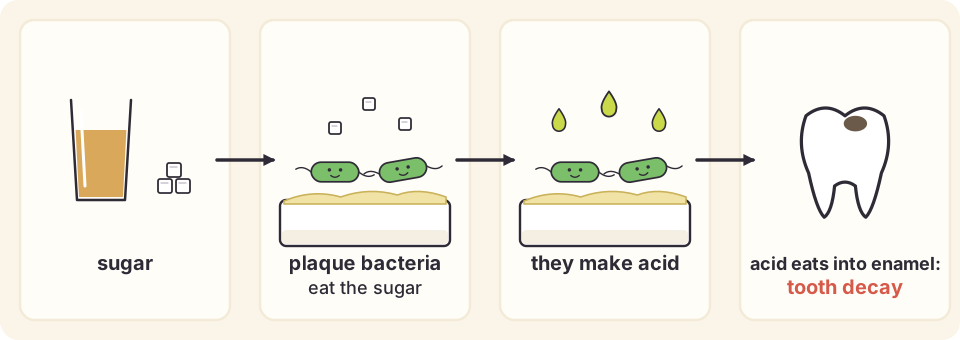
Your teeth are covered by enamel, the hard, shiny outer layer. Every day a sticky layer called plaque builds up on them. Plaque is full of bacteria, tiny living things too small to see.
When you eat or drink something sugary, the plaque bacteria feed on the sugar and turn it into acid. The acid slowly dissolves the enamel. Over time this can make a soft spot, and then a hole. That damage is tooth decay.2 At first it often doesn't hurt at all, so you may not know it is there.3
How often matters
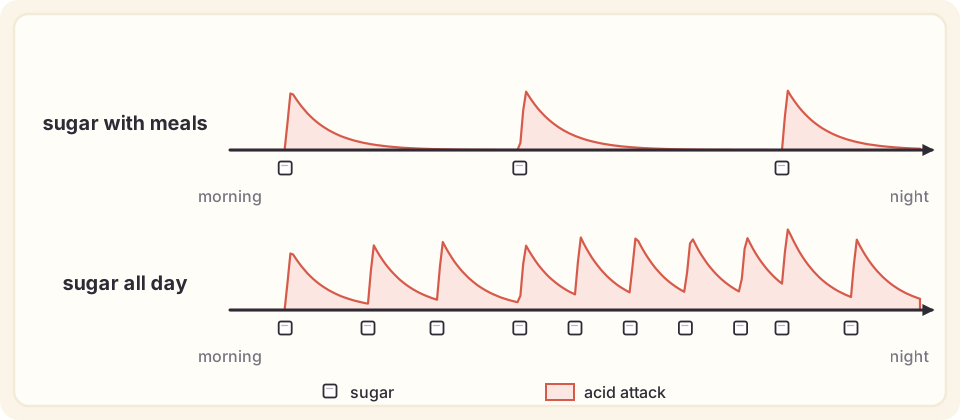
Each time sugar arrives, the acid attacks for a while, and then the mouth slowly recovers. If sugar keeps arriving, the teeth never get that rest.
Show the answer
Myth. The amount matters, but how often you have sugar matters a lot too. Health experts who work on children's teeth in Scotland say that limiting how often you have sugar is the most important thing, closely followed by limiting how much.4 So the friend who ate the sweets after lunch gave her teeth one attack. The friend who snacked and sipped all afternoon gave his teeth many.
Fluoride and brushing
Fluoride is a mineral that makes enamel stronger, so it resists decay better.5 The most useful place to get it is toothpaste. The NHS, the UK's health service, says:6
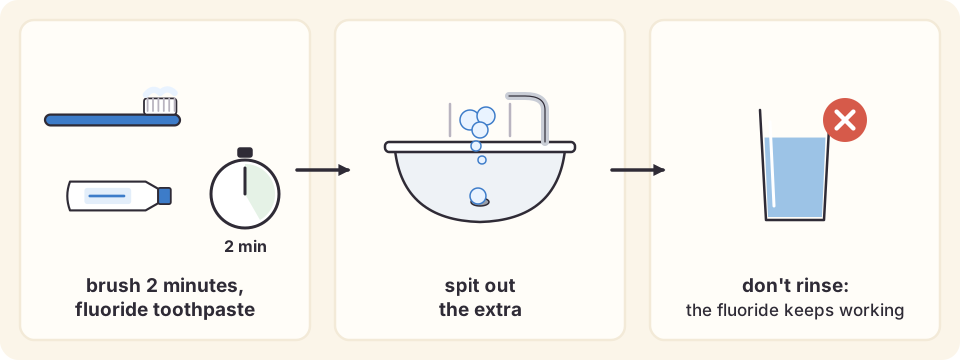
- Brush twice a day for about 2 minutes. One of those times should be last thing at night, just before bed.
- Use toothpaste with fluoride. For adults, at least 1,350 ppm (parts per million) of fluoride; the number is on the tube. WHO suggests 1,000 to 1,500 ppm.2
- Spit out the extra toothpaste, but don't rinse with water. Rinsing washes away the fluoride that is still working on your teeth.
Cleaning between your teeth helps too, because brushes miss plaque there. And regular check-ups let a dentist find decay early, before it hurts.
What you can do
- Brush twice a day for 2 minutes with fluoride toothpaste, the last time just before bed. Spit, don't rinse.
- Keep sweets and sweet drinks to mealtimes. Between meals, drink water and choose snacks without added sugar.
- Clean between your teeth, and see a dentist for check-ups or whenever a tooth hurts.
Words to know
- enamel - the hard, shiny outer layer of a tooth
- plaque - the sticky layer of bacteria that builds up on teeth
- tooth decay - damage to a tooth made by acid from plaque bacteria, which can end in a hole
- fluoride - a mineral, found in most toothpaste, that makes enamel stronger
Big idea
Plaque bacteria turn sugar into acid that eats into teeth, so have sugar less often, and brush with fluoride toothpaste twice a day.
Sources
-
World Health Organization, WHO highlights oral health neglect affecting nearly half of the world's population (news release, 2022). ↩
-
World Health Organization, Oral health (fact sheet). ↩ ↩2
-
NHS, Tooth decay. ↩
-
NHS Scotland Childsmile, Tooth decay. ↩