How Much to Move
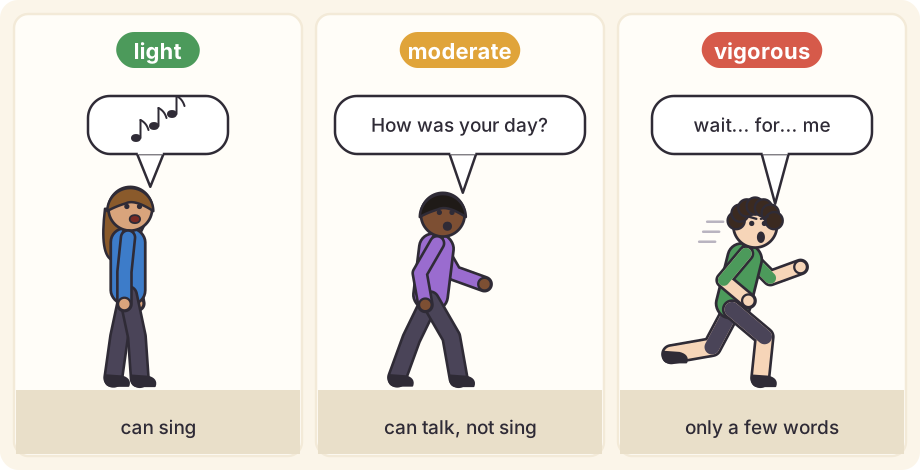
Two friends walk to school together, chatting all the way. A third runs for the bus and can only gasp "wait... for... me". All three are moving, but not equally hard. How hard, and how much, should a body move?
Myth or fact? No pain, no gain: exercise only works if it hurts.
How hard: the talk test
In moderate activity you breathe faster and your heart beats faster, but you can still talk. In vigorous activity you breathe hard and fast.
The easiest way to tell them apart is the talk test.1 If you can talk but not sing, the activity is moderate: brisk walking, cycling slowly, dancing, or heavy work in the garden. If you can't say more than a few words without stopping for a breath, it is vigorous: running, fast cycling, skipping with a rope, swimming lengths. And if you can easily sing, the activity is light, like a slow stroll. Light activity is still better than sitting still.2
How much: WHO's guidelines
In 2020 the World Health Organization (WHO) set out how much activity each age needs.2
| Age | Aerobic activity (heart and breathing faster) | Making muscles work hard |
|---|---|---|
| 5 to 17 | an average of 60 minutes a day, moderate to vigorous; vigorous on at least 3 days a week | at least 3 days a week, for muscles and bones |
| 18 to 64 | 150 to 300 minutes a week of moderate, or 75 to 150 minutes of vigorous, or a mix | at least 2 days a week, working all the main muscles |
| 65 and over | the same as other adults | the same, plus balance and strength activities on at least 3 days a week, to help prevent falls |
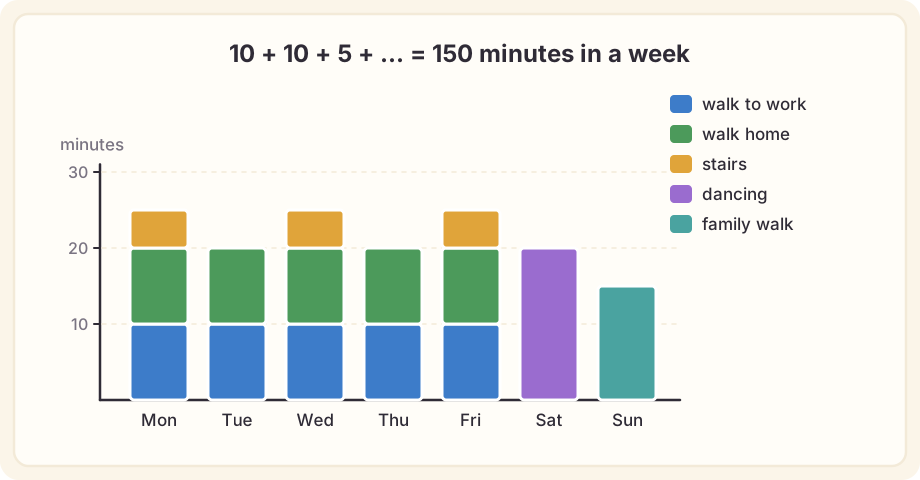
Vigorous activity counts double, so 75 minutes of running does about as much as 150 minutes of brisk walking. 150 minutes is 30 minutes on 5 days. The same guidelines also say to sit less (see Sitting Too Long), and they apply to people living with a disability too, with activity suited to each person's body and health.2
Short pieces count
The old guidelines, from 2010, counted only activity done for at least 10 minutes at a time. In 2020 WHO dropped that rule: bouts of any length now count.2 Five minutes on the stairs and a quick walk to the shop all add up.
No pain, no gain?
Show the answer
Myth. Moderate activity, the kind where you can still talk, counts in full in WHO's guidelines. You don't have to be out of breath, and it shouldn't hurt. Pain is not a sign it's working: the NHS says to stop the exercise at once if you feel any pain or feel unwell.3 If you are starting from little, start small and build up slowly.2
What you can do
- Try the talk test on your next walk: can you chat but not sing?
- Add up your week, short pieces included, and compare it with your age's amount.
- If you are far from it, add a little at a time.
Words to know
- moderate activity - activity that makes you breathe faster, but you can still talk
- vigorous activity - activity so hard you can only say a few words before taking a breath
- talk test - checking how hard you are working by whether you can talk, or even sing, while you move
Big idea
Adults need about 150 to 300 minutes of moderate activity a week, young people an hour a day on average, and every minute counts, however short the piece.
Sources
-
Centers for Disease Control and Prevention (CDC), Measuring Physical Activity Intensity. ↩
-
Fiona Bull and others, World Health Organization 2020 guidelines on physical activity and sedentary behaviour (British Journal of Sports Medicine, 2020). ↩ ↩2 ↩3 ↩4 ↩5