What Shapes Your Health
Sara and Amir are cousins, the same age, and both try to eat well and stay active. Sara lives in a quiet town with clean air, safe tap water and a park near her home. Amir lives beside a busy road full of traffic fumes, works long night shifts and has no safe place to walk. They make the same effort. Do they have the same chance of staying healthy?
More than your own choices
Your health is shaped by many things. Health experts call them the determinants of health: everything that makes a person more or less likely to be healthy. Some of them raise your risk - the chance that something harmful, like an illness, will happen. Others lower it.
The World Health Organization (WHO) sorts them into three groups:1
- The social and economic environment: money and social status, education, work and working conditions, support from family, friends and community, and culture - the customs and beliefs you grow up with.
- The physical environment: clean air, safe water, safe housing, safe roads and healthy workplaces.
- The person's own characteristics and behaviours: the genes you got from your parents, and what you do - what you eat, how active you are, whether you smoke, how you cope with stress.
WHO also names health services: whether you can get care that prevents and treats illness when you need it. And it names gender: men and women tend to get different illnesses at different ages.
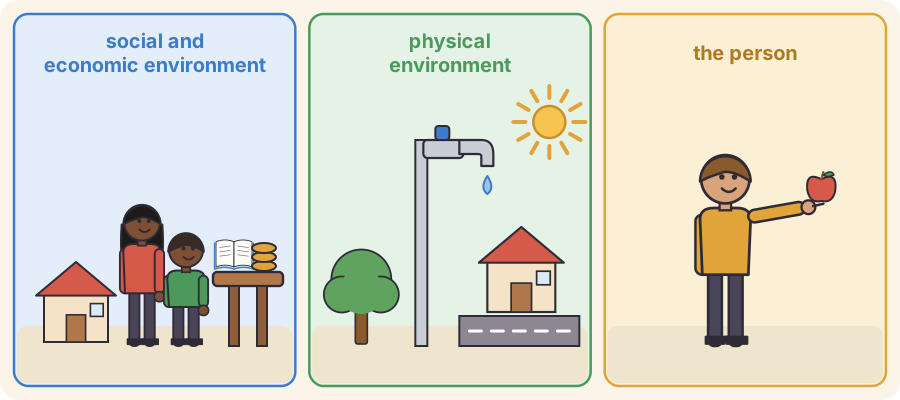
Where you are born, grow, work and live
WHO puts it simply: the social determinants of health are "the conditions in which people are born, grow, work, live and age".2 Sara and Amir show what that means. Amir breathes dirtier air every day, has to sleep in the daytime after his shifts, and has nowhere safe to walk. None of that is about how hard he tries.
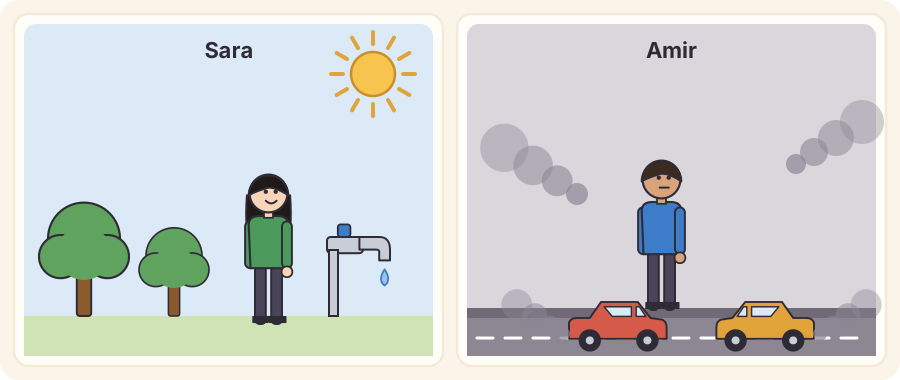
Not a matter of blame
Myth or fact? Your health is all down to your own choices.
Show the answer
Myth. Your choices matter, and many lessons of this course are about things you can do. But WHO says that people are unlikely to be able to control many of the determinants of health directly. So blaming people for poor health, or praising them for good health, is not fair.1
The determinants also act together, so they are hard to pull apart. A person with little money may live near a busy road, have less time to cook and find it harder to see a doctor. Be careful with any chart that splits your health into exact percentages for each cause.
This doesn't mean your choices don't count. It means two things are true together: the place you live shapes the choices you have, and the choices you can make still help.
Try it this week
Pick one thing that shapes your health that you can't change on your own, such as the air on your street or the hours of your job. Then pick one thing you can change a little, such as going to bed at the same time each night. Notice both. And the next time you hear someone blamed for being ill, remember Sara and Amir.
Words to know
- determinants of health - all the things that make a person more or less likely to be healthy: their surroundings, their life and work, their body and what they do
- risk - the chance that something harmful, like an illness, will happen
Big idea
Health is shaped by where we are born, grow, work, live and age, not only by our own choices - so blaming people for being ill is wrong.
Sources
-
World Health Organization, Determinants of health (questions and answers). ↩ ↩2