How Much Sleep You Need
A friend says five hours a night is plenty for him. Your grandmother sleeps nine. A baby in the family seems to sleep half the day. Who is right? Is there one number of hours that everyone should sleep?
Myth or fact? Everyone needs exactly 8 hours of sleep.
It depends on your age
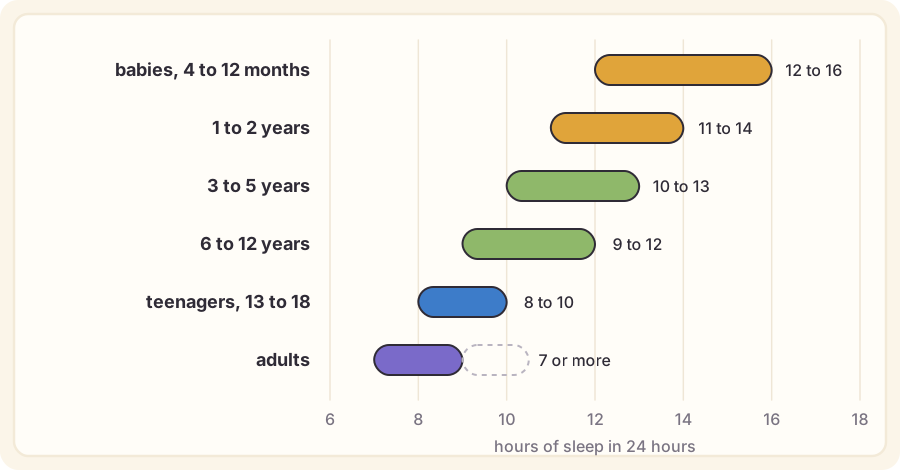
Sleep experts have looked at many studies of sleep and health and agreed on ranges for each age. These are hours of sleep in 24 hours, done regularly:12
| Age | Hours of sleep in 24 hours |
|---|---|
| babies, 4 to 12 months | 12 to 16, naps included |
| 1 to 2 years | 11 to 14, naps included |
| 3 to 5 years | 10 to 13, naps included |
| 6 to 12 years | 9 to 12 |
| teenagers, 13 to 18 years | 8 to 10 |
| adults | 7 or more |
Newborn babies, under 4 months, are left out: their sleep varies so much that the experts set no range.1 Most adults need 7 to 9 hours.3
Older adults need about the same as other adults, 7 to 9 hours. What changes is the way they sleep: they tend to go to bed earlier and wake earlier, and their sleep gets lighter and shorter, with more waking in the night.4
Show the answer
Myth. Need depends on age, and it varies between people of the same age too: "there is no magic amount of sleep that works for everybody of the same age".3 That is why the experts give ranges. A teenager needs more than 8 hours, and many adults do well on 7.
Can you catch up at the weekend?
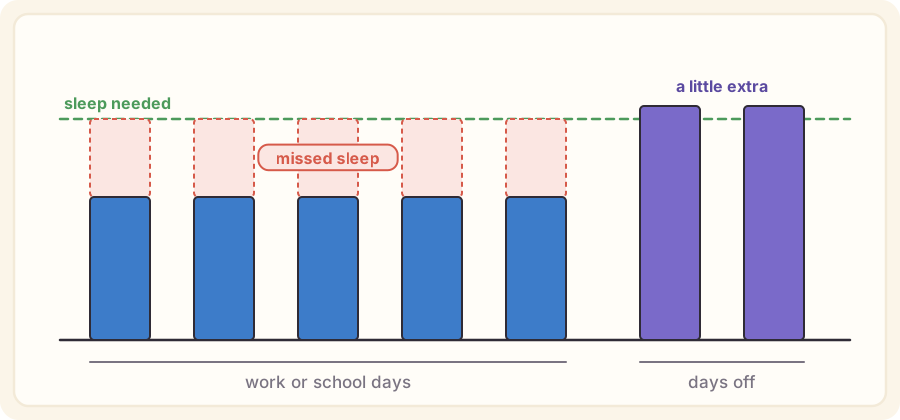
Many people sleep too little on work or school days and then sleep in on their days off. Sleeping longer on days off may not be enough to replace the sleep you missed.3
In a small lab study, young adults slept only 5 hours a night on weekdays and then as long as they liked at the weekend. They slept only about an hour more in total, far less than they had lost, and in the new week their body clocks, the inner timers that make us sleepy at night, ran later than before.5 The lesson Your Body Clock explains why that matters.
More is not always better either. In children and teenagers, regularly sleeping much more than the recommended hours may be linked to health problems, such as high blood pressure, diabetes and mental health problems.1 Someone who always needs a lot of sleep and still feels tired should talk to a doctor.
What you can do
- Find your age in the table and compare it with your own nights for one week.
- Aim for enough sleep on most nights, rather than catching up at the weekend.
- If you sleep enough hours but still feel tired every day, tell a doctor or nurse.
Words to know
- sleep need - how many hours of sleep in 24 hours keep a person of a given age healthy; a range, not one number
Big idea
Teenagers need about 8 to 10 hours and adults at least 7, regularly, and lost sleep can't simply be paid back at the weekend.
Sources
-
Paruthi and others, Recommended Amount of Sleep for Pediatric Populations (consensus statement of the American Academy of Sleep Medicine, 2016). ↩ ↩2 ↩3
-
Watson and others, Recommended Amount of Sleep for a Healthy Adult (consensus statement of the American Academy of Sleep Medicine and Sleep Research Society, 2015). ↩
-
National Institute of Neurological Disorders and Stroke (NIH), Brain Basics: Understanding Sleep. ↩ ↩2 ↩3
-
National Institute on Aging (NIH), Sleep and Older Adults. ↩
-
Depner and others, Ad libitum Weekend Recovery Sleep Fails to Prevent Metabolic Dysregulation (study of 36 young adults, Current Biology, 2019). ↩