How Much Water?
A friend carries a big bottle everywhere and says you must drink eight glasses of water a day, or you will dry out. Another friend drinks mostly tea and feels fine. After football on a hot day, you finish a whole bottle without stopping. How much water do you really need?
Myth or fact? Everyone must drink exactly eight glasses of water a day.
Water in, water out
Your body loses water all day long: in pee, in sweat and in every breath you breathe out. Hydration means having enough water in the body to replace what it loses. Dehydration is when the body loses more water than it takes in.1
Early signs of dehydration are feeling thirsty, dark yellow, strong-smelling pee, peeing less often than usual, a dry mouth, a headache and feeling tired or dizzy.1 Babies, children and older adults get dehydrated more easily.1
How much?
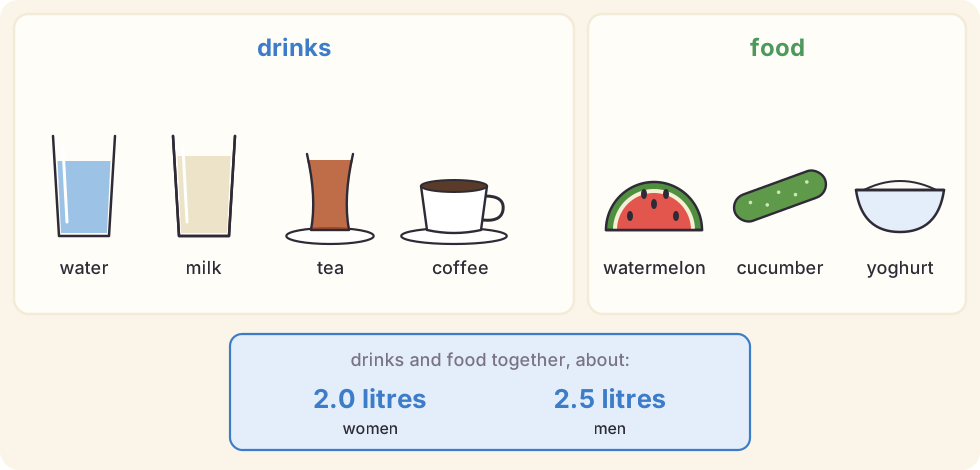
The European Food Safety Authority (EFSA) says about 2.0 litres of water a day is enough for women and about 2.5 litres for men. That is water from all sources: drinks and food together.2 Part of it comes from food, such as fruit, vegetables, soup and yoghurt.
The NHS, the UK's health service, gives 6 to 8 cups or glasses of fluid a day as a guide. Water, lower-fat milk, tea and coffee all count. You need more when it is hot, when you are active for a long time and when you are ill.3
Show the answer
Myth. "Eight glasses a day" is a handy guide, not a scientific rule. A kidney scientist, Heinz Valtin, looked for the studies behind it in 2002 and found none.4 For healthy people, thirst is a good guide: the body starts to feel thirsty early, long before it is in trouble.4
A simple check
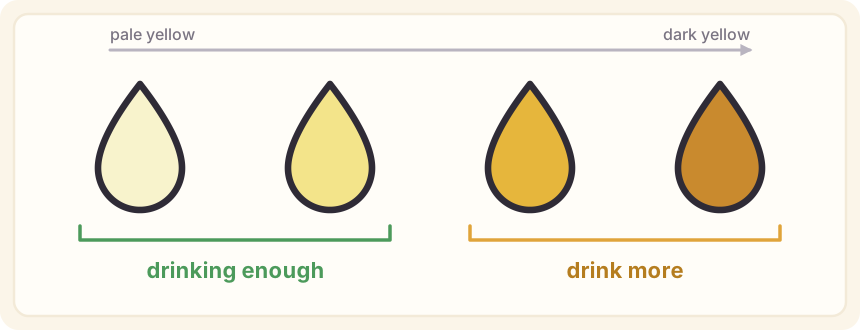
You can't see inside your body, but you can see your pee. Pale yellow pee is a good sign that you are drinking enough. Dark yellow pee means drink more.3
Too much is rare, but real
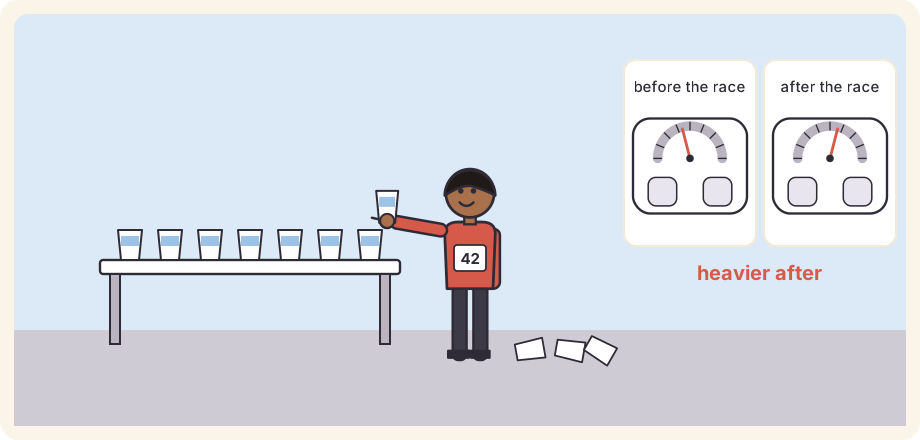
Drinking much more than the body loses, quickly, can lower the amount of sodium (part of salt) in the blood, and that can be dangerous. It is rare, and it mostly happens in long sports events. At the 2002 Boston Marathon, about 1 in 8 runners who were tested at the finish had low sodium in their blood. The runners most at risk had gained weight during the race: they had drunk more than they sweated out.5
What you can do
- Keep water near you and drink when you are thirsty, and more on hot days, during sport and when ill.
- Glance at your pee: aim for pale yellow.
- Make water, milk or tea your usual drinks, and keep juice to one small glass (150 ml) a day.3
Words to know
- hydration - having enough water in the body to replace what it loses
- dehydration - when the body loses more water than it takes in
Big idea
Most adults need about 2 to 2.5 litres of water a day from drinks and food; thirst and pale yellow pee are better guides than any fixed number of glasses.
Sources
-
NHS, Dehydration. ↩ ↩2 ↩3
-
European Food Safety Authority, EFSA sets European dietary reference values for nutrient intakes (news, 2010). ↩
-
NHS, Water, drinks and hydration. ↩ ↩2 ↩3
-
Heinz Valtin (2002), "Drink at least eight glasses of water a day." Really? Is there scientific evidence for "8 x 8"? (American Journal of Physiology). ↩ ↩2
-
Christopher Almond and others (2005), Hyponatremia among runners in the Boston Marathon (New England Journal of Medicine). ↩