Strong Muscles and Bones
Bones feel like a fixed, hard frame, and muscles like something you are born with. In fact both are alive, and both change with use. A child who runs and jumps and a grandmother who carries her own shopping are both building something. What, and how?
Bones are built while you are young
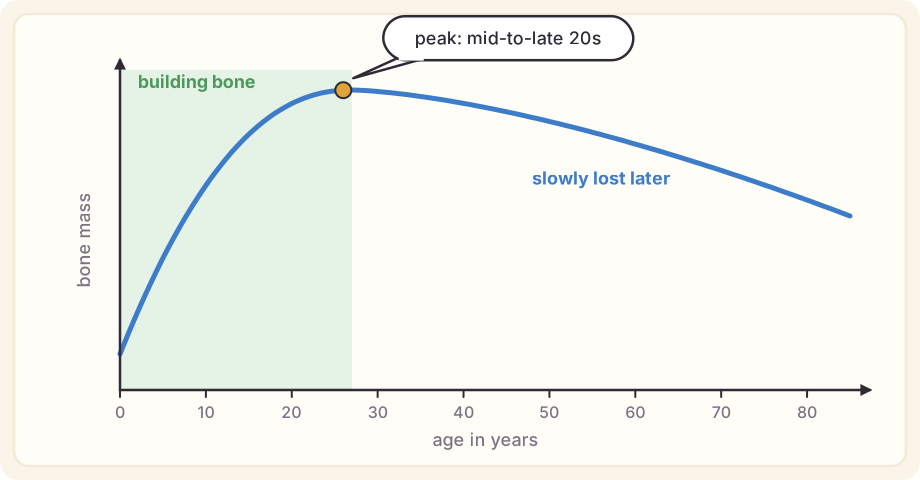
Bone is living tissue. Bits of old bone are always being removed and replaced with new bone. In childhood and the teenage years much more new bone is added than taken away. In most people the amount of bone, called bone mass, reaches its highest point by the mid-to-late 20s.1 How much bone you build by then helps decide how healthy your bones are for the rest of your life. Later, as you get older, bone is lost more quickly and new bone grows more slowly.2
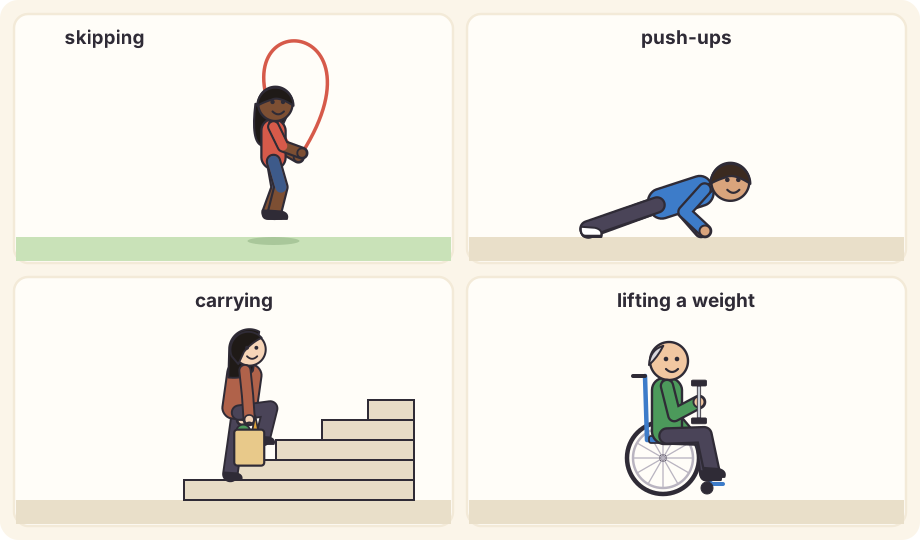
Bones grow stronger when they have to carry the body's weight against gravity and take a little force. This is weight-bearing activity: brisk walking, running, hopping, skipping and jumping, dancing, climbing stairs, and racket sports like badminton.31 For children's bones these are the best kind of activity, along with exercises that make muscles push or pull against a weight.1
Muscles: use them or lose them
Muscles grow stronger when they work hard against a weight. That weight can be your own body (push-ups, squats, climbing), heavy shopping, a stretchy exercise band or weights. This is muscle-strengthening activity. The World Health Organization (WHO) advises it on at least 2 days a week for adults and 3 days for young people.4
With age, muscles slowly get smaller and weaker, but strength exercise slows this down.5 It is never too late to start. A review of 121 trials with about 6,700 older people found that strength training made them stronger and better at everyday tasks like bathing or making a meal.6
Children and weights
Many parents worry that weights will stop a child growing. The American Academy of Pediatrics (AAP), the doctors who care for children in the US, says children of all ages can benefit from strength training if it is well supervised and done with good technique. Children as young as 5 can build strength with one-legged hops or frog jumps.7 Well-run programmes have not been shown to harm children's growth.8
Myth or fact? Sit-ups burn the fat on your belly.
Show the answer
Myth. Working one part of the body does not burn the fat on that part. In one small trial, people did belly exercises 5 days a week for 6 weeks. Their belly muscles got better at the work, but their belly fat did not change.9
What about stretching before sport to avoid injury? A review of 25 trials found that stretching made little difference, while strength training cut sports injuries to less than a third.10
What you can do
- Do something that makes your muscles work hard on 2 or 3 days a week: push-ups against a wall, squats, carrying, climbing.
- Choose weight-bearing activity for your bones, especially while you are young: walking, running, jumping, dancing.
- If you are new to weights, learn good technique from someone trained to teach it.
Words to know
- weight-bearing activity - activity where your bones carry your body's weight against gravity, like walking, running or jumping
- muscle-strengthening activity - activity that makes your muscles work hard against a weight, such as your own body, heavy bags or weights
Big idea
Bones and muscles grow stronger when they are used, bone is built most while you are young, and strength exercise helps at every age.
Sources
-
National Institute of Arthritis and Musculoskeletal and Skin Diseases (NIAMS), Kids and Their Bones. ↩ ↩2 ↩3
-
NIAMS, Osteoporosis. ↩
-
NIAMS, Exercise for Your Bone Health (2023). ↩
-
Fiona Bull and others, World Health Organization 2020 guidelines on physical activity and sedentary behaviour (British Journal of Sports Medicine, 2020). ↩
-
Roberto Cannataro and others, Strength training in elderly: an useful tool against sarcopenia (review, Frontiers in Sports and Active Living, 2022). ↩
-
Cochrane, Progressive resistance strength training for improving physical function in older adults (review of 121 trials). ↩
-
American Academy of Pediatrics, Guidance on Resistance Training for Children (2020). ↩
-
Paul Stricker, Avery Faigenbaum and Teri McCambridge, Resistance Training for Children and Adolescents (Pediatrics, 2020). ↩
-
Sachin Vispute and others, The effect of abdominal exercise on abdominal fat (Journal of Strength and Conditioning Research, 2011). ↩
-
Jeppe Lauersen, Ditte Bertelsen and Lars Andersen, The effectiveness of exercise interventions to prevent sports injuries (British Journal of Sports Medicine, 2014). ↩