Plants on Your Plate
In many homes there is always something green on the table: a plate of fresh herbs next to the bread, a salad, a bowl of fruit after dinner. Grandparents everywhere say "eat your vegetables". Were they right, and how much is enough?
How much fruit and vegetables?
The World Health Organization (WHO) says everyone older than 10 should eat at least 400 g of fruit and vegetables a day. Fresh, frozen and canned all count, as long as no sugar or much salt has been added.1
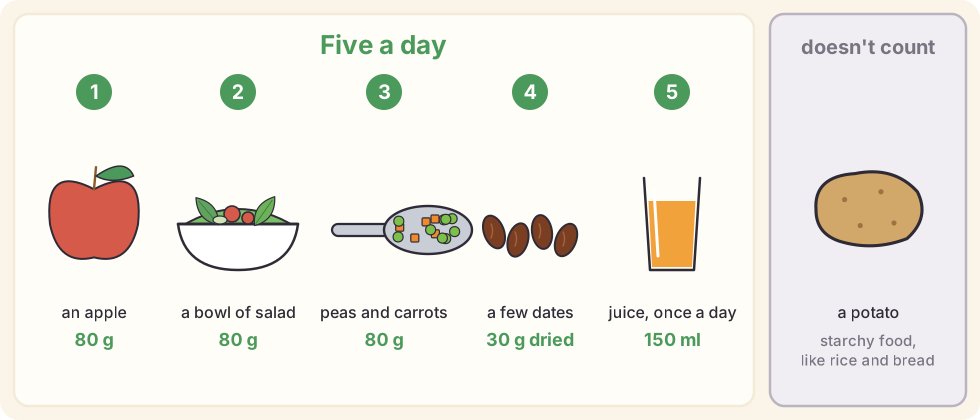
The NHS, the UK's health service, turns this into an easy rule: five a day, five portions of about 80 g each. A few things count differently:2
- Potatoes don't count, and nor do yams and cassava. They are starchy foods, like rice and bread.
- Pulses (lentils, chickpeas, beans) count, but only once a day, however much you eat.
- Fruit juice counts once at most: 150 ml a day in total.
- Dried fruit counts, but a portion is smaller: 30 g, for example a few dates.
Fibre: the part we can't digest
Fibre is the part of plant foods that the body can't digest. It passes through the gut and helps keep it working well; eating enough of it helps prevent constipation.3
WHO says everyone older than 10 should get at least 25 g of fibre a day, from foods that have it naturally.1 The UK advises 30 g for adults, but most adults there eat only about 20 g.3
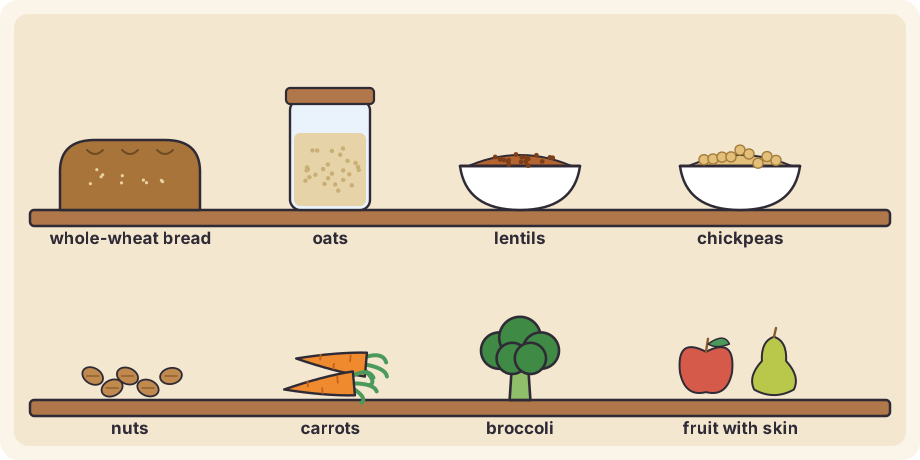
Fibre comes only from plants. Good sources are:
- whole grains - grains eaten whole, with their outer layer kept, like brown rice, whole-wheat bread, oats and bulgur
- pulses - the dried seeds of plants in the pea family: lentils, chickpeas, beans and dried peas
- vegetables, nuts and seeds, and fruit eaten with its skin
What the studies found
A large review made for WHO put together many studies that followed people for years. People who ate the most fibre had about 15 to 30 per cent less heart disease, stroke, type 2 diabetes and bowel cancer than people who ate the least.4
These studies watched what people did; they didn't make one group eat more fibre. So fibre is linked to better health, which is not quite proof that it causes it: people who eat lots of fibre may differ in other ways too (see cause or coincidence). Even so, the health agencies agree that more fibre, from whole foods, is a good idea.3
What you can do
- Put a vegetable or fruit in every meal: herbs with bread, a salad, fruit after dinner.
- Swap some white bread or white rice for whole grain kinds.
- Add lentils, chickpeas or beans to a soup or stew a few times a week.
Words to know
- fibre - the part of plant foods the body can't digest; it keeps the gut working
- whole grain - a grain eaten whole, with its outer layer kept, such as brown rice or oats
- pulses - lentils, chickpeas, beans and dried peas
Big idea
Aim for at least 400 g of fruit and vegetables a day and plenty of fibre from whole grains, pulses and plants; eating more of them is linked to less heart disease, diabetes and bowel cancer.
Sources
-
World Health Organization, Healthy diet (fact sheet, 2026). ↩ ↩2
-
NHS, 5 A Day: what counts?. ↩
-
Andrew Reynolds and others (2019), Carbohydrate quality and human health: a series of systematic reviews and meta-analyses (The Lancet). ↩