Illnesses That Don't Spread
When we think of illness, we often think of catching something, like a cold from a classmate. But think of the older people in your family: a grandfather with a weak heart, an aunt with diabetes. Nobody caught those from anyone. What are these illnesses, and why do they matter?
Myth or fact? Heart disease and diabetes are mostly problems of rich countries.
Two kinds of illness
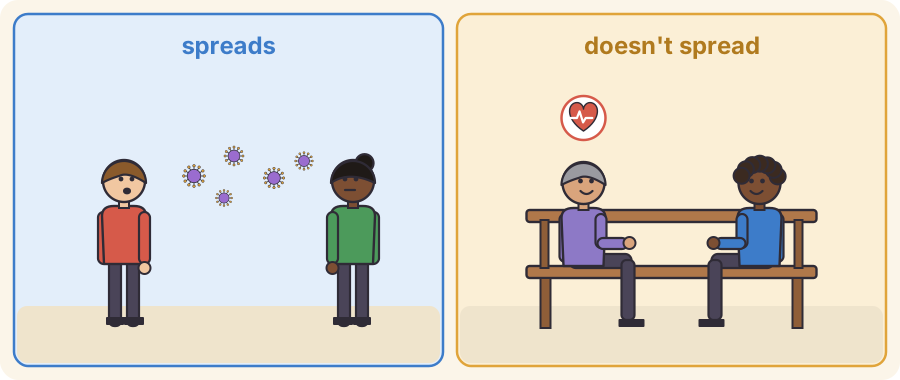
Some illnesses spread from person to person, because they are caused by germs, tiny living things that get into the body: a cold, flu, measles. These are communicable (infectious) diseases.
Others don't spread: you can't catch them from anyone. These are noncommunicable diseases, or NCDs for short. They usually last a long time, often for the rest of a person's life.1 The main groups are:
- Diseases of the heart and blood vessels, such as heart attacks and strokes
- Cancers
- Long-lasting lung diseases
- Diabetes, where the body can't keep the sugar in the blood at a healthy level
What people die of today
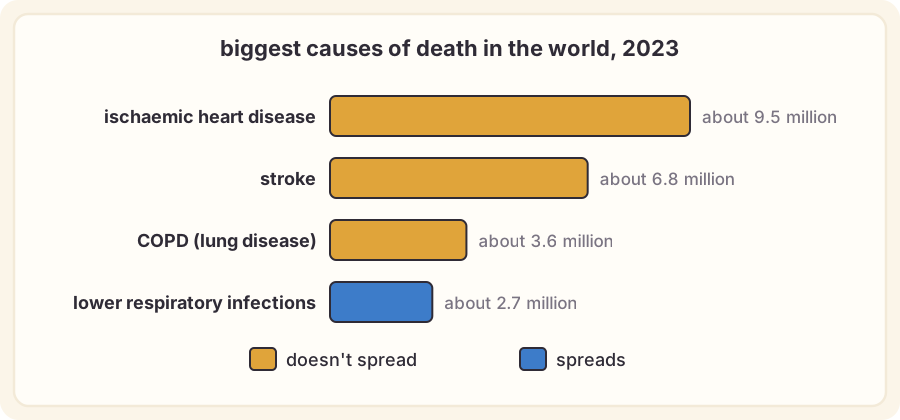
In 2023 about 61 million people died around the world. The biggest cause was ischaemic heart disease, where the blood vessels that feed the heart muscle get narrowed or blocked: about 9.5 million deaths, roughly 1 in 6. Next came stroke (about 6.8 million), COPD (a long-lasting lung disease) and lung infections such as pneumonia - the only one of the four that spreads. Of the ten biggest causes of death, eight don't spread.2
NCDs killed at least 43 million people in 2021: about 3 in 4 of all deaths not caused by the COVID-19 pandemic. About 18 million of those people died before the age of 70.1
Show the answer
Myth. About three quarters of all deaths from NCDs happen in low- and middle-income countries, and so do most of the deaths before age 70.1
What raises the risk
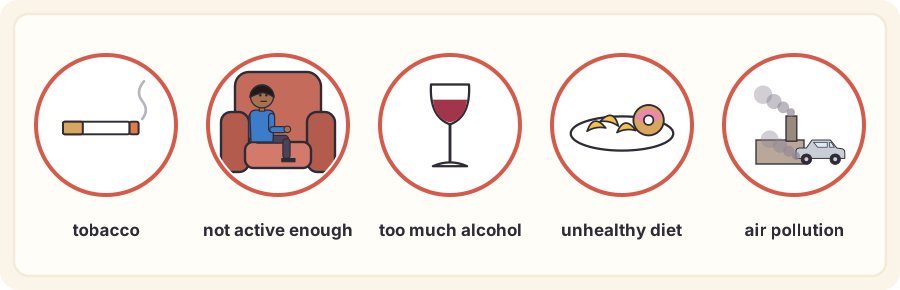
A risk factor is something that makes an illness more likely. It doesn't make it certain. WHO names the main risk factors for NCDs:1
- Tobacco use
- Not being active enough
- Drinking too much alcohol
- Unhealthy diets
- Air pollution, indoors and outdoors
High blood pressure - blood pushing too hard on the walls of the blood vessels - is linked to about 1 in 4 NCD deaths.1 Most people with it feel nothing, so only a measurement can tell.3
Genes, age, and the air and life around you matter too (see What Shapes Your Health). Getting ill doesn't prove someone did something wrong.
The hopeful part
Many of these risks can be lowered, by people and by whole countries; WHO says low-cost ways to do it already exist.1 Lowering a risk doesn't make an illness impossible, only less likely. Later lessons show how: Why Moving Matters, Plants on Your Plate, Sugar and Salt and Smoke and Vapour.
What you can do
- Ask a doctor, nurse or pharmacist whether you should have your blood pressure checked.
- Pick one risk factor above and read its lesson.
- If someone in your family has one of these illnesses, remember it is not their fault, and ask how you can help.
Words to know
- noncommunicable disease (NCD) - a long-lasting illness that doesn't spread from person to person, such as heart disease or diabetes
- communicable disease - an illness that spreads from person to person, caused by a germ
- risk factor - something that makes an illness more likely, but not certain
Big idea
Most people in the world today die of long-lasting illnesses that don't spread, and many of the things that raise their risk can be lowered.
Sources
-
World Health Organization, Noncommunicable diseases (fact sheet, 2025). ↩ ↩2 ↩3 ↩4 ↩5 ↩6
-
World Health Organization, The top 10 causes of death (fact sheet, 2026, data for 2023). ↩
-
World Health Organization, Hypertension (fact sheet, 2025). ↩