Why We Sleep
It is late, and there is a test tomorrow. A thought comes: if I sleep less, I get more hours to study. Lying still with your eyes closed can feel like lost time. So why does every person, in every country, need to sleep at all?
Myth or fact? When you fall asleep, your brain switches off and rests.
A night of sleep
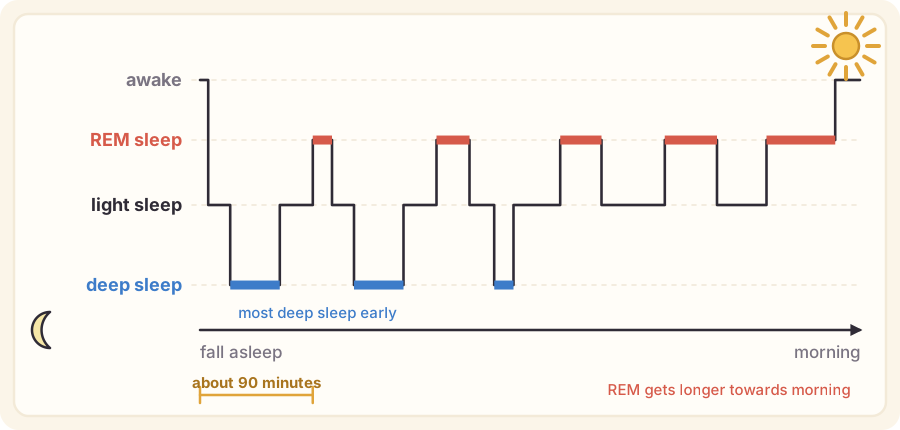
Sleep is not one long, flat state. Through the night you go round a cycle of different kinds of sleep, several times.1
In light sleep your heartbeat and breathing slow down and your muscles relax. In deep sleep your brain waves are at their slowest and it is hard to wake you. This is the sleep you need to feel refreshed in the morning, and most of it comes in the first half of the night.
Then comes REM sleep, short for "rapid eye movement" sleep. Your eyes move quickly behind closed eyelids, and most dreams happen now, so it is also called dreaming sleep. Your arm and leg muscles go still for a while, so you don't act out your dreams. The first REM sleep comes about 90 minutes after you fall asleep, and the REM periods get longer towards morning.1
Show the answer
Myth. Your brain stays busy all night. In REM sleep its activity comes close to how it looks when you are awake.1
What sleep does for you
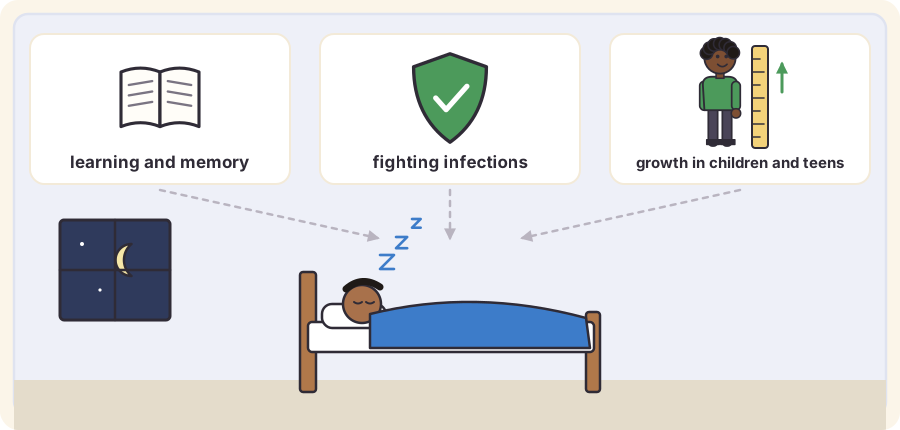
Sleep helps you learn and form long-term memories. Most likely both REM sleep and the other kinds of sleep play a part.1 People who don't sleep enough may get more colds and other infections, and in children and teenagers, sleep supports growth and development.2
Missing sleep now and then is part of life. Missing it again and again is different: for adults, regularly sleeping less than 7 hours a night is linked to more mistakes and accidents, weight gain, diabetes, high blood pressure, heart disease and depression.3
And yet scientists are honest about one thing: everyone needs sleep, but its full purpose "remains a mystery".1
Careful
You may read that sleep "washes" waste out of the brain. Some studies in mice suggested this, but a 2024 study in mice measured the opposite: less clearing during sleep.4 Scientists are still testing the idea, so treat it as a question, not a fact.
Too little sleep
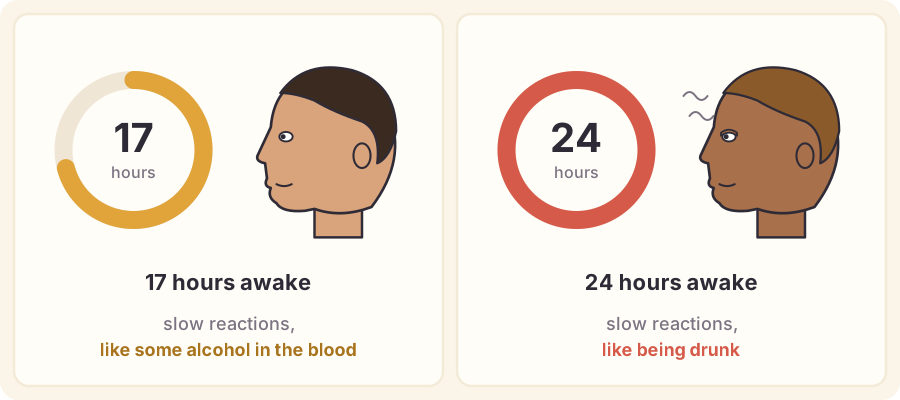
Tired people react more slowly and lose attention more easily. On lab tests of reaction and attention, being awake for 17 hours was similar to having some alcohol in the blood. Being awake for 24 hours was like being drunk.5 A long day of school and homework can easily reach 17 hours.
How much sleep is enough depends on your age: that is the next lesson, How Much Sleep You Need.
What you can do
- Before a test, count sleep as part of studying: your memory needs it.
- Don't drive, ride a motorbike or use dangerous tools after a night without sleep.
Words to know
- deep sleep - the deepest part of sleep, with the slowest brain waves, which you need to feel refreshed
- REM sleep - "rapid eye movement" sleep, when most dreams happen; also called dreaming sleep
Big idea
Sleep is not time switched off: it helps memory, defence against infections and growth, and missing it makes you slow and clumsy, even if science can't yet say all that it is for.
Sources
-
National Institute of Neurological Disorders and Stroke (NIH), Brain Basics: Understanding Sleep. ↩ ↩2 ↩3 ↩4 ↩5
-
National Heart, Lung, and Blood Institute (NIH), Why Is Sleep Important? (2022). ↩
-
Watson and others, Recommended Amount of Sleep for a Healthy Adult (consensus statement of the American Academy of Sleep Medicine and Sleep Research Society, 2015). ↩
-
Miao and others, Brain clearance is reduced during sleep and anesthesia (study in mice, Nature Neuroscience, 2024). ↩
-
CDC, National Institute for Occupational Safety and Health, Impairments due to sleep deprivation are similar to impairments due to alcohol intoxication (training for nurses, based on Dawson and Reid 1997 and Williamson and Feyer 2000). ↩