What Is a Fallacy?
A coin can look like gold and still be fake. You only find out by testing it. Reasons can be like that too: some feel convincing, get used every day, and still don't support the conclusion at all. Is there a way to recognise them?
Reasons that only look like reasons
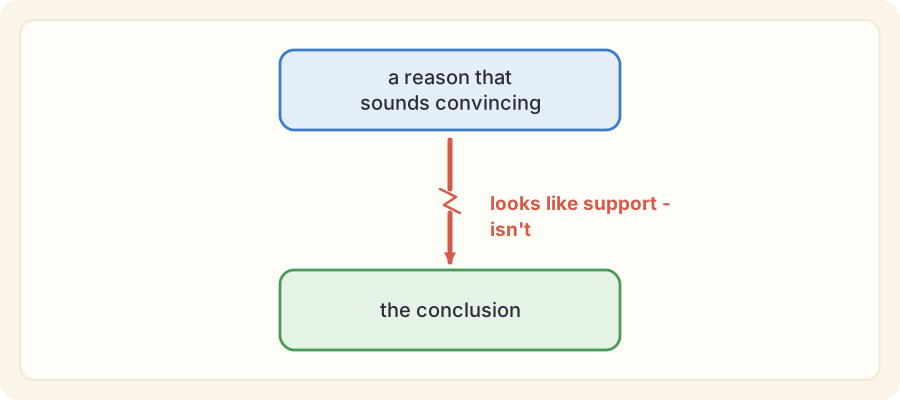
A fallacy (say "FAL-uh-see") is a common pattern of reasoning that seems to support a conclusion, but doesn't. Two things make something a fallacy:
- it is a mistake in reasoning - the reasons don't really support the conclusion;
- it is common and convincing - people fall for it again and again, because it feels like a good reason.
The word comes from a Latin word meaning "to deceive", or trick. Because fallacies come back so often, logicians have given many of them names. Once you know the name, you start to see the pattern everywhere.
You have already met three
You have learned three fallacies in this course already:
- Going backwards, from The Wet Street lesson: "If it rains, the street gets wet. The street is wet. So it rained."
- Hasty generalisation, from the Too Few Examples lesson: "It rained on my first two days, so it always rains here."
- After, so because of, from the It Happened After lesson: "The rooster crows and then the Sun comes up, so the crowing makes the Sun come up."
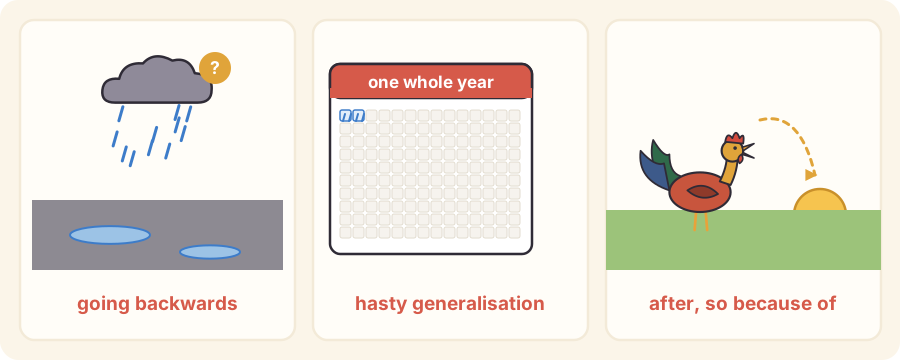
Each one is convincing for a reason. A wet street usually does mean rain. Two rainy days are some evidence. The rooster does crow before sunrise every day. The fallacy is in going further than the reasons allow.
A fallacy doesn't make the conclusion false
This is the most important thing to remember about fallacies. Finding a fallacy tells you that these reasons don't support the conclusion. It does not tell you the conclusion is false.
Maybe it really did rain in the night. "The street is wet, so it rained" is a bad argument for a claim that might still be true. If you want to know, you need better reasons - check whether the garden next door is wet too, or look at the weather report.
So when you spot a fallacy, the right reply is not "You're wrong!" It is "That reason doesn't show it. Is there a better one?"
The tricks ahead
The rest of this module looks at four more fallacies that turn up in arguments between people: attacking the person instead of the reasons, "everyone does it", offering only two choices, and arguing against something the other person never said. Each one is a way of seeming to win without giving a reason that supports the conclusion.
Try it at home
- Look back at the arguments in your notebook from this course.
- Find one that uses going backwards, a hasty generalisation, or "after, so because of".
- Write a better reason for the same conclusion - or write "I don't know" if there isn't one.
Words to know
- fallacy - a common pattern of reasoning that seems to support a conclusion but doesn't
Big idea
A fallacy is a convincing mistake in reasoning that people make again and again. Spotting one shows that the reasons don't support the conclusion - not that the conclusion is false.