Must It Be True?
There is a jar of cookies on the kitchen table. Your aunt says, "Every cookie in that jar is chocolate chip." You reach in without looking and take one. Before you look at it, what do you know about your cookie?
The jar of chocolate chip cookies
Here is your reasoning, written out as an argument:
Every cookie in this jar is chocolate chip.
I took this cookie from this jar.
So this cookie is chocolate chip.
You don't need to look at the cookie. If the two reasons are true - every cookie in the jar is chocolate chip, and yours came from the jar - then your cookie has to be chocolate chip. There is no way around it.
When an argument works like this, we say the conclusion follows from the reasons. In logic, an argument whose conclusion follows from its reasons is called valid.
The jar with one plain cookie
Now change one word. Your aunt says, "Most of the cookies in that jar are chocolate chip."
Most cookies in this jar are chocolate chip.
I took this cookie from this jar.
So this cookie is chocolate chip.
This time, the reasons can both be true while the conclusion is false. You might have picked the one plain cookie. The conclusion is likely, but it doesn't have to be true. So it doesn't follow, and the argument is not valid.
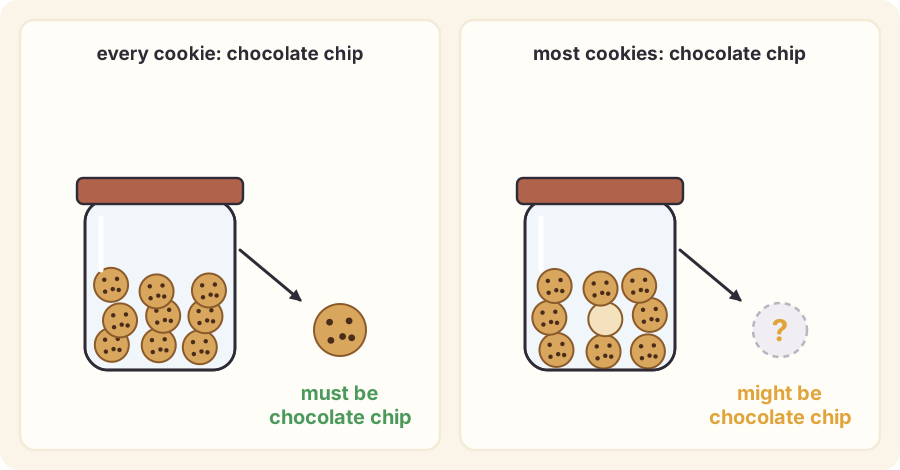
Not being valid doesn't make the second argument useless. "Probably chocolate chip" is still worth knowing. We will come back to arguments like this in the Every Swan I Have Seen lesson. For now, the point is the difference between must and might.
The test
How can you tell whether a conclusion follows? Use this test:
- Pretend the reasons are true - even if you don't know whether they are.
- Try to imagine the conclusion being false at the same time.
- If you can't imagine it, the conclusion follows: the argument is valid. If you can, it doesn't follow.
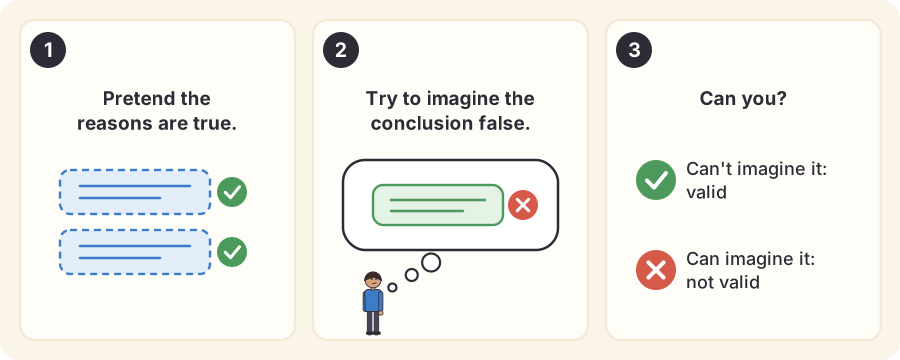
With the first jar, try step 2: every cookie in the jar is chocolate chip, your cookie came from the jar, and your cookie is not chocolate chip. That picture makes no sense, so the argument is valid. With the second jar, step 2 is easy: you picked the plain one. So it is not valid.
Notice that the test never asks you to check whether the reasons really are true. Validity is only about whether the conclusion follows if they are.
Try it at home
- Fill a cup with pencils that are all the same colour. Write the "every pencil" argument about taking one out.
- Add one pencil of another colour, and write the "most pencils" argument.
- Use the test on both. Which one is valid?
Words to know
- follows - a conclusion follows from reasons when, if the reasons are true, the conclusion has to be true
- valid - an argument is valid when its conclusion follows from its reasons
Big idea
An argument is valid when its conclusion must be true if its reasons are true. To test it, pretend the reasons are true and try to imagine the conclusion false. If you can't, the conclusion follows.