Sure or Only Likely?
"Every cookie in this jar is chocolate chip, so the one I take will be chocolate chip." "The Sun has come up every day, so it will come up tomorrow." Both feel safe. But in the last lesson we saw that they are not the same kind of argument. What exactly is the difference, and why does it matter?
Two kinds of reasoning
Logicians sort arguments into two big families.
Deduction is reasoning where the conclusion is meant to follow: if the reasons are true, the conclusion has to be true. The cookie jar argument from the Must It Be True? lesson is deduction. So is "If it rains, the ground gets wet; it is raining; so the ground will get wet."
Induction, which we met in the Every Swan I Have Seen lesson, is reasoning where the conclusion is meant to be likely: if the reasons are true, the conclusion is probably true, but it could still be false. "Every swan we have seen is white, so all swans are white" is induction.
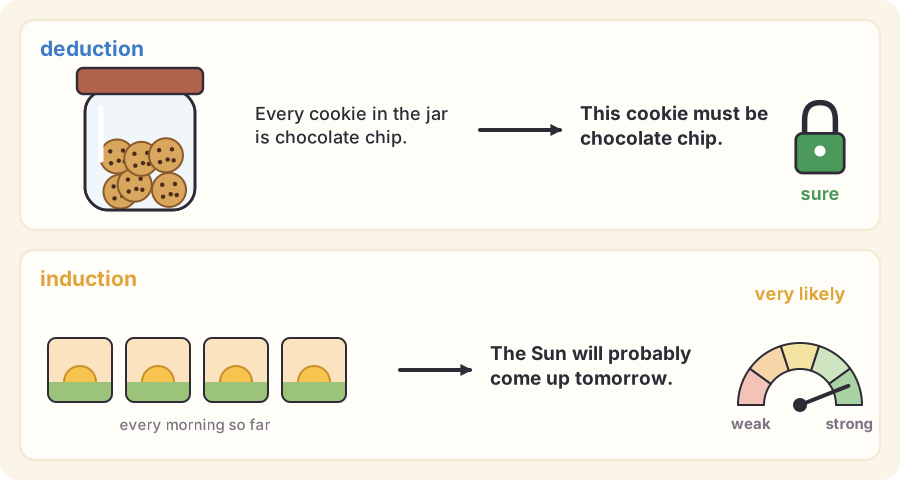
A simple way to tell them apart is to listen for the conclusion's strength:
- deduction: "so it must be...", "so it has to be..."
- induction: "so it probably is...", "so it will most likely..."
Strong and weak induction
A deduction either follows or it doesn't - there is nothing in between. Induction is different: it can be stronger or weaker, depending on how well the examples support the conclusion.
Compare two friends who both conclude "this restaurant's food is good":
- Ana has eaten there 30 times, ordering different dishes, and liked it every time.
- Ben has eaten there once and liked his soup.
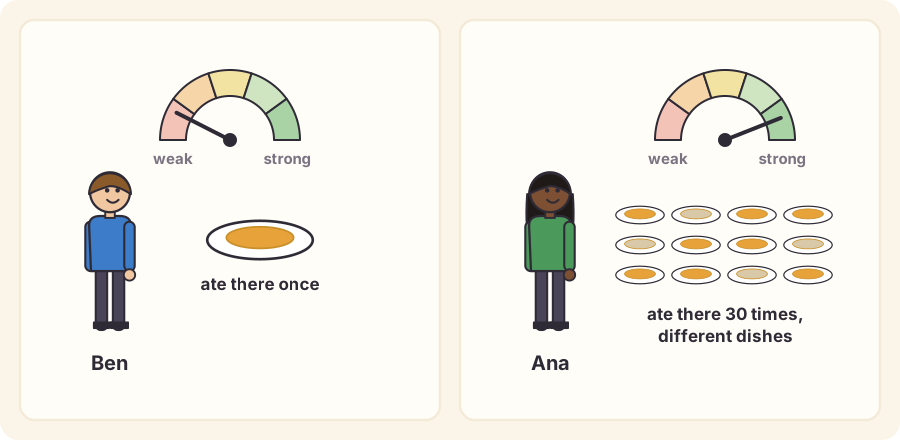
Both are using induction, and both could turn out wrong. But Ana's argument is much stronger: she has more examples, and more different ones. Ben's is weak: one bowl of soup tells you very little about everything else on the menu. The next lesson is about this mistake.
Why the difference matters
Mixing up the two kinds causes trouble both ways:
- Treating induction as sure. The Europeans in the swan lesson were right to believe all swans were white - but wrong to think it couldn't be false. Strong induction deserves confidence, not certainty.
- Treating everything that isn't sure as worthless. "You can't prove the Sun will come up tomorrow" is true - it is induction - but the argument is very strong, so you would be silly to plan as if it might not.
Most of what we know about the world - from science, from experience, from history - comes from induction. Deduction is how we work out what must follow from what we already know.
Try it at home
- Write down five conclusions you heard today. Mark each "D" for deduction (it must be true if the reasons are) or "I" for induction (it is probably true).
- For each induction, give it a strength from 1 (weak) to 5 (strong), and write what would make it stronger.
Words to know
- deduction - reasoning where the conclusion is meant to follow: if the reasons are true, it must be true
- induction - reasoning where the conclusion is meant to be likely, given the examples
- strong (induction) - giving good support: many examples, and varied ones
- weak (induction) - giving little support: few examples, or all of one kind
Big idea
Deduction aims for a conclusion that must be true if the reasons are; induction aims for one that is likely. A deduction follows or it doesn't, but induction comes in strengths - and even strong induction is never completely sure.