Thinking Well Together
Two friends disagree about whether their class should go to the science museum or the zoo for the end-of-year trip. They could shout, call each other names, and count who has more friends on their side. Or they could do something else. After everything in this course, what would reasoning well together look like?
Be fair first
Every fallacy in the last few lessons was a way of not dealing with someone's real reasons: attacking the person, counting heads, hiding choices, or building a straw man. The habit that protects against all of them is being fair to the other side.
Being fair means understanding the other person's argument in its best form - the strongest version of what they mean, not the weakest. If something they say is unclear, assume the sensible meaning and ask, instead of jumping on the silly one. Logicians call this the principle of charity: "charity" here means being generous with how you read someone.
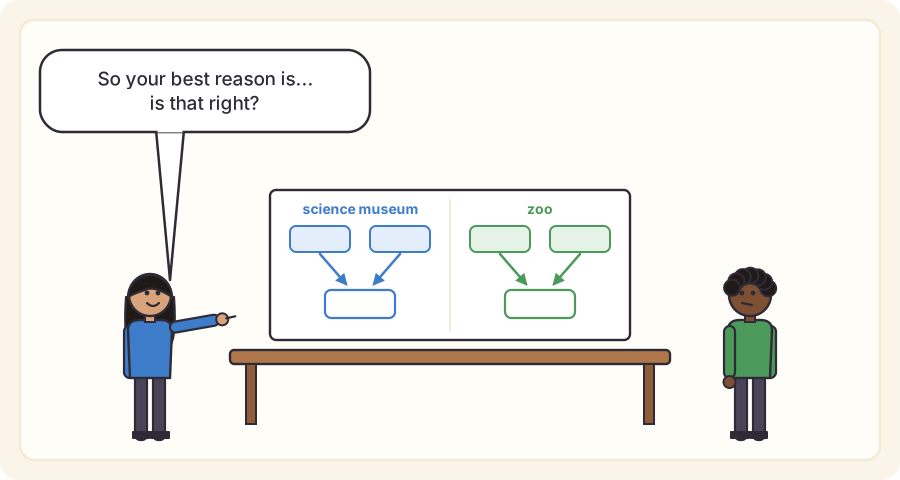
In The Straw Man lesson, the habit was to say the other person's view back to them. Being fair goes one step further: say it back so well that they would say "Yes, exactly - you put it better than I did."
The questions from this course
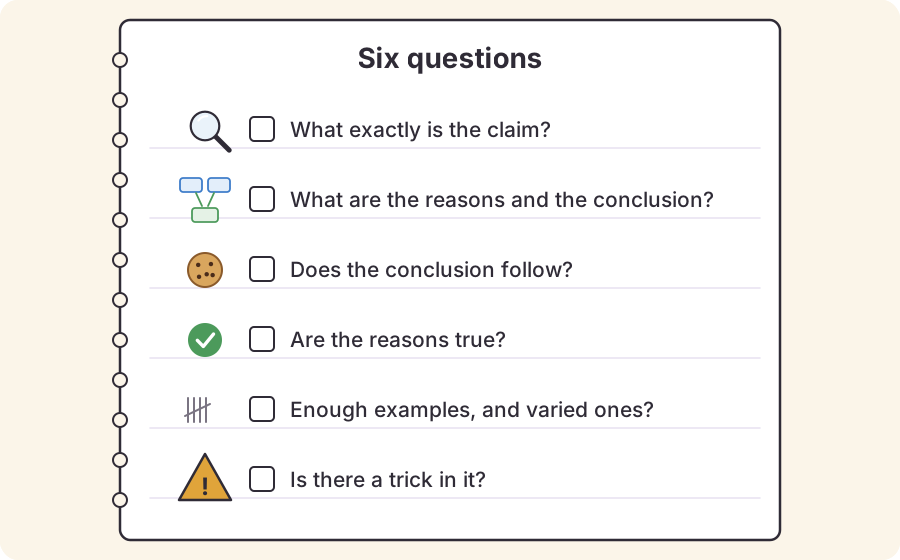
Then, together, you can ask the questions this course has been building:
- What exactly is the claim? Can it be checked, or is it about taste? (Checking a Claim)
- What are the reasons, and what is the conclusion? Draw the map. (Reasons and a Conclusion)
- Does the conclusion follow? Can you imagine the reasons true and the conclusion false? (Must It Be True?)
- Are the reasons true? (Sound Arguments)
- If it is based on examples, are there enough, and are they varied? (Too Few Examples)
- Is there a trick in it - going backwards, "after so because of", attacking the person, everyone does it, only two choices, a straw man?
Changing your mind
Here is the last and hardest part. Sometimes, when you look at the reasons carefully, the other person's argument turns out to be better than yours. Then reasoning well means changing your mind - and saying so.
That is not losing. In a quarrel there is a winner and a loser. In reasoning, if you change your mind because of a good reason, you have gained something: you believe something better supported than before. The other person helped you.
It also works the other way. If the reasons don't support their conclusion, you can say so kindly, without making them feel beaten. Remember the What Is a Fallacy? lesson: a weak reason doesn't make the conclusion false. Maybe together you can find a better one.
Try it at home
- Pick a small disagreement with someone in your family - about a film, a holiday, a rule at home.
- Ask them to give their best reasons, and say their argument back until they agree you have it right.
- Go through the six questions together. Did either of you change your mind, even a little?
Words to know
- principle of charity - understanding someone's argument in its best, most sensible form before you answer it
- changing your mind - giving up a belief, or holding it less strongly, because of good reasons
Big idea
Reasoning well together starts with being fair: understand the other side's argument at its best. Then ask the questions of this course - and when their reasons are better than yours, change your mind. That is not losing; it is the point.