The Wet Street
You wake up, look out of the window, and see that the street is wet. "It must have rained in the night," you think. That seems obvious. But is it something you know, or only a guess?
Going backwards
Here is your thinking, set out as an argument:
If it rains, the street gets wet.
The street is wet.
So it rained.
It looks a lot like the argument from the If It Rains... lesson, which was valid. But the order is different. That argument went forwards: from the if part (it rains) to the then part (the ground gets wet). This one goes backwards: from the then part (the street is wet) to the if part (it rained).
Use the test: pretend both reasons are true, and try to imagine that it did not rain. Can you?
Other ways to get a wet street
Yes, easily:
- a street-cleaning truck came past in the night, spraying water;
- a neighbour's garden sprinkler was left on;
- a water pipe under the road burst.
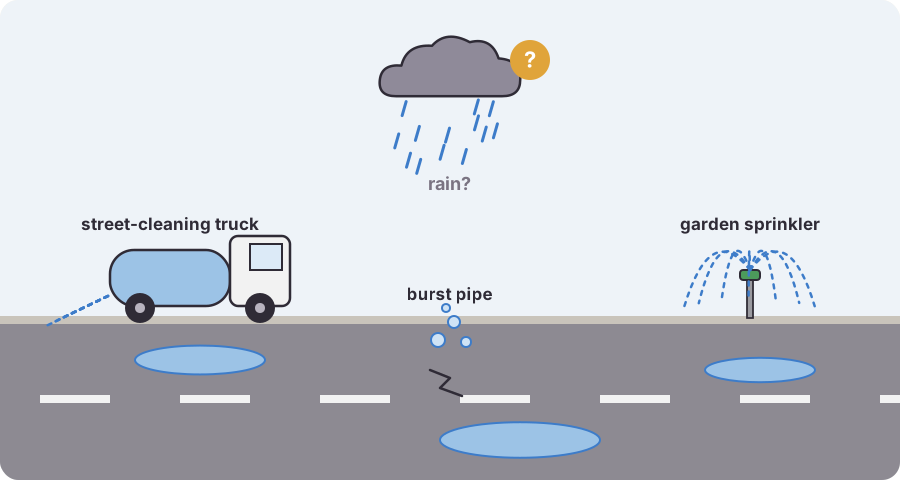
Each of these is a counterexample: the reasons are true (if it rains the street gets wet, and the street is wet) but the conclusion is false (it didn't rain). So the conclusion doesn't follow. Rain is one possible cause, maybe the most likely one, but the reasons don't prove it.
Remember from the If It Rains... lesson that an if-then claim says nothing about what happens when the if part doesn't happen. "If it rains, the street gets wet" doesn't say that rain is the only way to wet a street.
This mistake is so common that it is worth giving it a name. Let's call it going backwards: taking an if-then claim, finding that the then part is true, and concluding that the if part must be true.
What you can conclude
There is something you can be sure of, though. Suppose you look out and the street is dry:
If it rains, the street gets wet.
The street is dry.
So it didn't rain.
This one follows. Pretend both reasons are true and imagine that it did rain. Then the street would have got wet - but it is dry. That is impossible, so the conclusion has to be true.
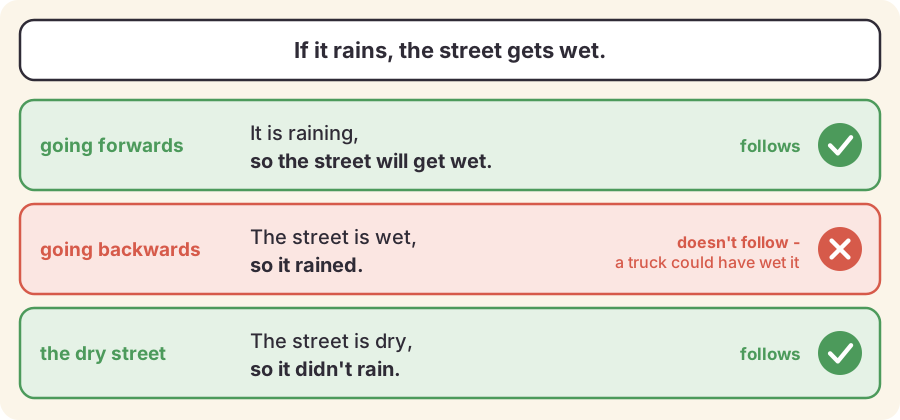
So with an if-then claim, two moves work and one is a trap:
- the if part happened, so the then part will happen - follows;
- the then part didn't happen, so the if part didn't either - follows;
- the then part happened, so the if part did - doesn't follow (going backwards).
Try it at home
- Complete: "If someone is at the door, the dog barks. The dog is barking. So..." Does "someone is at the door" follow? Think of a counterexample.
- Now complete: "If someone is at the door, the dog barks. The dog is quiet. So..." What follows this time?
- Listen for "going backwards" in everyday talk: "He's got a new car, so he must have got a pay rise."
Words to know
- going backwards - the mistake of concluding the if part from the then part ("the street is wet, so it rained")
Big idea
An if-then claim works in one direction. If the then part is false, the if part must be false too; but if the then part is true, the if part might still be false. A wet street doesn't prove it rained.