Can You Imagine It Wrong?
Your little cousin says, "All birds can fly." You could argue for an hour. Or you could show them one picture. Which picture would end the argument at once?
One penguin is enough
A penguin is a bird. It has feathers, it lays eggs, it has a beak - and it can't fly. So "all birds can fly" is false. One penguin is enough to show it.
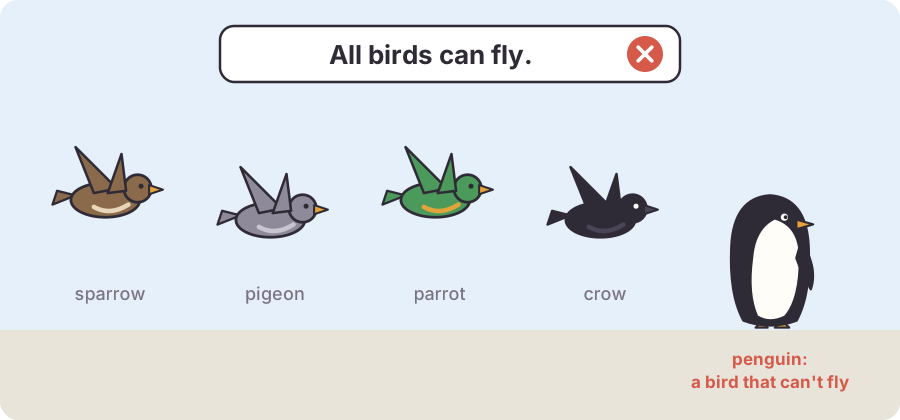
A case like this is called a counterexample: an example that goes against (counter to) a claim. A counterexample to "all birds can fly" is a bird that can't fly. Ostriches and kiwis would work too.
Notice something about "all" claims. Showing a thousand birds that can fly doesn't prove that all birds can fly - the next one might be a penguin. But showing one bird that can't fly proves that not all of them can. It is much easier to show that an "all" claim is false than to show that it is true.
Counterexamples to arguments
Counterexamples have a second job. They can show that a conclusion doesn't follow.
In the Must It Be True? lesson, the test for a valid argument was: pretend the reasons are true and try to imagine the conclusion false. A counterexample is what you find when that test succeeds - a case where the reasons are true and the conclusion is false.
Remember this invalid argument from the Good Shape, Wrong Facts lesson:
All cats have four legs.
Tom has four legs.
So Tom is a cat.
Here is a counterexample: a dog called Tom. All cats have four legs (true). Tom the dog has four legs (true). Tom is a cat - false! The reasons are true and the conclusion is false, so the conclusion doesn't follow.
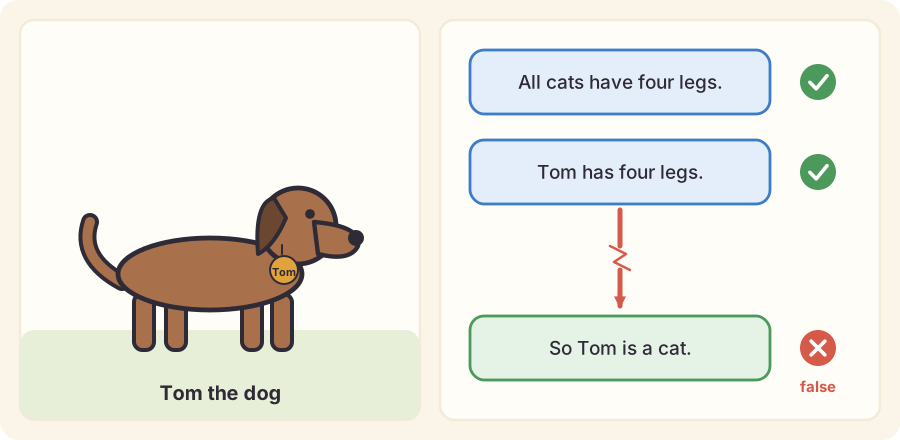
The counterexample doesn't have to be real. You only need to be able to imagine it without anything impossible in it. A dog called Tom is easy to imagine, and that is enough to show the argument is not valid.
How to find one
When you hear an "all" claim, or an argument you aren't sure about, ask: can I imagine a case where this goes wrong?
- "Everyone in my class likes football." Is there one person who doesn't?
- "It's sunny, so it must be warm." Can you imagine a sunny day that is cold? (A bright winter morning in the snow.)
- "She's tall, so she must play basketball." Can you imagine a tall person who doesn't?
If you can imagine a case, you have a counterexample.
Try it at home
- Write down three "all" or "every" claims you hear this week ("all teenagers love their phones", "every shop is closed on Friday").
- For each one, try to find a counterexample.
- For one argument you hear, try to imagine a case where the reasons are true and the conclusion is false.
Words to know
- counterexample - one case that shows an "all" claim is false, or a case where an argument's reasons are true and its conclusion false
Big idea
One counterexample is enough to show that an "all" claim is false, however many examples agree with it. And a case where the reasons are true and the conclusion false shows that the conclusion doesn't follow.