All, Some and None
A shop sign says "Some fruit half price!" and you find that every single piece of fruit is half price. Was the sign wrong? And if a friend says "Not all of my apples are red," does that mean none of them are? Small words like "all" and "some" do a lot of work in reasoning.
How much of the group
Look at three baskets of apples, and three claims:
- All the apples in this basket are red.
- Some of the apples in this basket are red.
- None of the apples in this basket are red.
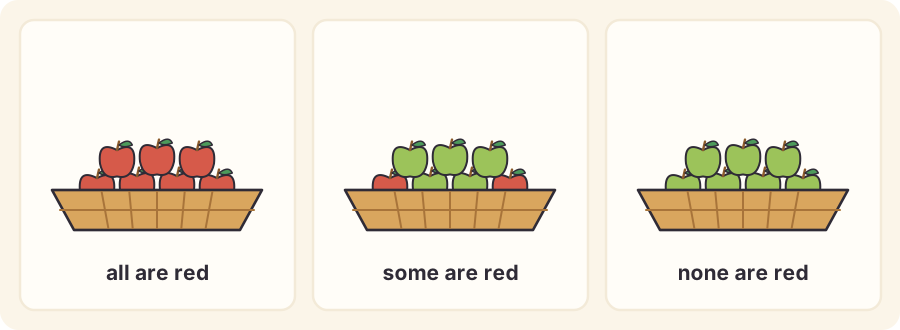
Each claim is about a group (the apples in the basket) and says how much of the group has some feature (being red). Words like this - all, every, each, some, none, no - are called quantity words, because they say how many.
You have met them before. "Every cookie in this jar is chocolate chip" in the Must It Be True? lesson was an "all" claim. "All birds can fly" in the Can You Imagine It Wrong? lesson was another.
What "some" means
In everyday talk, "some" often hints "but not all". If a friend says "Some of the cake is left," you expect there isn't the whole cake.
In logic, "some" means just at least one - maybe a few, maybe most, maybe even all. So "some fruit is half price" is true when all the fruit is half price. The sign wasn't wrong, only less exciting than it could have been.
Why use "some" so carefully? Because then "some" claims are easy to check: find one red apple, and "some apples are red" is true.
The opposite of "all"
Here is where people slip. What is the opposite of "All the apples are red"?
Many people say, "None of the apples are red." But that is too much. To show that "all the apples are red" is false, you only need one apple that isn't red - a counterexample. So the opposite of "all are red" is "not all are red", which means the same as "some are not red".
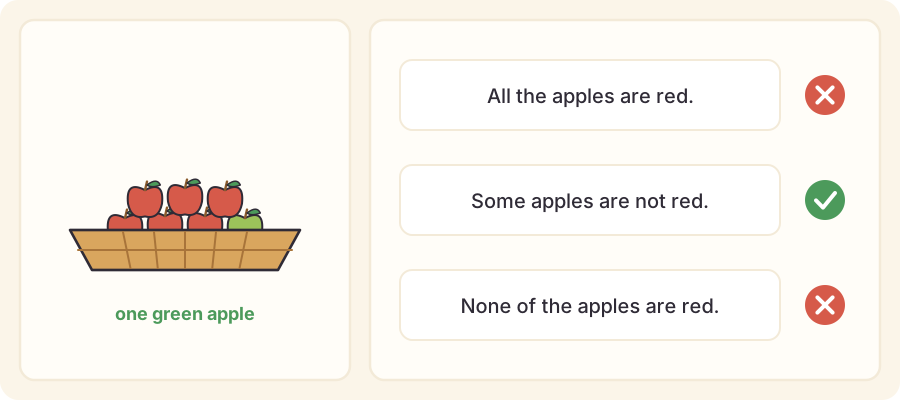
The same goes the other way. The opposite of "None of the apples are red" is not "all are red" - it is "some are red". One red apple is enough.
| claim | what shows it is false |
|---|---|
| All are red. | one apple that isn't red |
| None are red. | one apple that is red |
| Some are red. | checking every apple and finding none that is red |
Try it at home
- Put some objects in a bowl - for example spoons, or coloured pencils.
- Write an "all", a "some" and a "none" claim about them, and say which are true.
- Write the opposite of each claim. Check: does one object settle it?
Words to know
- quantity word - a word that says how much of a group a claim is about: all, every, some, none, no
- some (in logic) - at least one; possibly all
- not all - at least one isn't; the same as "some are not"
Big idea
"all", "some" and "none" say how much of a group a claim is about. In logic "some" means at least one, and the opposite of "all are" is "some are not", never "none are".