Spotting the Conclusion
"We should leave now, because the film starts at eight and the cinema is half an hour away." That sentence is an argument, but it doesn't come in the neat order of the last lesson, with the conclusion at the end. How can you tell which part is the conclusion?
Signpost words
In the Reasons and a Conclusion lesson we saw that an argument is a set of reasons (premises) given to support one claim, the conclusion. People rarely label the parts, but they often leave little words that work like signposts on a road.
Some words come just before a conclusion:
- so
- therefore
- that's why
- which means
Other words come just before a reason:
- because
- since
- as
- after all
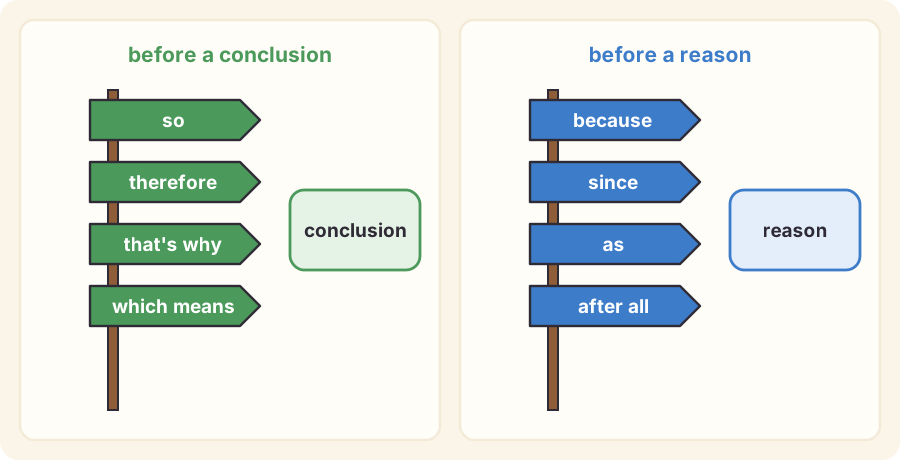
Logicians call these words indicators, because they indicate - point to - the parts of an argument.
The conclusion can come first
Look again at the film argument:
We should leave now, because the film starts at eight and the cinema is half an hour away.
"Because" comes before the reasons. So the part before "because" - "we should leave now" - is the conclusion. The conclusion came first, and the reasons followed.
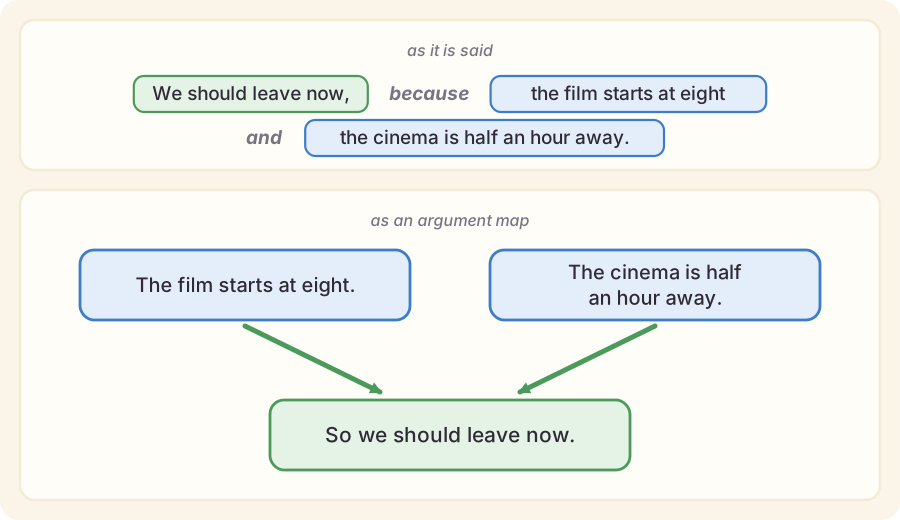
The same argument can be said in the other order, with "so":
The film starts at eight and the cinema is half an hour away, so we should leave now.
Different order, same argument, same map.
When there are no signposts
Sometimes there are no signpost words at all:
Don't touch that pan. It has just come off the stove.
Here, ask one question: what is this person trying to get me to believe or do? They want you to leave the pan alone. That is the conclusion. "It has just come off the stove" is the reason. A useful test is to try putting "because" between the two parts: "Don't touch that pan, because it has just come off the stove." It still makes sense, so you have found the right order.
One warning: "so" doesn't always signal a conclusion. In "I was so tired", it just means "very". Signposts help, but the real test is always the question: which claim are the others supporting?
Try it at home
- Listen to an advert or read one on a sign or a box.
- Write down every "so", "because", "since" or "therefore" you find.
- For each one, underline the conclusion in green and the reasons in blue.
- Find one argument with no signpost words, and use the "because" test on it.
Words to know
- indicator - a signpost word that points to a conclusion ("so", "therefore") or to a reason ("because", "since")
Big idea
Words like "so" and "therefore" come before a conclusion, and words like "because" and "since" come before a reason. When there are no such words, ask: which claim are the others trying to support?