Sound Arguments
A doctor tells you, "You need to rest your ankle for a week." You want to know whether to believe it. In the last two lessons we found two separate questions to ask about any argument. Which one matters here - and what happens when an argument passes both?
Two checks
In the Good Shape, Wrong Facts lesson we saw that an argument can go wrong in two different ways:
- The conclusion might not follow from the reasons - the argument is invalid.
- One of the reasons might be false - like "all cats can fly".
So every argument gets two checks. The first check is about the shape: if the reasons were true, would the conclusion have to be true? The second check is about the facts: are the reasons really true?
An argument that passes both checks is called sound.
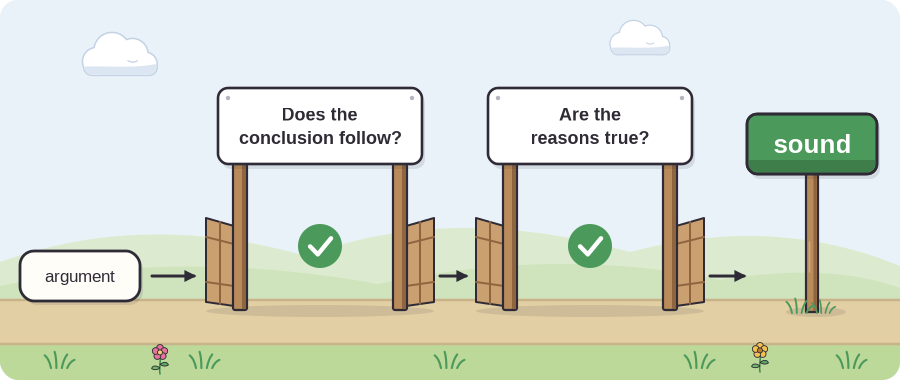
Why sound arguments are special
Think about what passing both checks means. The reasons are true. And the conclusion follows, which means: if the reasons are true, the conclusion has to be true. Put those together and there is only one possibility: the conclusion of a sound argument is true.
Here is a sound argument:
Every planet in our solar system goes around the Sun.
The Earth is a planet in our solar system.
So the Earth goes around the Sun.
Both reasons are true, and the conclusion follows (it has the same shape as the cookie argument). So the conclusion must be true - and it is.
Four kinds of arguments
Put the two checks together and there are four kinds of arguments:
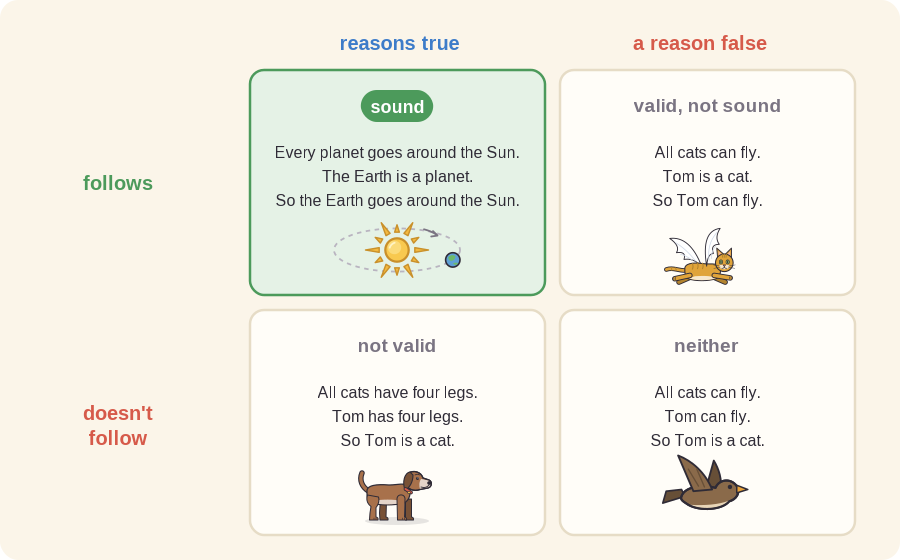
Only one of the four is sound. That is why, when someone gives you an argument, it isn't enough to like the conclusion or to agree with the reasons. You need both: true reasons, and a conclusion that follows from them.
Back to the doctor
The doctor's argument might be:
A sprained ankle heals faster when you rest it.
Your ankle is sprained.
So your ankle will heal faster if you rest it.
The conclusion follows. And the reasons are the kind of thing a doctor can check: they have learned how ankles heal, and they have looked at yours. So you have good grounds to think the argument is sound.
Notice that the checks are different jobs. Anyone can do the first one, just by thinking. The second one often needs looking, measuring or asking someone who knows, as we saw in the Checking a Claim lesson.
Try it at home
- Write one argument of each of the four kinds from the table, about things in your own life.
- Swap with someone and see if they can sort your four arguments into the right boxes.
Words to know
- sound - an argument is sound when its conclusion follows and all its reasons are true
Big idea
A sound argument passes two checks: its conclusion follows (it is valid) and its reasons are true. The conclusion of a sound argument must be true, which is what makes sound arguments so useful.