If It Rains...
"If you finish your homework, you can play outside." A parent says it, and later the child finishes the homework but isn't allowed out. The child says, "You broke your promise!" Is that fair? What exactly did the "if" sentence promise?
Two parts and a link
Sentences with "if" are everywhere:
- "If it rains, the ground gets wet."
- "If you drop a glass on stone, it breaks."
- "If you heat ice, it melts."
Each one is a claim with two parts. The part after "if" is the if part. The other part is the then part - sometimes said with the word "then": "If it rains, then the ground gets wet." A claim like this is called an if-then claim (logicians call it a conditional).
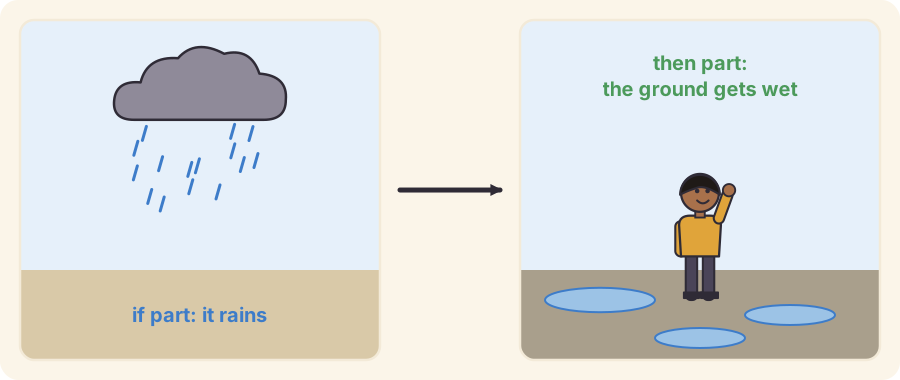
An if-then claim doesn't say that it is raining. It doesn't say the ground is wet. It says something about the link between them: whenever the if part happens, the then part happens too.
When is an if-then claim false?
Think about a day and the claim "If it rains, the ground gets wet." There are four kinds of day:
- It rains, and the ground gets wet.
- It doesn't rain, and the ground stays dry.
- It doesn't rain, but the ground is wet anyway (someone watered the garden).
- It rains, and the ground stays dry.
Which of these days would show that the claim is false? Only day 4. On day 4, the if part happened and the then part didn't - the link failed.
Days 1 and 2 fit the claim. And day 3 doesn't break it either: the claim only talks about what happens when it rains. It says nothing about days without rain. The ground can get wet for other reasons.
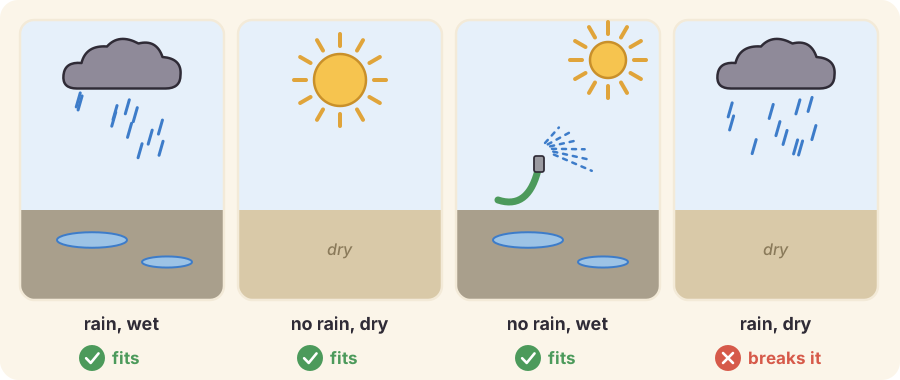
So an if-then claim is false only when the if part is true and the then part is false.
Using an if-then claim
If-then claims are very useful as reasons in an argument:
If it rains, the ground gets wet.
It is raining.
So the ground will get wet.
This conclusion follows. Pretend both reasons are true and try to imagine the ground staying dry: you can't, because that would be day 4, which the first reason rules out.
Now back to the homework. "If you finish your homework, you can play outside." The child finished, and wasn't allowed out. That is the if part true and the then part false - day 4. So yes, the child is right: the promise was broken.
Try it at home
- Write down three if-then claims you hear: rules at home or school, safety signs, instructions ("if the light is red, stop").
- For each one, underline the if part and the then part.
- Describe the one kind of situation that would break it.
Words to know
- if-then claim - a claim that when one thing (the if part) happens, another (the then part) happens too; also called a conditional
- if part - the part of an if-then claim after "if"
- then part - the part of an if-then claim that is said to follow when the if part happens
Big idea
An if-then claim is about a link: whenever the if part happens, the then part happens too. It is broken only when the if part is true and the then part is false.