The Straw Man
At a school meeting, a parent says, "The school shop should sell fewer sweets." Another parent stands up: "So you want to ban every treat and make children eat nothing but vegetables? That's ridiculous!" People nod. But is that what the first parent said?
Two different claims
Put the two side by side:
- What the first parent said: the shop should sell fewer sweets.
- What the second parent answered: banning every treat and eating nothing but vegetables.
Those are very different claims. "Fewer sweets" is a small change. "Ban every treat" is extreme, and easy to laugh at. The second parent didn't answer the real argument at all. They swapped it for a sillier one, and knocked that down instead.
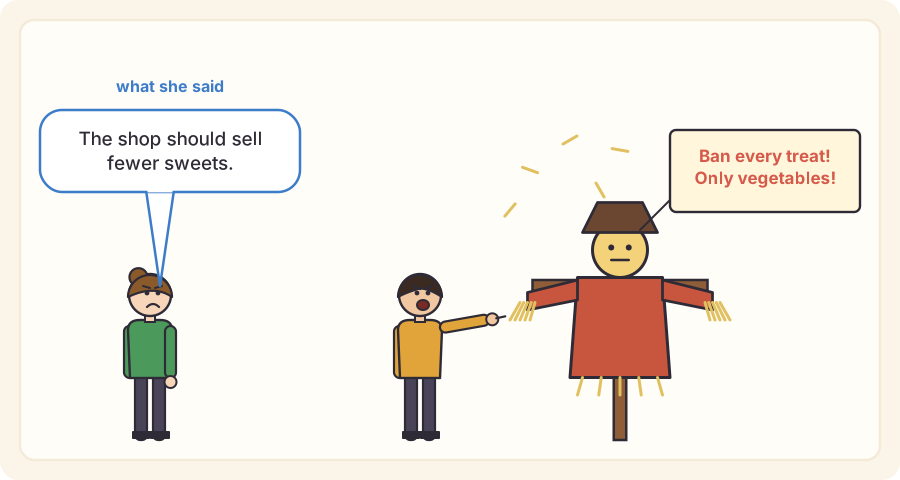
This is a fallacy called the straw man. A straw man is a scarecrow: a figure of a person made of straw, the kind farmers stand in fields. Beating up a straw man is easy, because it can't fight back. Arguing against a weaker version of someone's claim is easy in the same way - and proves just as little.
How a straw man is made
A straw man usually changes the real claim in one of these ways:
- making it bigger: "fewer sweets" becomes "no treats ever";
- adding "all" or "never": "some screen time is too much" becomes "you think all screens are evil";
- adding a bad reason: "I'd like to walk to school" becomes "you just want to get out of helping in the morning".
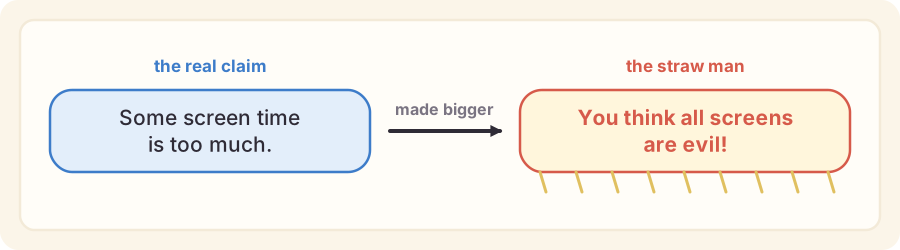
Remember from the All, Some and None lesson how much the little quantity words change a claim. Swapping "some" for "all" is one of the quickest ways to build a straw man.
Sometimes people build a straw man on purpose, to win. Often they do it by accident: they didn't really listen, or they heard what they expected to hear.
How to avoid it
Before you argue against something, say it back first:
"So you're saying the shop should sell fewer sweets - not none, just fewer. Is that right?"
If the other person agrees that you have it right, you are arguing with the real claim. If they say "No, that's not what I mean", you have just avoided a straw man. This is the simplest and most powerful habit in this whole course, and the next lesson builds on it.
And if someone builds a straw man of your argument, you don't need to defend the straw man. Calmly say what you actually said: "I didn't say no treats. I said fewer sweets."
Try it at home
- Next time someone disagrees with you, try saying their view back to them before answering. Did you get it right the first time?
- Listen for "so you're saying..." in a discussion, and check whether what follows really is what the other person said.
Words to know
- straw man - the fallacy of changing someone's argument into a weaker or sillier one, then arguing against that instead
Big idea
A straw man swaps someone's real claim for a weaker or sillier one and knocks that down instead. Beating the straw man proves nothing about the real claim - so say the other person's view back to them before you argue.