Reasons and a Conclusion
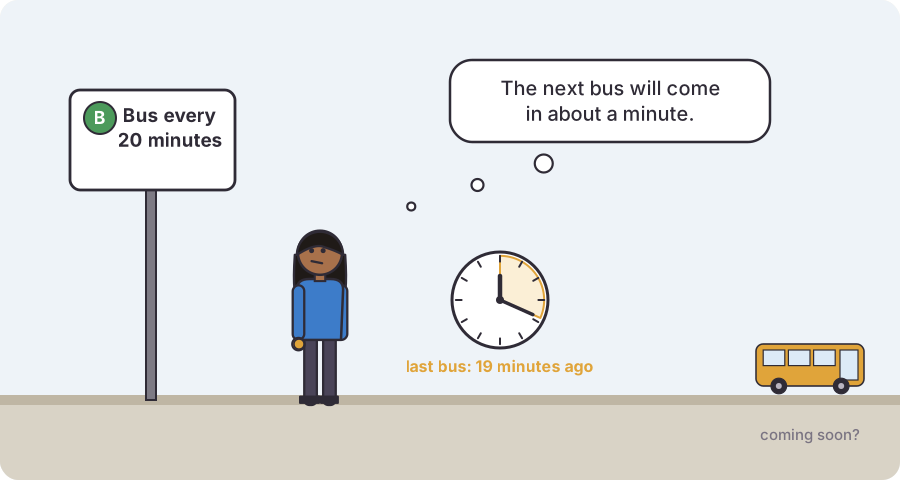
Leila is waiting at a bus stop. She looks at the sign and at her watch and says, "The next bus will come in about a minute." She isn't guessing. She has worked it out from things she knows. How did she get there?
Leila's reasons
Leila knows two things:
- The sign says the bus comes every 20 minutes.
- She saw the last bus leave 19 minutes ago.
Put those together and you get her idea: the next bus will come in about a minute.
Written out one line at a time, it looks like this:
The bus comes every 20 minutes.
The last bus left 19 minutes ago.
So the next bus will come in about a minute.
This is an argument. In logic, an argument is not a fight. It is a set of claims where some of them (the reasons) are given to support another one.
The parts of an argument
An argument has two kinds of parts:
- the reasons - the claims given as support. Logicians call them premises (say "PREM-iss-iz"). Leila has two premises.
- the conclusion - the claim the reasons are supporting, the one the argument is trying to show. Leila's conclusion is that the next bus will come in about a minute.
Remember from the True or False? lesson that a claim is a sentence that is either true or false. Every part of an argument is a claim.
Drawing an argument
A good way to see an argument is to draw it as a map: each reason in a box at the top, the conclusion in a box at the bottom, and arrows from the reasons to the conclusion.
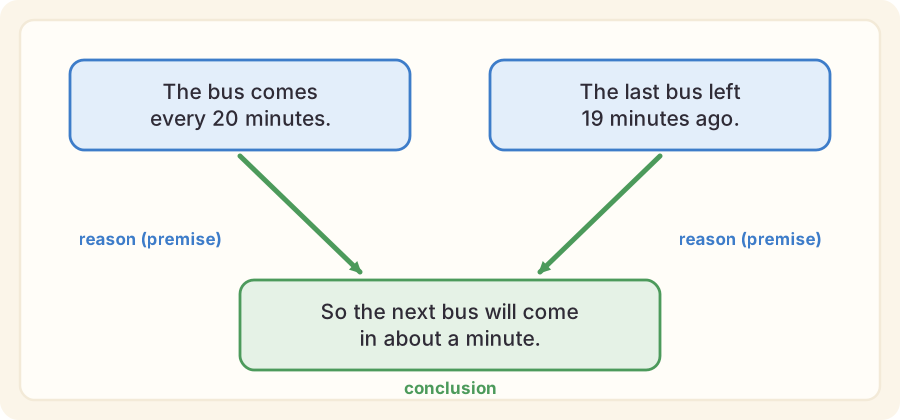
The arrows show the direction of support: from the reasons to the conclusion, never the other way. Leila's two reasons work together. Neither one is enough alone: knowing only that the bus comes every 20 minutes doesn't tell you when the next one is due.
An argument can have one reason or many, but it always has just one conclusion. When someone argues for two things at once, that is really two arguments.
Try it at home
- Think of something you worked out today: when to leave home, what to wear, which way to go.
- Write your conclusion at the bottom of a page.
- Write each reason that led you there in a box above it, and draw an arrow from each box to the conclusion.
- Ask: do the reasons work alone, or only together?
Words to know
- argument - a set of claims where some (the reasons) are given to support another (the conclusion)
- premise - a reason given in an argument
- conclusion - the claim an argument is trying to show
- argument map - a drawing of an argument: reasons in boxes, with arrows to the conclusion
Big idea
An argument is a set of reasons (premises) given to support one claim (the conclusion). Drawing it as a map, with arrows from the reasons to the conclusion, shows exactly what supports what.