Good Shape, Wrong Facts
"All cats can fly. Tom is a cat. So Tom can fly." You know cats can't fly, so something is wrong with this argument. But is the problem that the conclusion doesn't follow? Use the test from the last lesson and see what happens.
Testing the flying cat
In the Must It Be True? lesson we learned the test for a valid argument: pretend the reasons are true, then try to imagine the conclusion false.
All cats can fly.
Tom is a cat.
So Tom can fly.
Pretend all cats can fly, and pretend Tom is a cat. Now try to imagine that Tom can't fly. You can't: if every cat flies and Tom is a cat, Tom flies. So the conclusion follows. The argument is valid.
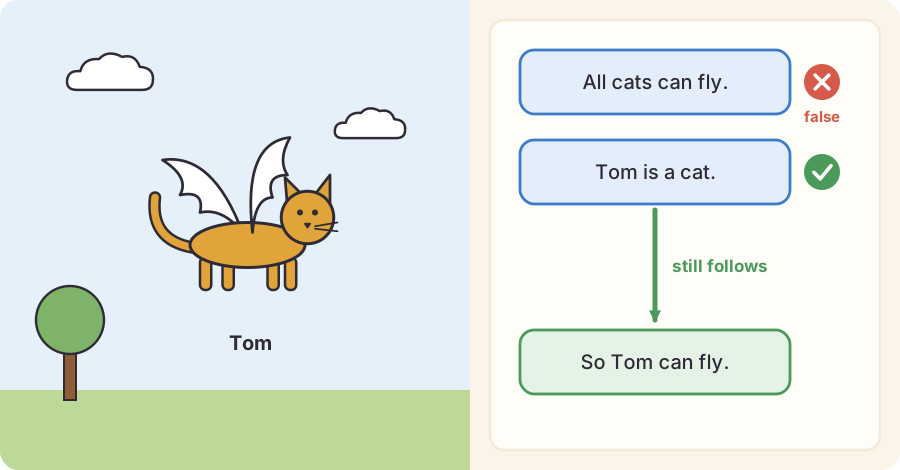
That sounds strange, but it is exactly what "valid" means. The problem with the flying-cat argument is not that the conclusion fails to follow. The problem is that one of the reasons - "all cats can fly" - is false.
The shape of an argument
Why does the flying-cat argument work like the cookie argument? Put them side by side:
Every cookie in this jar is chocolate chip. This cookie is from the jar. So this cookie is chocolate chip.
All cats can fly. Tom is a cat. So Tom can fly.
They are about different things, but they have the same shape:
All ___ are ___. This one is a ___. So this one is ___.
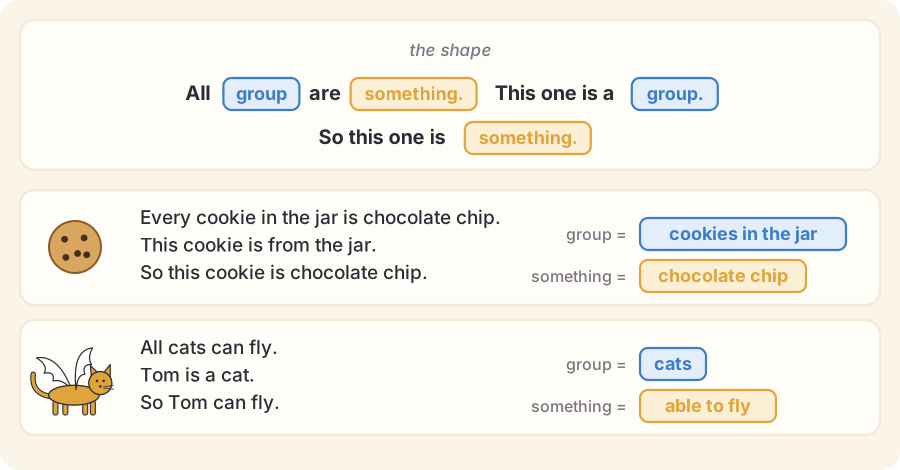
Any argument with this shape is valid, whatever you put in the blanks. That is why logicians say validity is about shape (they also say "form"), not about the facts. The facts - whether the reasons are true - are a separate question.
The other way round
It works the other way too. An argument can have a true conclusion and still not be valid:
All cats have four legs.
Tom has four legs.
So Tom is a cat.
Maybe Tom really is a cat. But the argument is invalid (not valid): the conclusion doesn't follow: dogs have four legs too, so Tom could be a dog. Imagining the reasons true and the conclusion false is easy. The conclusion happens to be true, but these reasons don't show it.
So there are two separate questions to ask about any argument:
- Does the conclusion follow? (Is it valid?)
- Are the reasons true?
The next lesson puts them together.
Try it at home
- Copy the shape "All ___ are ___. This one is a ___. So this one is ___."
- Fill it in three times: once with true reasons, once with a silly false reason (like the flying cat), and once about your own family or school.
- Check that the conclusion follows every time, even the silly one.
Words to know
- shape - the pattern of an argument, left when you take out what it is about; also called its form
- invalid - not valid: the conclusion doesn't follow from the reasons
Big idea
Validity is about the shape of an argument, not the facts in it. An argument with false reasons can still be valid, and an argument with a true conclusion can still be invalid. Following and being true are two separate questions.