Everyone Does It
"Can I have this game? Everyone in my class has it!" Most parents have heard that, and most of them answer, "If everyone jumped off a bridge, would you jump too?" The parents are pointing at a real mistake in reasoning. What is it?
The bandwagon
The child's argument goes:
Everyone in my class has this game.
So I should have it too.
Or, in another form:
Everyone says this phone is the best.
So this phone is the best.
In both, the only reason given is that many people do it or believe it. Using popularity as if it were a reason a claim is true is a fallacy called the bandwagon.
A bandwagon was a big cart that carried a band through the streets in a parade. People ran to jump on it and join the fun, without asking where it was going. To "jump on the bandwagon" means to join in because everyone else is.
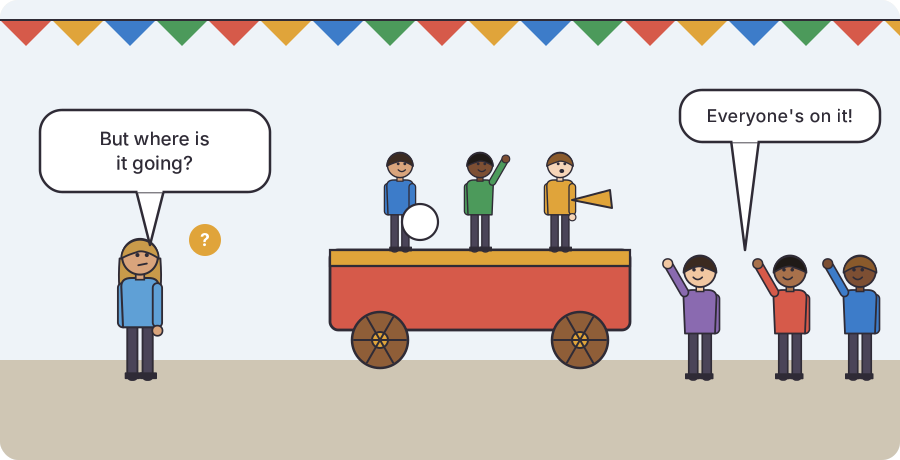
Many people can be wrong together
Why isn't popularity a good reason? Because a claim is true or false depending on the world, not on how many people believe it. In the True or False? lesson we saw that a claim is true when it matches how things really are - and a vote doesn't change how things are.
History is full of times when nearly everyone believed something false:
- For a very long time, most people believed that the Earth stood still at the centre of everything, and the Sun moved around it.
- For a long time, most doctors didn't wash their hands between patients, and many laughed at the first doctors who said they should.
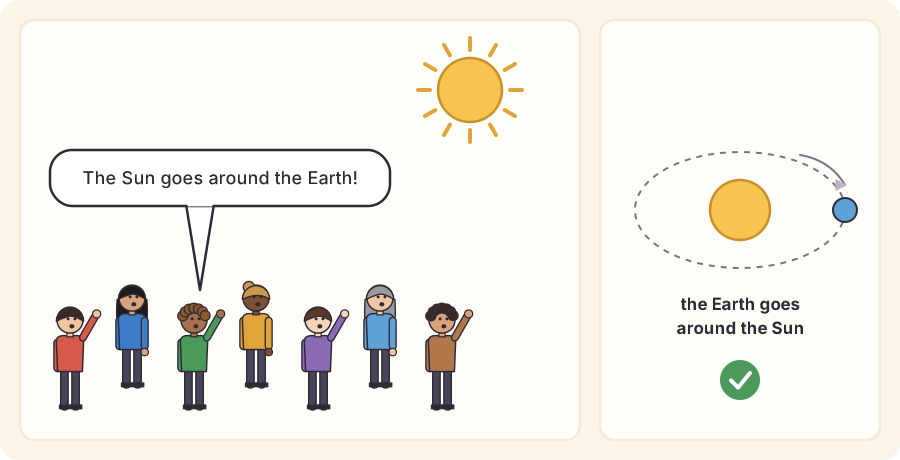
Each time, the crowd was large, sure, and wrong.
When numbers can be a clue
Popularity isn't always useless. If a thousand people who have stayed at a hotel say the rooms are clean, that tells you something - because each of them has looked. Their reports are many examples, and we saw in the Sure or Only Likely? lesson that many varied examples can make strong induction.
The difference is this: are the many people reasons that point to the world (each one checked for themselves), or are they just many people agreeing (each one going along with the others)? A crowd of people who each went and looked is evidence. A crowd of people who each heard it from someone else is just a crowd.
And for a choice like the game, "everyone has it" isn't a reason about the game at all. Better reasons would be about the game itself: what it costs, whether it is fun, whether it is right for your age.
Try it at home
- Look at three adverts and find any that say "number one", "best-selling" or "everyone's talking about".
- For each, ask: is this a reason about the thing itself, or only about how many people like it?
- Write one better reason the advert could have given.
Words to know
- bandwagon - the fallacy of treating "many people believe it" or "many people do it" as a reason that it is true or right
- popularity - how many people like, believe or do something
Big idea
A claim is true or false depending on the world, not on how many people believe it. "Everyone does it" is not a reason - unless the "everyone" are people who each went and checked.