Too Few Examples
Daniel moves to a new town. On his first day it rains. On his second day it rains again. He writes to his grandmother: "It always rains here." Is that a reasonable thing to conclude after two days?
Two days are not a year
Daniel is using induction, which we met in the Every Swan I Have Seen lesson: going from examples to a general conclusion. But look at what he is going on:
It rained on my first day.
It rained on my second day.
So it always rains here.
Two days out of a whole year. He hasn't seen a summer here, or even a full week. In the Sure or Only Likely? lesson we saw that induction can be strong or weak. This is very weak.
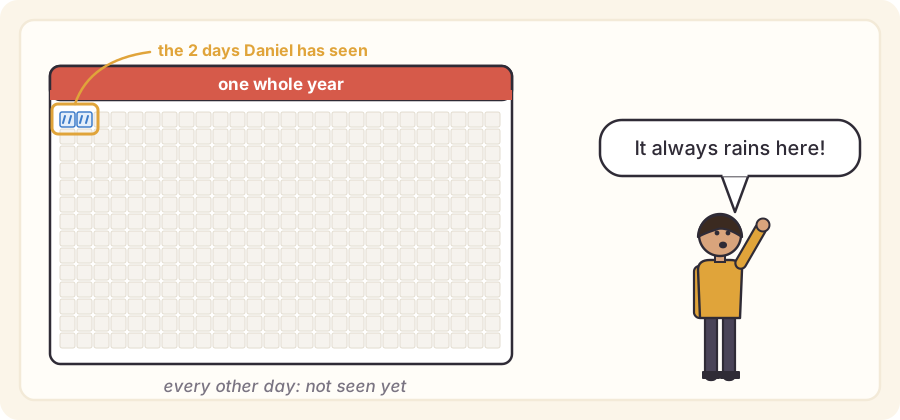
Jumping from too few examples to a claim about all of them is such a common mistake that it has a name: a hasty generalisation. "Hasty" means done too quickly. A generalisation is a general conclusion - a claim about all of a group, or about what always happens.
Examples all of one kind
There is a second way to get it wrong, even with lots of examples. Imagine Mina wants to know the most popular sport in her school. She asks 40 people - all of them at the football club after training. Every one says football.
40 examples is quite a lot. But they are all the same kind of person: people who chose to play football. The swimmers, the runners and the people who don't like sport at all were never asked.
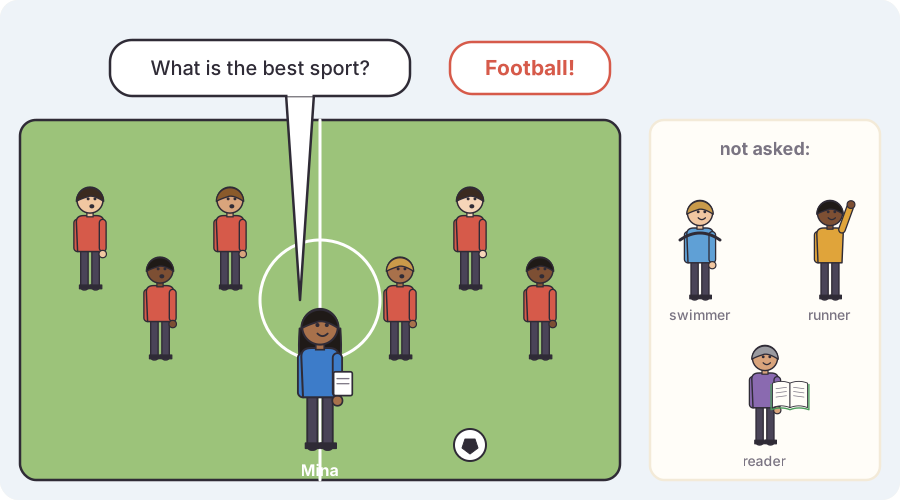
So the second check is: are the examples varied enough? Do they come from all parts of the group the conclusion is about, or only from one corner of it?
Why it matters
Hasty generalisations can be harmless ("it always rains here"). But they are also how unfair ideas about whole groups of people begin. Someone meets two rude people from a town and decides "people from that town are rude". Two people out of thousands is a tiny number of examples, and the two you happen to remember are not a fair choice either.
To avoid a hasty generalisation, ask three questions:
- How many examples do I have?
- How varied are they - do they cover the whole group?
- Am I saying more than they show? "It rained both days I've been here" is true. "It always rains here" says much more.
The honest version of a conclusion is often just a smaller one.
Try it at home
- Think of one general claim you have made about a place, a food, a game or a kind of person.
- Write down how many examples it was based on, and how varied they were.
- Rewrite the claim so that it says only what your examples show.
Words to know
- generalisation - a general conclusion: a claim about all of a group, or about what always happens
- hasty generalisation - a generalisation made from too few examples, or from examples all of one kind
Big idea
A generalisation is only as good as its examples. Too few examples, or examples all of one kind, make a hasty generalisation - so before saying "always" or "all", ask how many examples you have and how varied they are.