An Argument Is Not a Fight
"My parents had an argument last night." When people say that, they usually mean a quarrel: raised voices, slammed doors, someone upset. But in the Reasons and a Conclusion lesson we used the word "argument" for something calm: Leila working out when her bus would come. Are these the same thing?
Two meanings of one word
The word "argument" has two meanings:
- In everyday talk, an argument is a quarrel: two people disagreeing angrily, each trying to win.
- In logic, an argument is reasons given for a conclusion. Nobody has to be angry. Nobody even has to disagree. One person can make an argument alone, writing in a notebook.
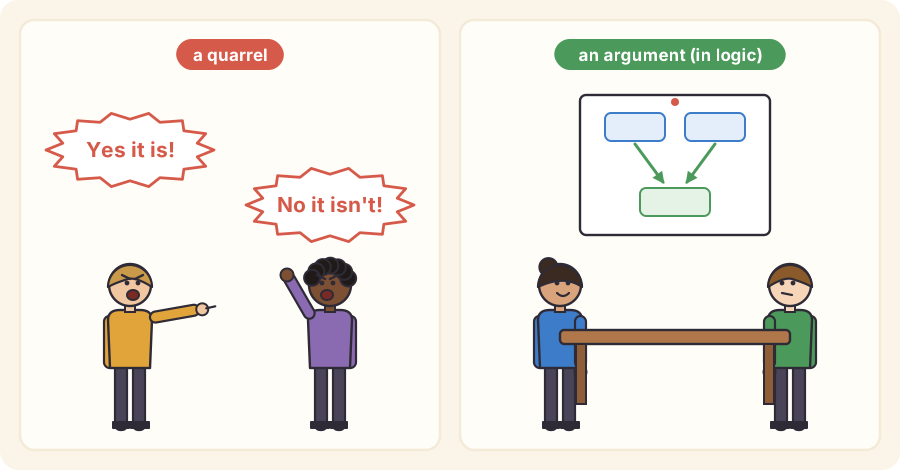
A quarrel and a logical argument can happen at the same time - people can shout their reasons - but they are different things. You can have a quarrel with no reasons in it at all, like the one in the picture. And you can have a logical argument with no quarrel at all.
Things that are not reasons
In a quarrel, people often try to win in ways that add no reasons:
- saying it louder - "IT WILL RAIN!" is no better supported than "It will rain."
- saying it again - repeating a claim ten times gives it no extra support.
- insisting - "I'm sure", "Trust me", "Everyone knows that" tell you how the speaker feels, not why the claim is true.
- getting angry - being upset can be completely understandable, but it is not support for a claim.
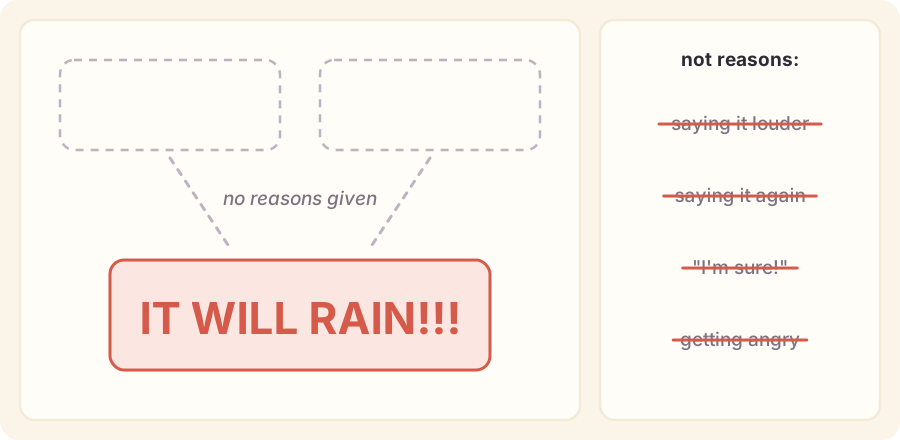
Draw the argument map of "IT WILL RAIN! I'M SURE!" and you get a conclusion with nothing above it. However loud the conclusion is, there are no arrows pointing to it.
Why logic wants the calm kind
A quarrel ends when someone gives up or walks away. A logical argument ends in a different way: when the reasons have been looked at and you can see whether they support the conclusion. That can happen even if the two people still disagree, and it can happen without anyone feeling beaten.
So when a conversation turns into a quarrel, a good question is the one from the Why Do You Think So? lesson: "Why do you think so?" It turns the quarrel back into an argument.
Try it at home
- Next time you see or hear a disagreement - in real life, a film or online - write down what each side says.
- Sort what they say into two lists: reasons (claims given as support) and not reasons (louder, again, insisting, anger).
- Is it more quarrel or more argument?
Words to know
- quarrel - an angry disagreement where each side tries to win
- argument (in logic) - reasons given to support a conclusion; no anger needed
Big idea
In logic, an argument is reasons given for a conclusion, not a fight. Shouting, repeating and insisting can make a claim sound stronger, but they add no reasons, so they don't make it any better supported.