Checking a Claim
Two friends are arguing. One says, "This table is longer than the door is wide." The other says, "No, it isn't!" Then they argue about something else: "Mango ice cream is the best ice cream." "No, chocolate is!" One of these arguments can be settled in a minute. The other could go on forever. What is the difference?
Claims you can check
"The table is longer than the door is wide" is a claim: it is either true or false. Even better, you can check it. Take a tape measure, measure both, and compare. Then the argument is over.
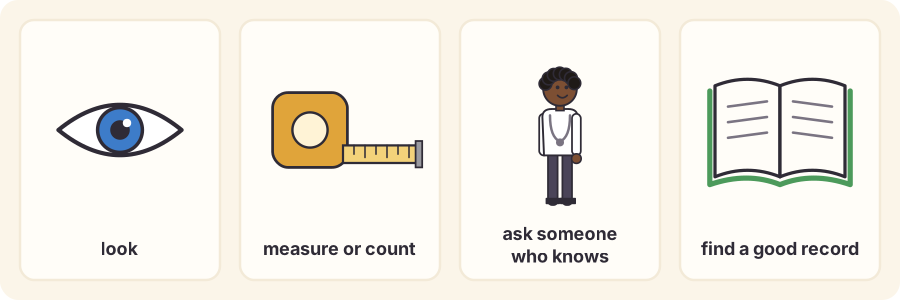
There are a few ways to check a claim:
- look - "It is raining outside." Open the window.
- measure or count - "There are 30 children in the class." Count them.
- ask someone who knows - "This mushroom is safe to eat." Ask an expert, not a friend who is guessing.
- find a good record - "The bridge was built in 1932." Look it up in a source you can trust.
Some claims are hard to check. "There is life on a planet around another star" is either true or false, but nobody can check it yet. It is still a claim. We just have to say "We don't know yet."
Sentences about taste
Now look at "Mango ice cream is the best ice cream." What could you measure to check it? Nothing. One person loves mango, another loves chocolate, and neither of them is making a mistake. This kind of sentence is about taste: what a person likes.
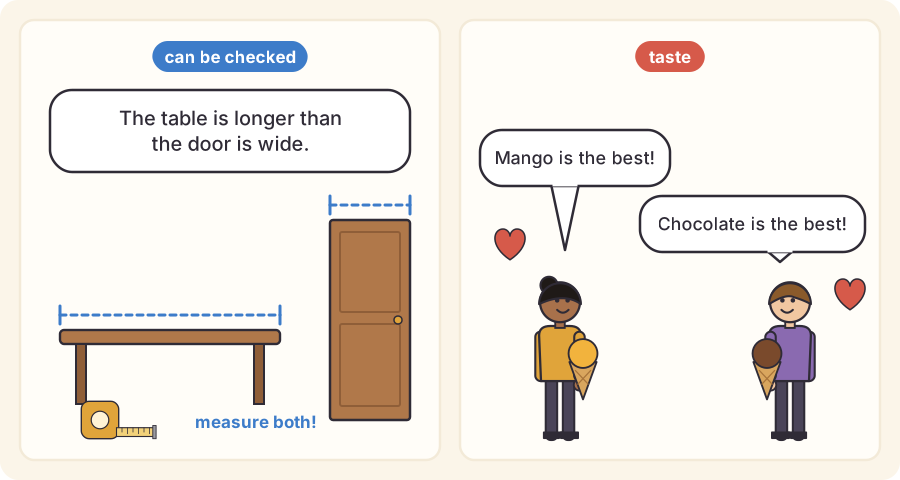
A sentence about taste sounds like a claim about the ice cream, but it really tells us about the person who says it. There is an honest way to say it:
"I like mango ice cream best."
That is a claim, and it is true if the speaker really does like mango best. It is a claim about the speaker, not about the ice cream.
Why this helps
Before you argue, ask: is this something we can check? If it is, stop arguing and go and check. If it is about taste, there is nothing to win: you can both be right about what you like.
Many real arguments mix the two. "This film is boring" is mostly taste. "This film is three hours long" can be checked. Pulling them apart is a big part of reasoning well.
Try it at home
- Write down five sentences you hear in an argument, or that you say yourself.
- Next to each one, write "check" if it could be checked, and how (look, measure, ask someone who knows, find a record).
- Write "taste" if it is about what someone likes, and rewrite it as an "I like..." sentence.
Words to know
- check - to find out whether a claim is true, by looking, measuring, asking someone who knows or finding a good record
- taste - what a person likes; two people can have different tastes without either one being wrong
Big idea
Many claims can be checked, by looking, measuring, asking an expert or finding a good record. Sentences about taste are different: they tell us what the speaker likes, so there is nothing to check and nothing to win.