Every Swan I Have Seen
For hundreds of years, people in Europe had seen thousands of swans, and every single one was white. "All swans are white" seemed as safe a claim as any. Then, in 1697, a group of Dutch sailors reached the west coast of Australia. What did they find on a river there?
From examples to "all"
The reasoning of those Europeans went like this:
This swan is white.
That swan is white.
Every swan anyone has ever seen is white - thousands of them.
So all swans are white.
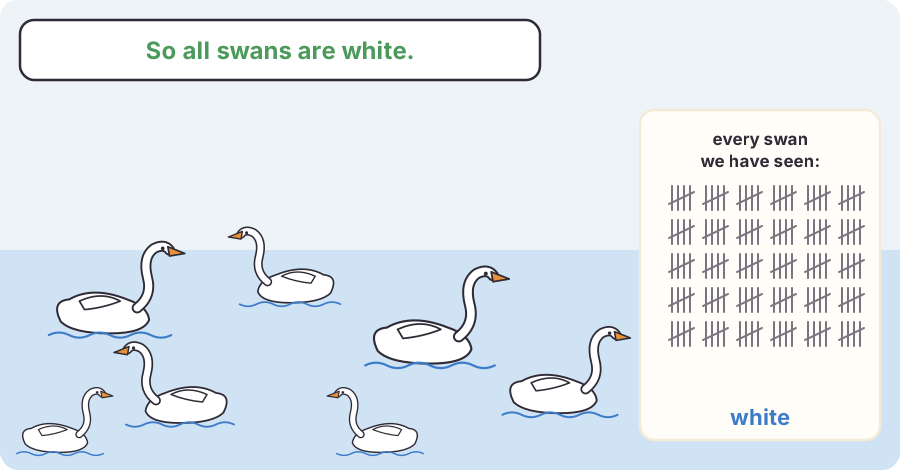
This kind of reasoning is called induction: going from many examples to a general conclusion about all of them, including the ones nobody has seen.
The black swans
The sailors were led by Willem de Vlamingh. On a river in what is now Western Australia, they saw swans that were black. Black swans live there still, and the river is called the Swan River after them.
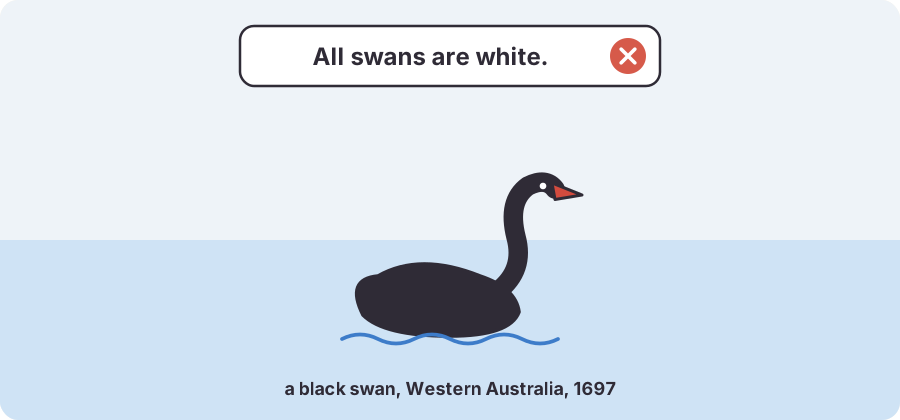
One black swan was a counterexample, like the penguin in the Can You Imagine It Wrong? lesson. "All swans are white" was false, and thousands of white swans could not save it.
Notice something important. The Europeans weren't being silly. They had very many examples, and they had never seen a single swan of another colour. Their reasoning was good reasoning. It just wasn't certain. Before Australia, there were simply no black swans in front of them to see.
Induction is everywhere
You use induction all the time, and you are right to:
- The Sun has come up every morning of your life, so it will come up tomorrow.
- The stove was hot every time it was switched on, so it will be hot now.
- This bus has come every 20 minutes for weeks, so it will come every 20 minutes today. (This is how Leila in the Reasons and a Conclusion lesson could trust the sign.)
Without induction you couldn't learn anything from experience. You would have to touch the hot stove again every day to find out whether it is still hot.
But induction is different from the cookie argument in the Must It Be True? lesson. There, if the reasons were true, the conclusion had to be true. With induction, the reasons can all be true - every swan we have seen really was white - and the conclusion can still be false. The conclusion goes beyond the reasons: it talks about swans nobody has seen yet.
So the right question about induction isn't "Must the conclusion be true?" It is "How likely is the conclusion, given the examples?" The next lesson looks at that difference.
Try it at home
- Write down three things you expect will happen tomorrow because they have always happened before.
- For each one, write how many examples you are going on (every day for years? three times?).
- Try to imagine a "black swan" for each one: something that would show the pattern doesn't always hold.
Words to know
- induction - reasoning from many examples to a general conclusion that goes beyond them
- general conclusion - a conclusion about all of a group, including the ones not seen
Big idea
Induction goes from many examples to a conclusion about all of them. We need it to learn from experience, but it is never completely sure: one black swan was enough to show that thousands of white ones had not proved "all swans are white".