True or False?
"Close the door!" Is that true or false? The question sounds strange. Now try "The door is closed." That one is easy to answer: you look at the door. Why can you ask "true or false?" about some sentences and not about others?
Sentences that say how things are
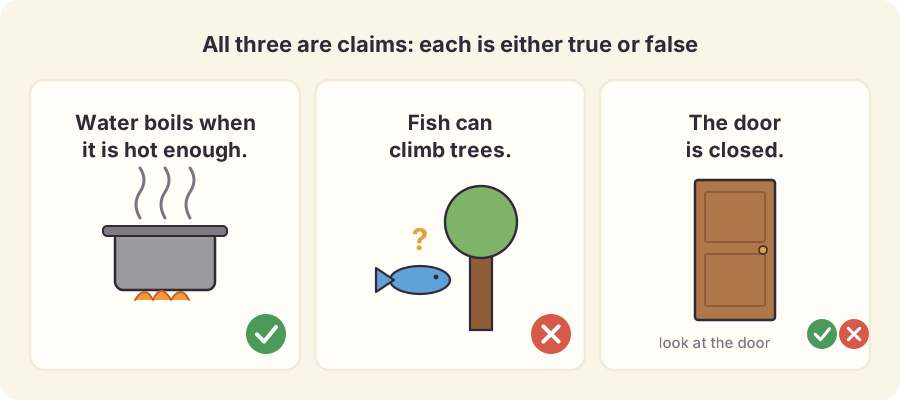
Some sentences tell us how the world is:
- "The door is closed."
- "Water boils when it is hot enough."
- "My sister is ten years old."
- "Fish can climb trees."
Each one could be checked against the world, and each one is either true or false. A sentence like this is called a claim. Logicians also call it a statement.
Notice the last one: "Fish can climb trees" is false, but it is still a claim. A claim doesn't have to be true. It only has to be the kind of sentence that is either true or false.
Sentences that are not claims
Many sentences don't say how the world is. They do other jobs:
- Questions ask: "Is the door closed?"
- Orders and requests tell someone what to do: "Close the door, please."
- Greetings say hello: "Good morning!"
- Wishes say what we want: "I hope it's sunny tomorrow."
None of these is true or false. You can answer a question, obey an order, or return a greeting, but you can't say "That's false!" to "Good morning!"
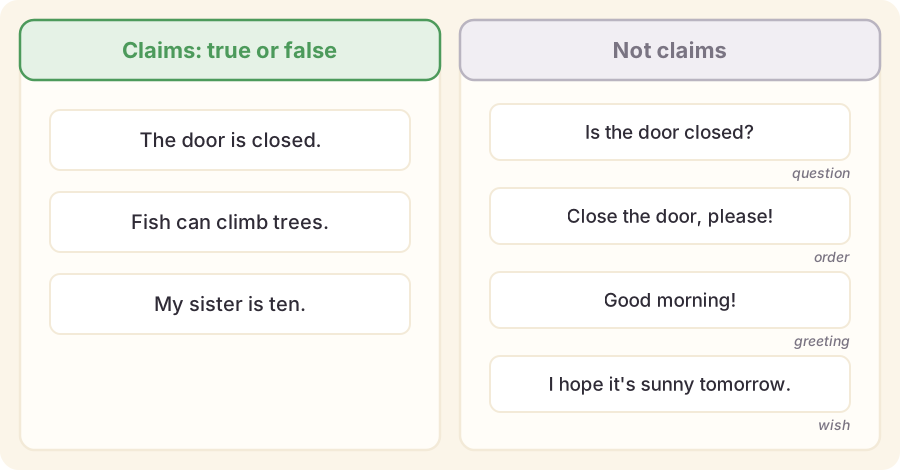
There is one surprise. "I hope it's sunny tomorrow" is a wish, but "Maryam hopes it's sunny tomorrow" is a claim - a claim about Maryam. It is true if she really does hope that, and false if she doesn't.
Why claims matter
In the Why Do You Think So? lesson, Sara said "It will rain today" and gave a reason: "the sky is full of dark clouds". Look again: both the idea and the reason are claims. Each one is either true or false.
That is no accident. Reasoning is made of claims. We give claims as reasons for other claims. A question or an order can't be a reason, because it is neither true nor false. So the first thing to do with any piece of reasoning is to find the claims in it.
Try it at home
- Open any book, newspaper or website and copy out five sentences.
- Next to each one, write "claim" or "not a claim".
- For each claim, write whether you think it is true, false, or "I don't know yet". "I don't know yet" is fine: a claim is still a claim even if you can't check it right now.
Words to know
- claim - a sentence that is either true or false; also called a statement
- true - matching how the world really is
- false - not matching how the world really is
Big idea
A claim is a sentence that is either true or false, even if we don't yet know which. Questions, orders, greetings and wishes are not claims. Reasoning is made of claims.