Attack the Person
At dinner, Reza says, "We should eat less sugar - it's bad for our teeth." His older sister laughs: "You ate three biscuits this afternoon! Why should anyone listen to you?" Everyone laughs, and the conversation moves on. But did the sister actually answer what Reza said?
Aiming at the wrong thing
Reza made an argument:
Sugar is bad for our teeth.
So we should eat less sugar.
His sister's reply was about Reza: what he ate, whether anyone should listen to him. It said nothing at all about sugar or teeth. Even if Reza ate a hundred biscuits, sugar would be exactly as bad for teeth as before.
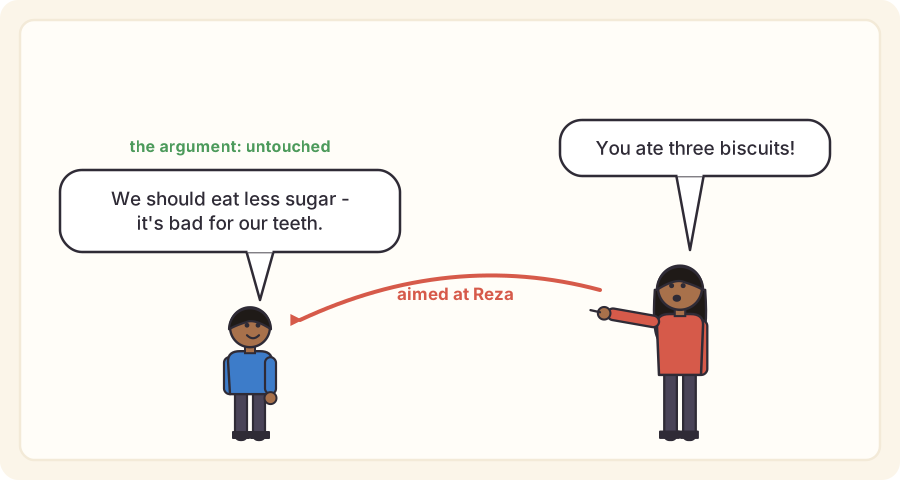
Answering an argument by attacking the person who made it, instead of their reasons, is a fallacy called attacking the person. In the What Is a Fallacy? lesson we saw that a fallacy seems to support a conclusion but doesn't. Here the conclusion the sister wants is "Reza's argument is wrong", and her "reason" - he ate biscuits - doesn't support it.
Why it fools us
Attacking the person works on us for a few reasons:
- it is often funny or embarrassing, so it wins the moment;
- it feels fair to point out that someone doesn't do what they say;
- it moves everyone's attention from the claim to the person.
It comes in many forms:
- Insults: "Only an idiot would believe that."
- "You do it too": "You say I shouldn't shout, but you shouted yesterday."
- Who they are: "You're just a kid, what do you know?" or "Of course you would say that."
Each one can be true - maybe Reza is a bit of a hypocrite (someone who doesn't do what they tell others to do) - and still have nothing to do with whether the argument is good.
Arguments stand on their own
Here is the key idea. An argument's reasons are claims, and each claim is true or false whoever says it. "Sugar is bad for teeth" is checked by looking at teeth, not at Reza.
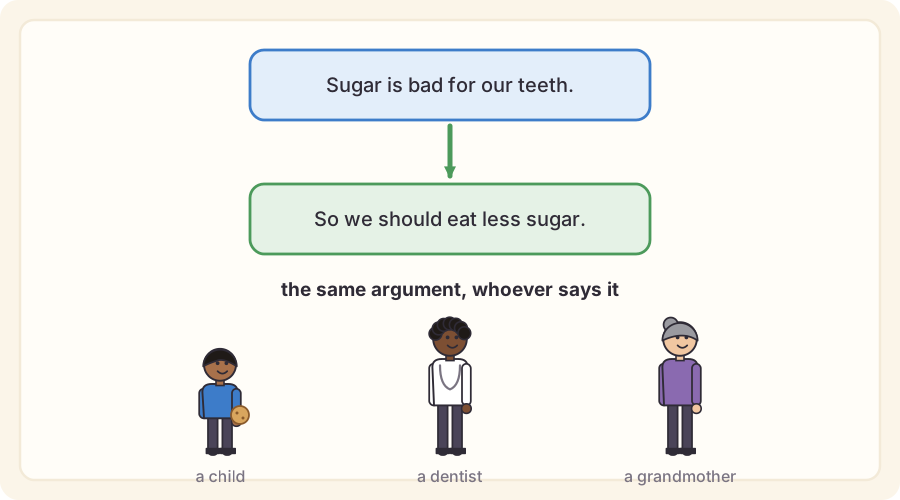
So to answer an argument, you have to answer the argument: show that a reason is false, or that the conclusion doesn't follow.
There is one fair question about people. When an argument depends on someone's word - "trust me, I saw it" - it is reasonable to ask whether they are honest, or whether they really know. That is about whether a reason is true, which is part of checking an argument. Attacking the person is different: it treats who someone is as if it settled whether their argument is good.
Try it at home
- Listen for replies that are about the person instead of what they said: in films, online comments, or games with friends.
- Write one down, and write what the person had actually argued.
- Write a reply that answers the argument instead.
Words to know
- attacking the person - the fallacy of answering an argument by attacking the person who made it, instead of their reasons
- hypocrite - someone who doesn't do what they tell others to do
Big idea
An argument is as good or as bad as its reasons, whoever gives it. Attacking the person who made it - insults, "you do it too", "who are you to say" - leaves the reasons exactly where they were.