Only Two Choices
"Either you come to my party, or you're not my friend." That is hard to hear. It seems to leave you only two doors: go to the party, or lose a friend. But are those really the only two doors?
Two doors - or more?
The argument behind the sentence goes like this:
Either you come to my party, or you're not my friend.
You aren't coming to my party.
So you're not my friend.
The conclusion follows from the reasons. The trick is in the first reason. It says there are only two possibilities, when there are clearly more: you could be a good friend who is away that day, or ill, or already promised to visit your grandparents.
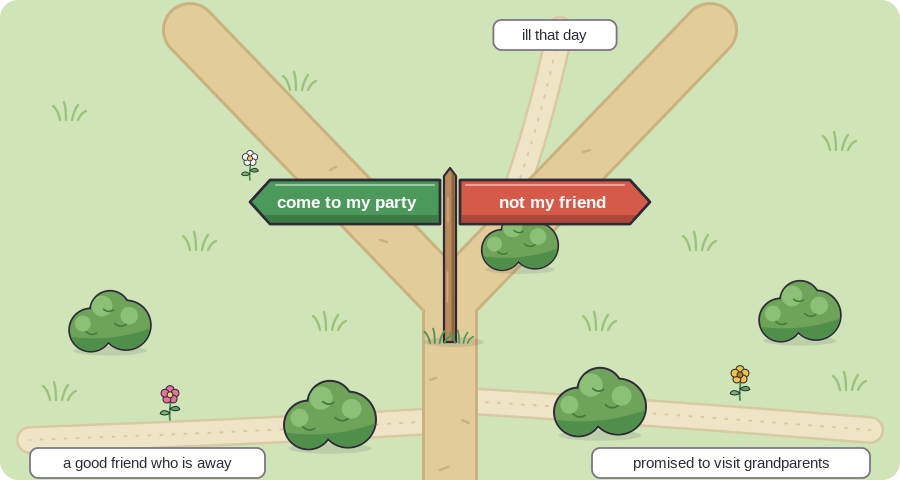
Offering only two choices when there are really more is a fallacy called a false dilemma. A dilemma is a choice between two possibilities, usually hard ones. A false dilemma is a choice that pretends there are only two.
Why it works
A false dilemma usually puts one choice that sounds good next to one that sounds terrible, and hides everything in between. Then the terrible one does the arguing for you:
- "Either you get top marks, or you'll never get a good job." (Most people with good jobs didn't get top marks in everything.)
- "Either we buy the expensive phone, or we put up with a phone that doesn't work." (There are many phones in between.)
- "You're either with us or against us." (You could agree with some things and not others, or not have decided yet.)
Like the other fallacies in this module, it can feel convincing - especially when someone is in a hurry, upset, or wants an answer now.
The fix: look for the missing choices
The way out of a false dilemma is to ask: are these really the only possibilities? Then list the others.
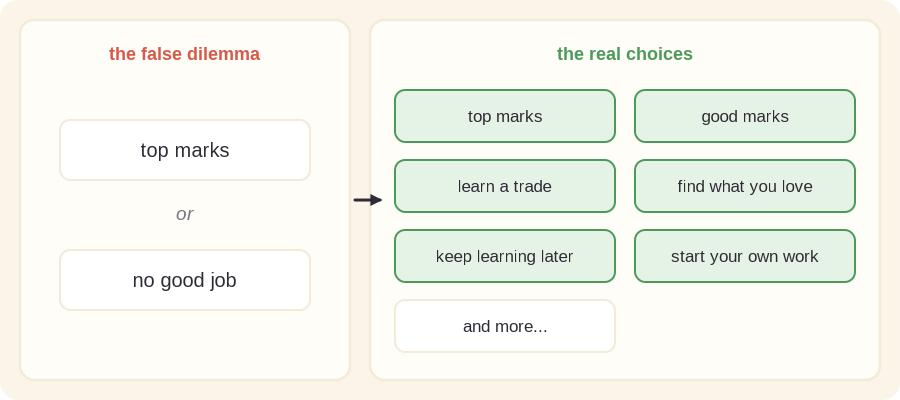
Sometimes there really are only two choices: a light switch is on or off; a number is even or odd; you passed the test or you didn't. A dilemma is only false when it leaves out choices that are really there.
Notice the connection to the All, Some and None lesson. The opposite of "all are red" was not "none are red" - there was a whole range in between, "some". A false dilemma does the same thing: it jumps from one end to the other and forgets the middle.
Try it at home
- Listen for "either... or..." sentences this week, and write three down.
- For each one, ask: are there really only two choices? List as many others as you can.
- Find one "either... or..." that really does have only two choices.
Words to know
- dilemma - a choice between two possibilities, usually hard ones
- false dilemma - the fallacy of offering only two choices when there are really more
Big idea
A false dilemma pretends there are only two choices, so that rejecting one seems to force the other. The fix is to ask whether these are really the only possibilities, and to look for the ones in between.