All Dogs Are Animals
"All dogs are animals." True. Now turn it around: "All animals are dogs." That is obviously false - a cat is an animal and not a dog. But with other claims, the turn-around is much harder to spot. How can you see it every time?
Groups as circles
A good way to picture an "all" claim is to draw each group as a circle: everything in the group goes inside its circle.
"All dogs are animals" means every dog is inside the animal circle. So the dog circle sits inside the animal circle.
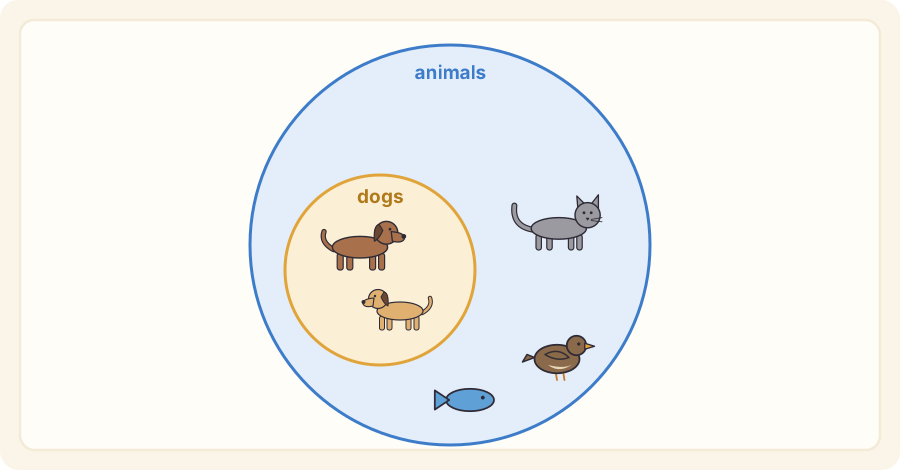
Now look at the picture and ask two questions:
- Is every dog inside the animal circle? Yes. So "all dogs are animals" is true.
- Is every animal inside the dog circle? No - the cat, the bird and the fish are animals outside the dog circle. So "all animals are dogs" is false.
An "all" claim puts one circle inside another, and inside only goes one way. So an "all" claim can't be turned around. "All dogs are animals" and "all animals are dogs" are two different claims, and one can be true while the other is false.
Harder cases
With dogs and animals, the mistake is easy to see. With other claims it hides:
- "All the winners trained every day." Turned around: "Everyone who trained every day was a winner." But many people train every day and don't win.
- "All spiders have eight legs." Turned around: "Everything with eight legs is a spider." But scorpions have eight legs, and they are not spiders.
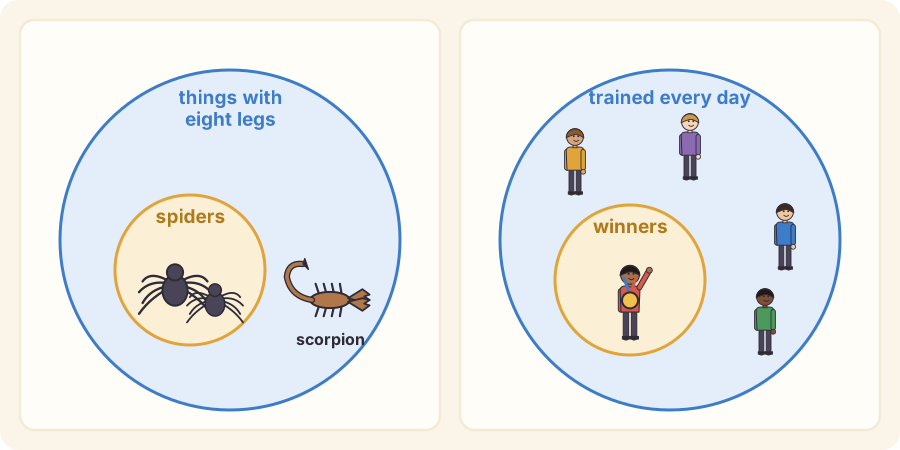
Each time, the turn-around goes wrong in the same way. The picture shows why: there is room in the big circle for things that are not in the small one.
Circles and arguments
Circles also help you check whether an argument follows. In the Good Shape, Wrong Facts lesson we saw this invalid argument:
All cats have four legs.
Tom has four legs.
So Tom is a cat.
Draw it: a "cats" circle inside a "four legs" circle. Tom is inside the "four legs" circle. But where exactly? He could be inside the cat circle - or in the space around it, with the dogs. The reasons don't say which, so the conclusion doesn't follow.
Now try the cookie argument: every cookie in the jar is inside the "chocolate chip" circle, and your cookie is inside the "cookies in the jar" circle. Then it must be inside the "chocolate chip" circle too. No other place is possible, so that conclusion follows.
Try it at home
- Draw circles for "All squares are shapes with four sides." Then put a rectangle that isn't a square in the picture. Where does it go?
- Turn the claim around. Is it still true?
- Find one "all" claim in an advert or on a box, and draw it as circles.
Words to know
- turning around - swapping the two groups in an "all" claim, as in going from "all dogs are animals" to "all animals are dogs"; it can turn a true claim into a false one
Big idea
An "all" claim puts one group's circle inside another's, and inside only goes one way. So an "all" claim can't be turned around: all dogs are animals, but not all animals are dogs.