The Four Moves
Every evening, Leo walks past a small corner shop. He has noticed something:
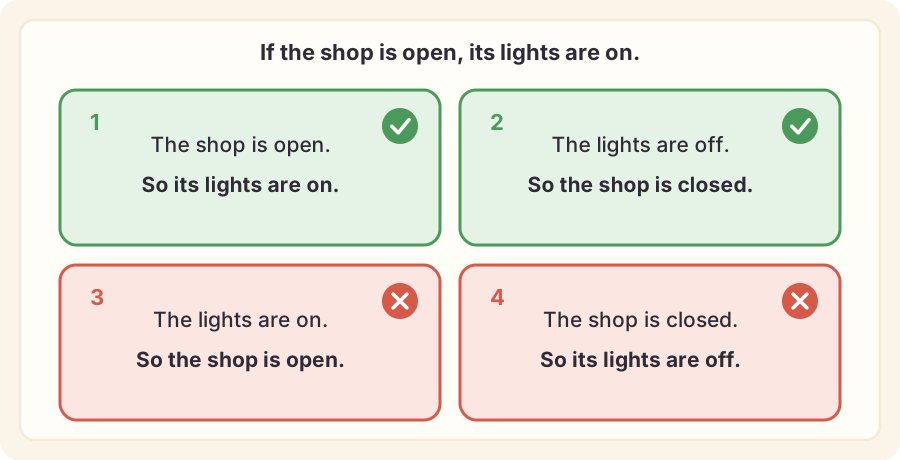
If the shop is open, its lights are on.
That's true: the shop never opens in the dark. In Level 1 we saw that an if-then claim works in one direction. Now we can collect every move you can make with one, and see which ones work.
Two parts, two names
An if-then claim has two parts. Logicians give them names:
- the if part is the antecedent (from the Latin for "going before");
- the then part is the consequent (from the Latin for "following").
You don't have to use these words. But they help to name the four moves.
The four moves
With "if the shop is open, its lights are on", you might learn one of four things, and try to conclude something from it.
- The shop is open. So its lights are on. This follows: if the claim is true and the shop is open, the lights must be on. This is the forwards move from Level 1. Its old Latin name is modus ponens.
- The lights are off. So the shop is closed. This follows too: if the shop were open, the lights would be on, and they aren't. This is the "dry street" move from Level 1. Its Latin name is modus tollens.
- The lights are on. So the shop is open. This does not follow. This is "going backwards" from Level 1, and its name is affirming the consequent: you say the then part is true and jump to the if part.
- The shop is closed. So its lights are off. This does not follow either. Its name is denying the antecedent: you say the if part is false and jump to the then part being false.
Why the last two fail
Leo walks past late one night. The shop is closed, the door is locked, the sign says "Closed" - and the lights are on. A cleaner is mopping the floor inside.
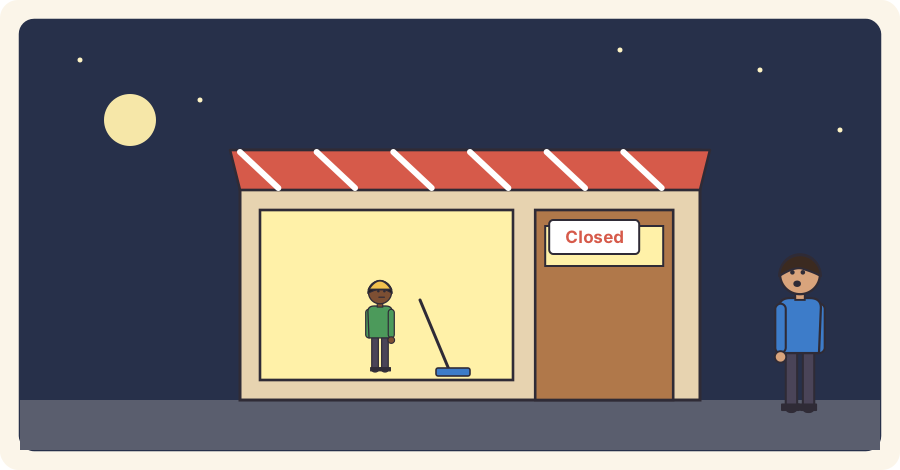
That one scene is a counterexample to both trap moves:
- move 3 said "the lights are on, so the shop is open" - but the lights are on and the shop is closed;
- move 4 said "the shop is closed, so its lights are off" - but the shop is closed and the lights are on.
And the claim "if the shop is open, its lights are on" is still true! It never said the lights are on only when the shop is open. As in Level 1, an if-then claim says nothing about what happens when its if part is false.
The shape is what matters
Here is the important thing. The four moves work, or fail, because of their shape, not because of shops or lights. Swap in any if-then claim you like: moves 1 and 2 will always follow, and moves 3 and 4 never follow just by their shape. That is why logicians gave them names: once you know the shape, you can check an argument about anything.
Try it at home
"If it's a cat, it has whiskers." Which of the four moves is each of these, and does it follow?
- "Bella has whiskers, so Bella is a cat."
- "Rex isn't a cat, so Rex has no whiskers."
- "This goldfish has no whiskers, so it isn't a cat."
- "Tom is a cat, so Tom has whiskers."
Words to know
- antecedent - the if part of an if-then claim
- consequent - the then part of an if-then claim
- affirming the consequent - "the then part is true, so the if part is" (doesn't follow)
- denying the antecedent - "the if part is false, so the then part is" (doesn't follow)
Big idea
There are four moves with an if-then claim. Forwards from the if part, and backwards from a false then part, always follow. The other two never follow by their shape alone - one lit shop at night shows why.