Arguments in a Chain
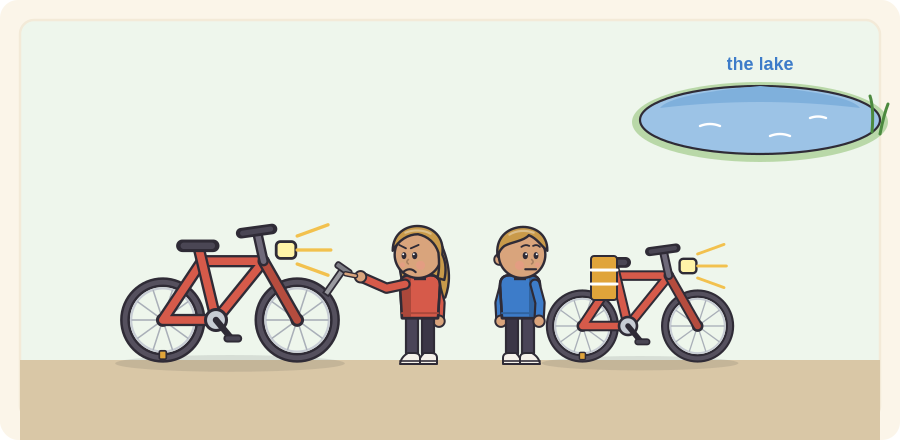
Lena is about to cycle to the lake with her brother. She checks her bike and says: "There's a nail in my front tyre. So the tyre will go flat. And you can't ride a bike with a flat tyre. So we can't cycle to the lake today."
That is more than one argument. It is two, joined together.
A conclusion that becomes a reason
Look at "the tyre will go flat". Lena first concludes it, from the nail:
There is a nail in the tyre.
So the tyre will go flat.
Then she uses it as a reason for her final conclusion:
The tyre will go flat.
You can't ride a bike with a flat tyre.
So we can't cycle to the lake today.
A claim that is a conclusion of one step and a reason for the next is called a middle conclusion. The last conclusion, the one the whole thing is aiming at, is the final conclusion.
Drawing a chain
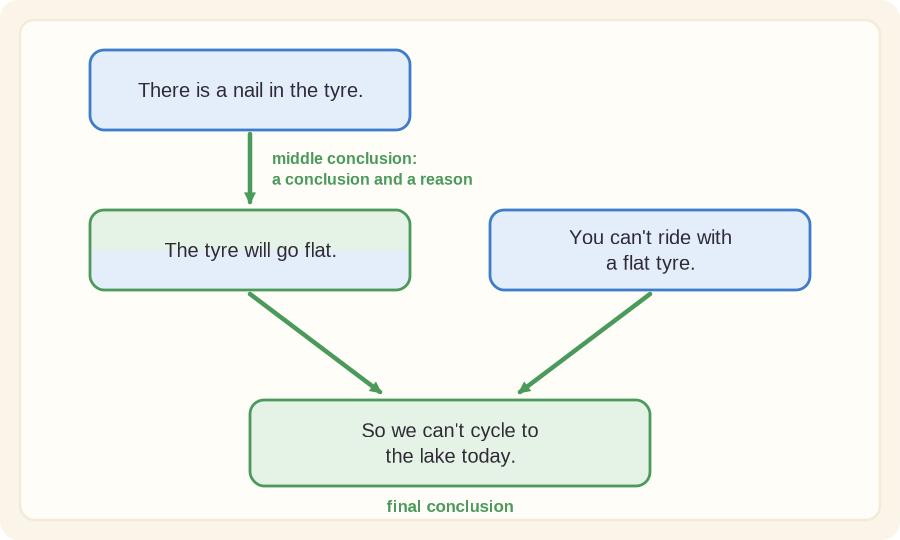
On an argument map, a chain is a map with more than one level. The reasons are at the top, the middle conclusion in the middle, the final conclusion at the bottom. The middle conclusion's box is half blue, half green: it is a conclusion and a reason.
Check each link
To check a chain, check each step on its own, with the test from Level 1: pretend the reasons of that step are true, and try to imagine its conclusion false.
- Step one: a nail in the tyre, but the tyre doesn't go flat? That can happen: some tyres are filled with a special liquid that seals small holes, and some nails stay stuck in and block their own hole for a while. So this step is likely, not certain.
- Step two: the tyre is flat and you can't ride with a flat tyre, but they still cycle to the lake? Not if those two reasons are true. This step follows.
So the whole chain is only likely, because its first link is only likely. Like a real chain, an argument chain is only as strong as its weakest link. One weak step anywhere and the final conclusion is weak too, even if every other step is perfect.
And there is a way out that Lena may have missed: her brother could help her fix the tyre. When you find the weak link, you also find where to look for another answer.
Try it at home
- Split this chain into its steps and find the middle conclusion: "The shop closes at six. It's already quarter to six and the shop is twenty minutes away. So we won't get there in time. So we'll have to buy bread tomorrow."
- Which step is weakest?
Words to know
- middle conclusion - a claim that is concluded in one step and used as a reason in the next
- final conclusion - the conclusion the whole chain is aiming at
Big idea
Long arguments are chains of short ones. Find the middle conclusions, check every step on its own, and remember that the chain is only as strong as its weakest link.