The Slippery Slope
Kai asks if he can stay up until nine o'clock tonight to watch a film. His big sister objects:
"If Kai stays up till nine tonight, tomorrow he'll want ten. If he gets ten, he'll want midnight. If he stays up till midnight, he'll be too tired for school. And if he's too tired for school, he'll fail all his exams. So if Kai stays up till nine, he'll fail his exams!"
Their dad laughs. But why, exactly, is it silly?
A chain of ifs
Kai's sister has built a chain of ifs: each if-then claim starts where the last one ended.
If the first thing happens, the second will.
If the second happens, the third will.
So if the first thing happens, the third will.
The shape is valid. If the first thing always leads to the second, and the second always leads to the third, then the first always leads to the third. Logicians call this the chain rule (or the hypothetical syllogism). You use it every day: "If I miss the bus, I'll be late. If I'm late, I'll miss the start of the test. So if I miss the bus, I'll miss the start of the test."
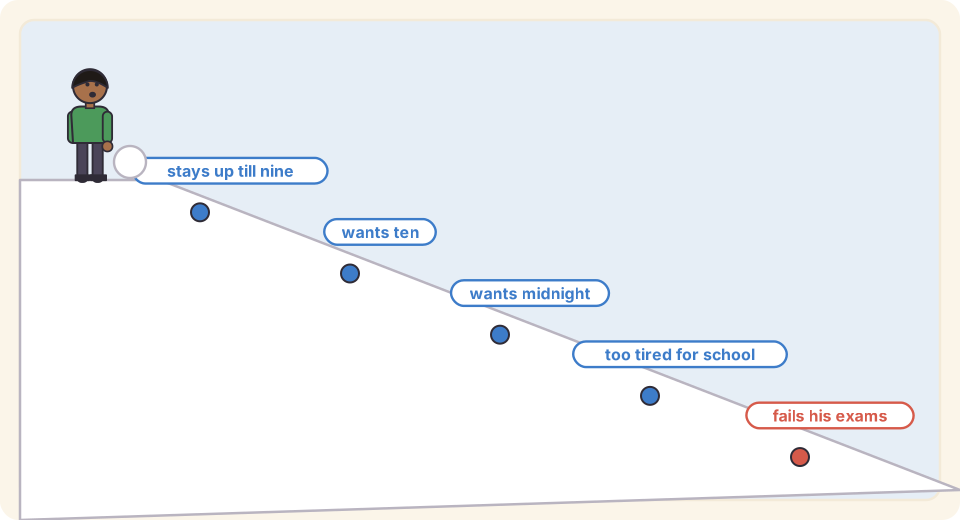
Where the slope gets slippery
So what's wrong? Not the shape: the links. Each "if" in the chain is only maybe, not always:
- Staying up till nine once doesn't mean he will always want ten. Dad can say no tomorrow.
- One late night doesn't mean he will be too tired every day.
In Arguments in a Chain we saw that a chain is only as strong as its weakest link. With chains of "maybe", it is even worse: the maybes add up. Suppose each of Kai's four links is a fair coin toss, true half the time. Then the whole chain comes true only about 1 time in 16. A long chain of likely-ish links makes an unlikely conclusion.
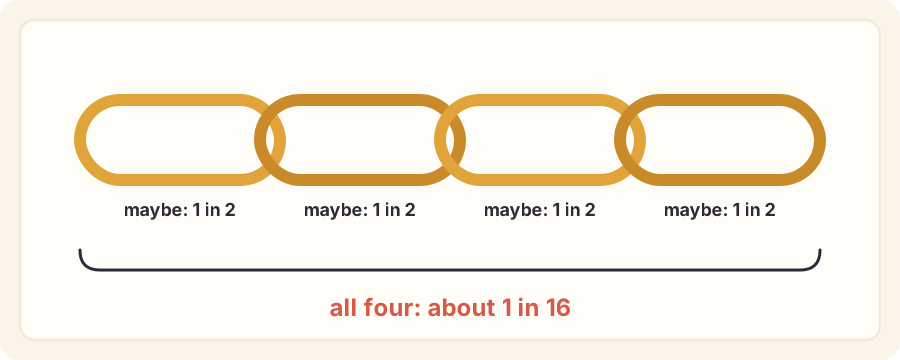
An argument that says one small step will lead, link by link, to something terrible, when the links are weak, is called a slippery slope. It is a fallacy: it uses the strength of the shape to hide the weakness of the links.
Not every slope is slippery
Some chains really are strong. "If you don't fix the small leak in the roof, rain will get in. If rain gets in, the wood will rot. If the wood rots, the roof will fall in." Each link here is what usually happens, and there's good evidence for it. The way to tell the difference is to look at each link on its own and ask: how sure are we that this one leads to the next?
Try it at home
- Check each link: "If we let one pupil use their phone in class, everyone will want to. Then nobody will listen. Then nobody will learn anything."
- Write your own strong chain of three ifs, where every link is very likely.
Words to know
- chain of ifs (the chain rule) - joining if-then claims end to end, so the first if leads to the last then: valid in shape
- slippery slope - a chain of ifs from a small step to something terrible, whose links are weak
Big idea
A chain of ifs is valid in shape, but it can't be stronger than its links, and many maybes together make an unlikely conclusion. Check every link before you slide down the slope.