Saying the Opposite
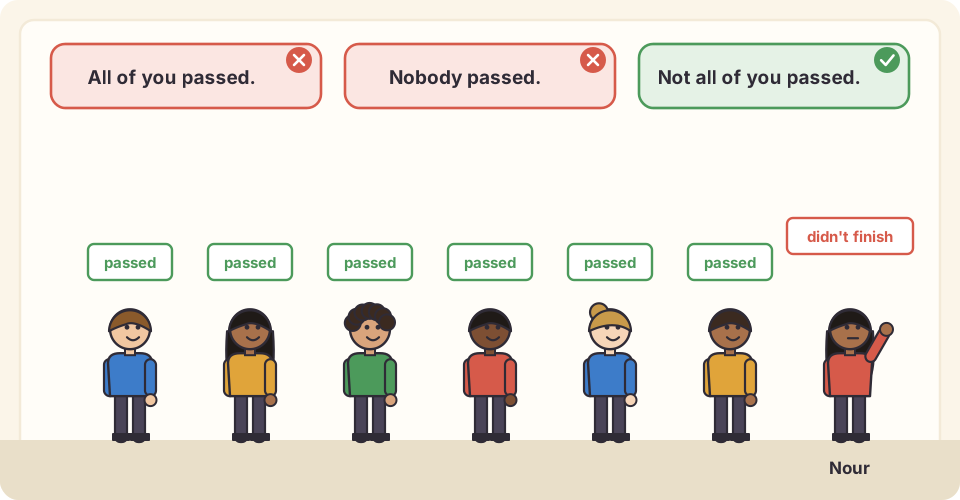
After the school fitness test, the coach tells the class: "Great news. All of you passed!" Nour puts up her hand. "That's not true, coach. I didn't finish the run."
Nour has said the coach's claim is false. But what exactly does that mean? Did nobody pass? Of course not. Most of the class passed. So what is the opposite of "all of you passed"?
The real opposite
The real opposite of a claim is the claim that is true exactly when the first one is false. Logicians call it the negation of the claim. One of the two is always true, and never both.
The negation of "all of you passed" is "not all of you passed": at least one person didn't. Nour is enough to make it true.
"Nobody passed" is not the negation. If it were, then one of "all passed" and "nobody passed" would always be true. But in Nour's class, both are false: some passed and one didn't.
Opposites that aren't opposites
Everyday language is full of near-opposites that are not negations. Two claims can both be false at once, even though they look like opposites:
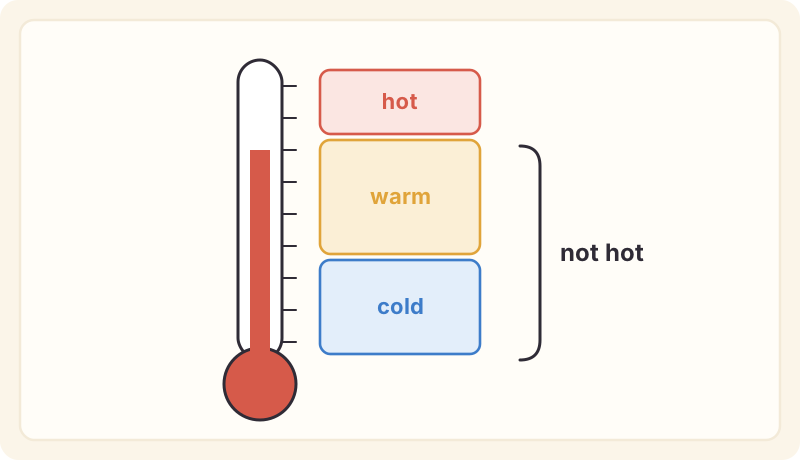
- "The soup is hot" and "the soup is cold" can both be false: the soup can be warm. The negation of "the soup is hot" is "the soup is not hot".
- "She always walks to school" and "she never walks to school" can both be false: she walks on some days. The negation of "always" is "not always".
- "He loves football" and "he hates football" can both be false: maybe he doesn't care either way.
A small table of negations
Here are the negations you need most:
| Claim | Its negation |
|---|---|
| All dogs bark. | Not all dogs bark. (Some dog doesn't.) |
| Some dogs bark. | No dogs bark. |
| No dogs bark. | Some dogs bark. |
| She always walks. | She doesn't always walk. (Sometimes she doesn't.) |
| He never lies. | He sometimes lies. |
In Level 1 we saw that one counterexample breaks an "all" claim. That is the same idea: one dog that doesn't bark makes "not all dogs bark" true.
Why it matters
When you disagree with someone, you only have to show the negation of what they said, not the far opposite. If a friend says "you're always late", you don't have to prove you are never late, only that you are not always late. And if you want to show their claim is false, you only need one example.
People also use the trick the other way. "So you're saying nobody passed?" is a way to turn your careful "not all" into something extreme and easy to laugh at, a bit like the straw man from Level 1.
Try it at home
Write the negation of each claim:
- Everybody in my family likes rice.
- It always rains on my birthday.
- Some of the apples are rotten.
- The shop is open.
Words to know
- negation - the claim that is true exactly when another claim is false; its real opposite
Big idea
The negation of a claim is true exactly when the claim is false. The negation of "all" is "not all", of "always" is "not always", of "some" is "none". Far opposites like "hot" and "cold" can both be false.