The Missing Reason
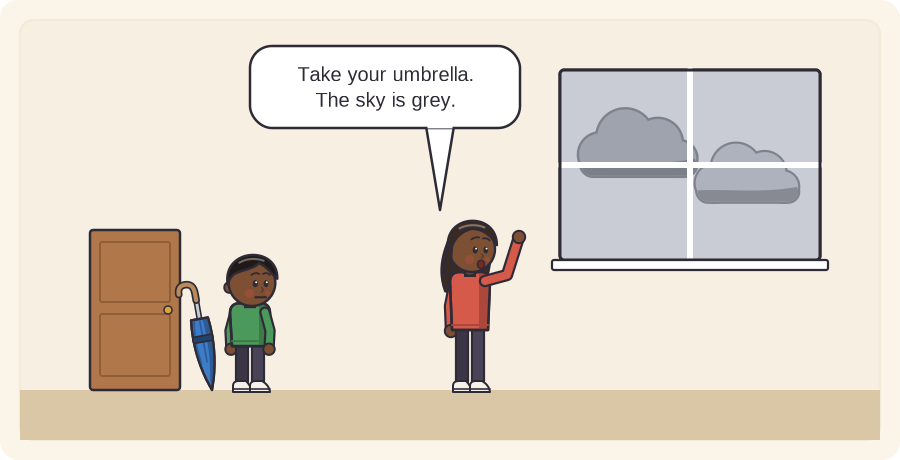
Kofi is putting on his shoes. His mum looks out of the window and says: "Take your umbrella. The sky is grey." Kofi takes it. It sounds like a perfectly good reason. But look closely: is it really a complete argument?
A gap between the reason and the conclusion
Here is what Kofi's mum said, set out as an argument. In Level 1 we learned to write the reasons first and the conclusion last, starting with "So":
The sky is grey.
So you should take your umbrella.
Now use the test from Level 1: pretend the reason is true, and try to imagine the conclusion false. Can the sky be grey while Kofi has no need for an umbrella? Easily. A grey sky is just a colour. If grey skies had nothing to do with rain, nobody would bother to mention it.
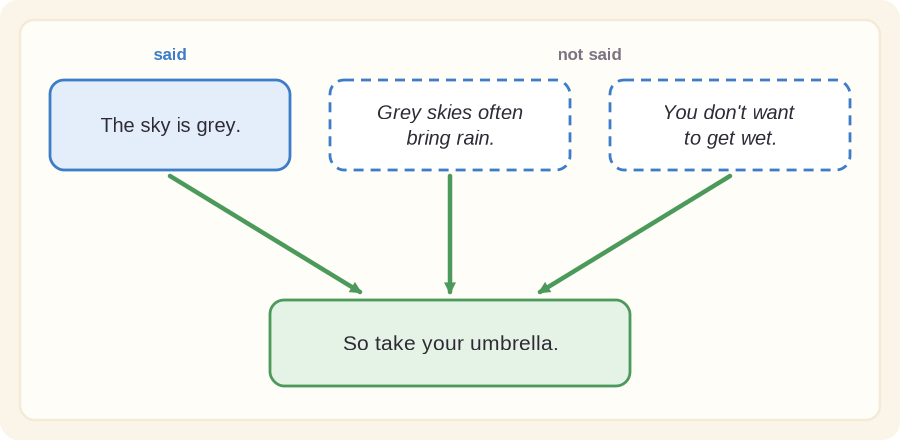
So something is missing. Kofi's mum is relying on a reason she didn't say, because it is so obvious to both of them:
The sky is grey.
Grey skies often bring rain.
You don't want to get wet.
So you should take your umbrella.
A reason that an argument needs but doesn't say out loud is called a hidden premise (or simply a missing reason). Remember that "premise" is the logic word for a reason.
Drawing the missing reason
On an argument map, a hidden premise gets a box with a dashed border: it belongs to the argument, but nobody said it.
People leave reasons out all the time, and usually that is fine. Saying every reason would make talk slow and boring. Kofi and his mum both know that grey skies bring rain.
Where the trouble hides
But a missing reason is also the best place for a weak idea to hide, because nobody has to say it, so nobody checks it. Listen to this:
Mr Diaz is a doctor.
So he must be rich.
The missing reason is "All doctors are rich." Once it is said out loud, you can see that it is false: some doctors work in poor villages, some are just starting, some give their time for free. The argument looked fine only while its weakest reason stayed hidden.
So the habit to learn is: when a conclusion seems to jump from its reason, ask what else would have to be true for the conclusion to follow. Say it out loud. Then ask whether that is true.
Try it at home
- Find the missing reason: "Don't drink that milk - it's past its date."
- Find the missing reason: "Amir got top marks, so he must have cheated." Is it true?
- Listen for one argument today that jumps from a reason to a conclusion. Write down the reason that was left unsaid.
Words to know
- hidden premise (or missing reason) - a reason an argument needs but doesn't say
Big idea
Most everyday arguments leave a reason unsaid. Finding it and saying it out loud is how you check an argument, because a weak idea is easiest to miss when nobody says it.