One Word, Two Meanings
Mr Ali parks his car next to a sign that says FINE FOR PARKING. When he comes back, there is a ticket on the windscreen: he has to pay money. "But the sign said it was fine to park here!" he says.
Mr Ali has fallen for one of the oldest tricks in language: one word, two meanings.
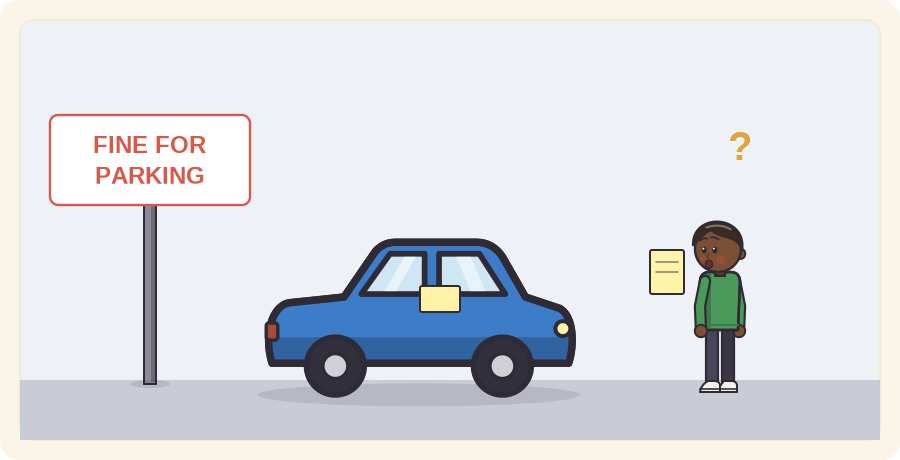
Two meanings of "fine"
"Fine" can mean all right ("I'm fine, thanks") or money you must pay as a punishment ("a fine for parking"). The sign meant the second. Mr Ali read the first.
That is just a misunderstanding. It becomes a problem in reasoning when an argument uses one word in two meanings and depends on it. Here is a famous example:
A feather is light.
Whatever is light cannot be dark.
So a feather cannot be dark.
It sounds like it follows, and the conclusion is false: crows and ravens have black feathers. What has gone wrong?
The word that changed
In the first line, "light" means not heavy. In the second line, "light" means pale, not dark. The argument only looks linked because the same word appears in both reasons. Write the meanings out in full:
A feather is not heavy.
Whatever is pale cannot be dark.
So a feather cannot be dark.
Now there is no link at all. The two reasons are about different things.
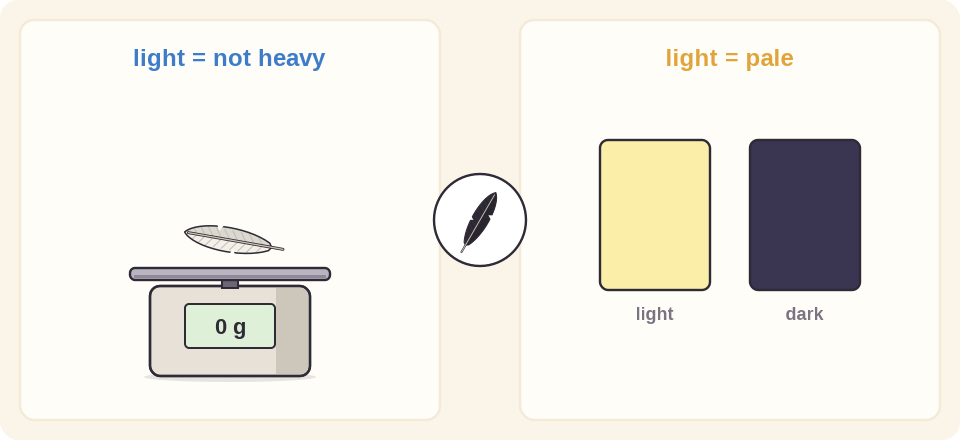
Using a word in two meanings in one argument is called equivocation (from Latin for "calling equally": giving two things the same name). In Two Steps with All we saw that a syllogism needs a middle group that links the two reasons. Equivocation is a fake link: it looks like one middle group, but it is really two.
How to catch it
- Find the word that carries the argument from one reason to the next.
- In each line, swap that word for what it means there.
- If the meanings differ, the link is broken.
Equivocation isn't always a joke, and in serious talk it is hard to see, because the word looks the same each time. "Everyone has a right to their own opinion, so my opinion is right" slides from "right" meaning allowed to have to "right" meaning correct. Having the right to an opinion doesn't make the opinion correct. Watch for words like "right", "free", "fair" and "natural", which have several everyday meanings.
Try it at home
- Find the word with two meanings: "The sign said 'Slow children', so the children around here must be slow learners."
- Find it here: "Nothing is better than a holiday by the sea. A cheese sandwich is better than nothing. So a cheese sandwich is better than a holiday by the sea."
Words to know
- equivocation - using one word in two meanings in the same argument, so that it only seems to follow
Big idea
An argument can seem to follow only because a word changes its meaning halfway through. Swap each key word for what it means in that line; if the meanings differ, the link is fake.