Questions with a Trap
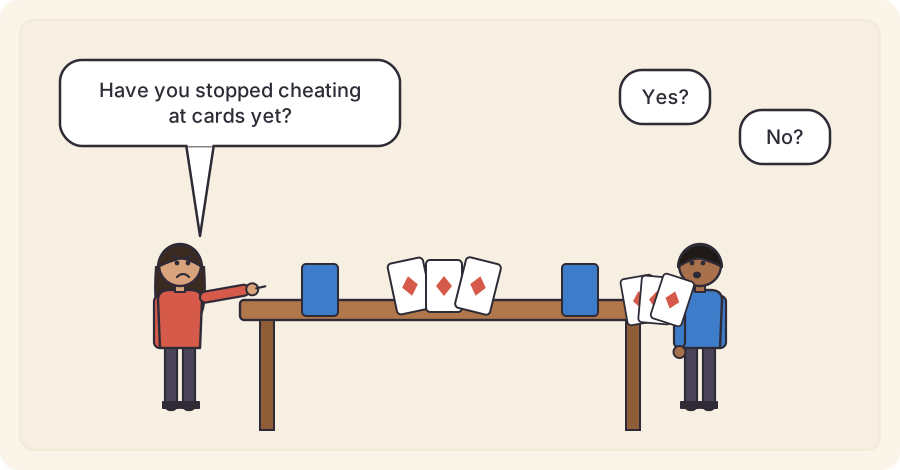
The family is playing cards. Tariq has just won for the third time in a row. His cousin Leila narrows her eyes and asks: "Tariq, have you stopped cheating at cards yet?"
"No!" says Tariq. Everyone gasps. "I mean yes!" Everyone gasps again.
Tariq can't win. Whatever he answers, he seems to admit something.
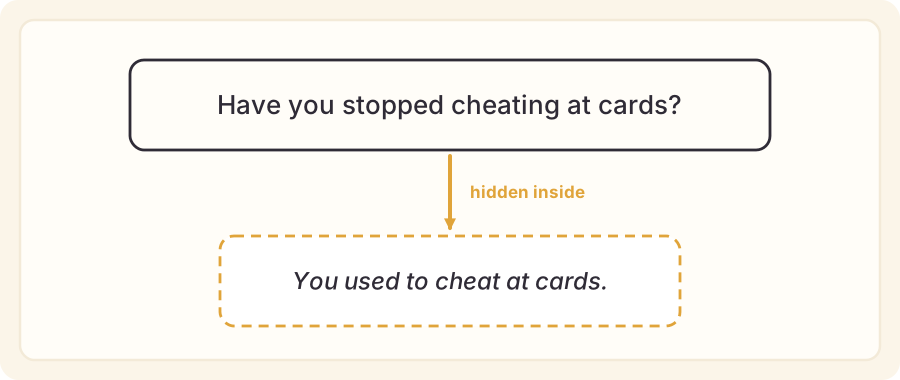
A claim hidden in a question
Look at what each answer would mean:
- "Yes, I've stopped" means: I used to cheat, but I don't now.
- "No, I haven't stopped" means: I cheated, and I still do.
Both answers agree that Tariq cheated before. That claim isn't asked; it's built into the question. A question like this is called a loaded question: it is loaded with a claim, the way a cart is loaded with a heavy box, and whoever answers it has to carry the box.
It works like the hidden premise at the start of this course: a claim that nobody says out loud, so nobody checks it.
Loaded questions everywhere
Loaded questions aren't only jokes at the card table:
- A survey asks: "How much did you enjoy our delicious new menu?" (It assumes you enjoyed it, and that it's delicious.)
- An advert asks: "Why do more families choose Sunny Juice?" (Do they?)
- Someone asks: "Why are you always so rude?" (Always? Rude?)
The trick is that a question doesn't look like a claim. We are used to checking statements, but we answer questions quickly, especially short yes-or-no ones.
How to answer one
Don't answer the question as asked. Answer the hidden claim instead:
"I've never cheated at cards, so I can't have stopped."
Or name the trick politely: "That question assumes I cheated. I didn't." And when you ask questions, check that they don't carry a claim the other person hasn't agreed to. "What did you think of the film?" is fair. "Wasn't that film boring?" is leaning.
Try it at home
- Find the hidden claim: "Where did you hide the biscuits?"
- Find the hidden claim: "Why is our team the best in the league?"
- Rewrite question 1 so it isn't loaded.
Words to know
- loaded question - a question with a claim built into it, so that any short answer agrees with that claim
Big idea
Some questions hide a claim inside them, and any yes or no seems to admit it. Pull the hidden claim out, and answer that instead.