Turning It Around
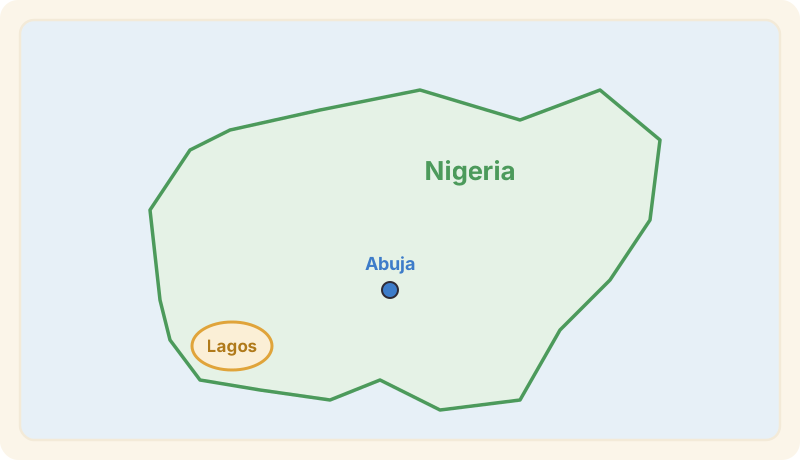
Tunde says: "If you live in Lagos, you live in Nigeria." That's true: Lagos is a city in Nigeria. His little cousin turns it around: "So if you live in Nigeria, you live in Lagos!" Everyone laughs. Tunde's cousin lives in Abuja, which is in Nigeria too.
Turning a sentence around can change what it says. But there is one way to turn it that never changes anything.
Turning it around: the converse
Take an if-then claim and swap its two parts. The new claim is called the converse:
Claim: If you live in Lagos, you live in Nigeria.
Converse: If you live in Nigeria, you live in Lagos.
The claim is true; the converse is false. A converse is a different claim. Sometimes both are true, sometimes only one. So you can never get the converse just from the claim.
This is the mistake of "going backwards" from Level 1, seen from another side. "If it rains, the street gets wet" is true. Its converse, "if the street is wet, it rained", is not: the street-cleaning truck can wet it.
Turning it around and saying "not": the contrapositive
Now do two things: swap the parts, and put "not" into both of them:
Claim: If you live in Lagos, you live in Nigeria.
Contrapositive: If you don't live in Nigeria, you don't live in Lagos.
This new claim is called the contrapositive, and it says exactly the same thing as the claim. Check it: if you don't live anywhere in Nigeria, you certainly don't live in Lagos, because Lagos is in Nigeria. Whenever the claim is true, the contrapositive is true, and the other way round.
You have seen the contrapositive at work already. In The Four Moves, move 2 went "the lights are off, so the shop is closed". That move works because "if the shop is open, its lights are on" says the same as "if the lights are off, the shop is not open".
The link to needed and enough
In the Needed or Enough? lesson we met things that are needed and things that are enough. An if-then claim says both at once:
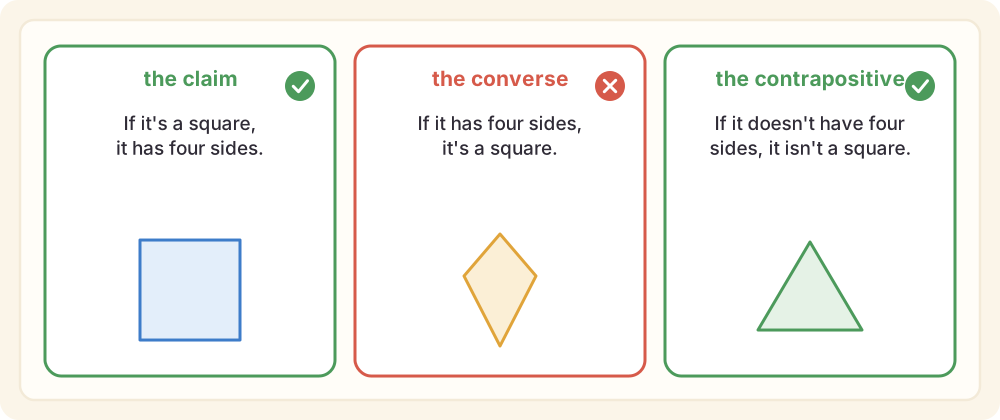
If it's a square, it has four sides.
- the if part is enough for the then part: being a square is enough for four sides;
- the then part is needed for the if part: you can't be a square without four sides.
The contrapositive just says the second of these out loud: no four sides, no square. That is why it means the same thing.
Try it at home
For each claim, write the converse and the contrapositive, and say which one means the same as the claim:
- If it's a robin, it's a bird.
- If you are in the team, you come to training.
- Find a claim whose converse is also true. (Hint: try "if and only if" from the last lesson.)
Words to know
- converse - the if-then claim with its parts swapped; a different claim
- contrapositive - the parts swapped and both made "not"; the same claim in other words
Big idea
Turning an if-then claim around gives its converse, which may be false. Turning it around and adding "not" to both parts gives its contrapositive, which always says the same thing.