Good Without Being a Proof
Hana's family is planning a picnic for Sunday. "Let's not," says her dad. "The weather forecast says there is a 90% chance of heavy rain on Sunday, and the forecasts here are usually right."
Hana sighs. "But that doesn't prove it will rain!"
She is right: it doesn't. But her dad's argument is still a good one. How can an argument be good if it isn't a proof?
Two kinds of good argument
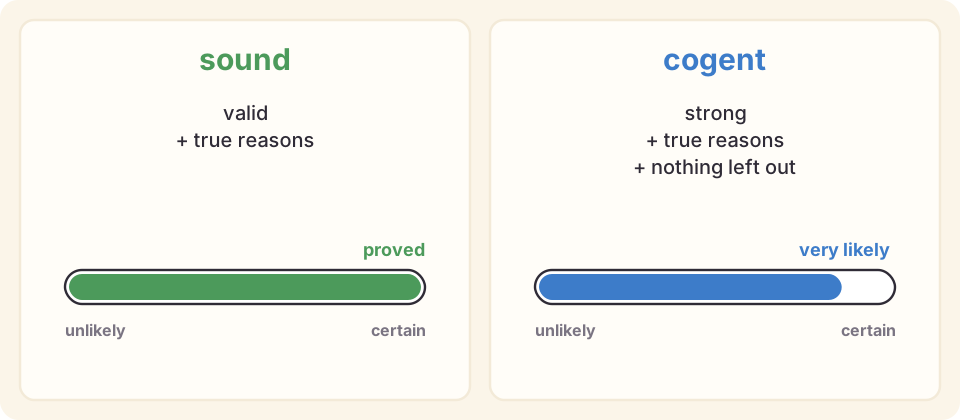
In Level 1 we met sound arguments: valid, with true reasons. A sound argument proves its conclusion: if the reasons are true and the conclusion must follow, the conclusion is true.
But most arguments in real life can't be valid. Arguments from examples, from "most", from experts and from analogies can only make a conclusion likely. For those, there is a second kind of good:
- the argument is strong: if its reasons were true, the conclusion would very likely be true;
- its reasons are true;
- and nothing important has been left out: there is no other fact you know that would change the picture (like knowing Pingu is a penguin in Most and Nearly All).
An argument like that is called cogent (from Latin for "driving together"). Hana's dad's argument is cogent: a 90% forecast from a usually reliable source is strong, and it is true that the forecast said so.
Asking for proof is sometimes a trick
"That doesn't prove it!" is true of almost everything people believe about the world: that the sun will rise tomorrow, that the bridge will hold, that the medicine works. If we waited for proof, we would never decide anything. Asking for a proof when a cogent argument is all anyone could have is a way to avoid being convinced. The fair question is not "is it proved?" but "is it good enough to act on?"
Putting the course together
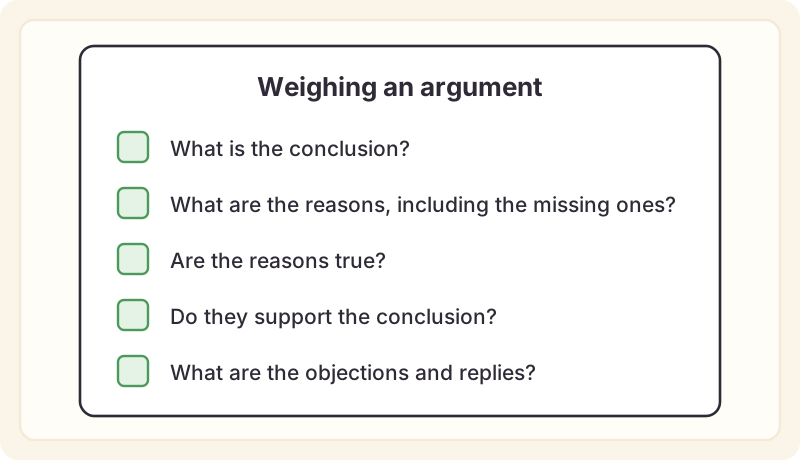
Here are the questions this course has given you, in the order to ask them:
- What is the conclusion? And is there a chain, with middle conclusions?
- What are the reasons? Including the missing ones, filled in fairly.
- Are the reasons true? Check the hidden ones especially, and any loaded question or either-or.
- Do they support the conclusion? Is it a valid shape, or a strong argument from "most", experts or analogy? Watch for words that change their meaning, circles and slippery slopes.
- What are the objections, and are there good replies?
Level 3 will give these questions a new tool: writing claims with letters and checking arguments with tables, so that the shapes you have learned here can be tested exactly.
Try it at home
- Is this argument sound, cogent, or neither? "The last bus left at 11. It's now midnight. So we can't get the bus home tonight."
- Pick an argument you heard this week and take it through the five questions.
Words to know
- cogent - a strong argument with true reasons and nothing important left out; the "good" for arguments that can't be valid
Big idea
A good argument doesn't have to be a proof. Sound arguments prove their conclusions; cogent ones make them very likely. Most good reasons in real life are cogent, and that is good enough to act on.