And and Or
At the school canteen, two menu boards hang side by side.
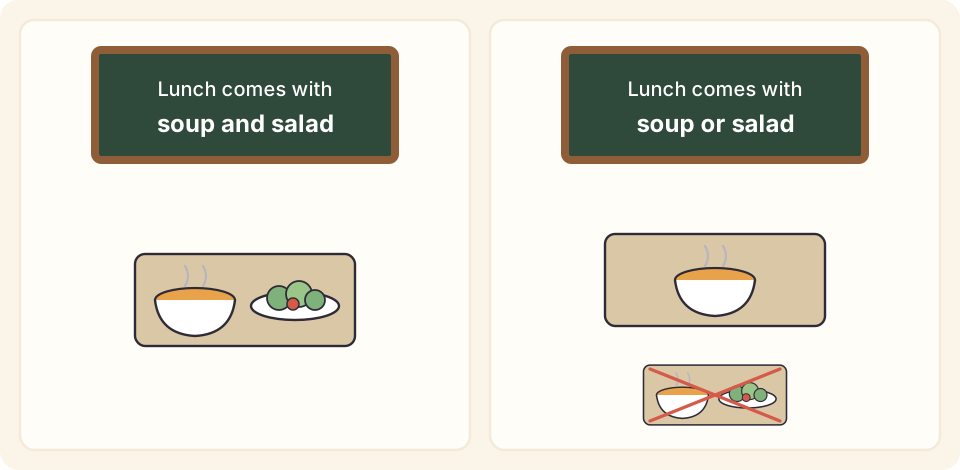
- Monday's board says: Lunch comes with soup and salad.
- Tuesday's board says: Lunch comes with soup or salad.
On Monday, Felix gets a bowl of soup and a plate of salad. On Tuesday he asks for both again, and the cook shakes her head. One small word made all the difference.
Joining claims with "and"
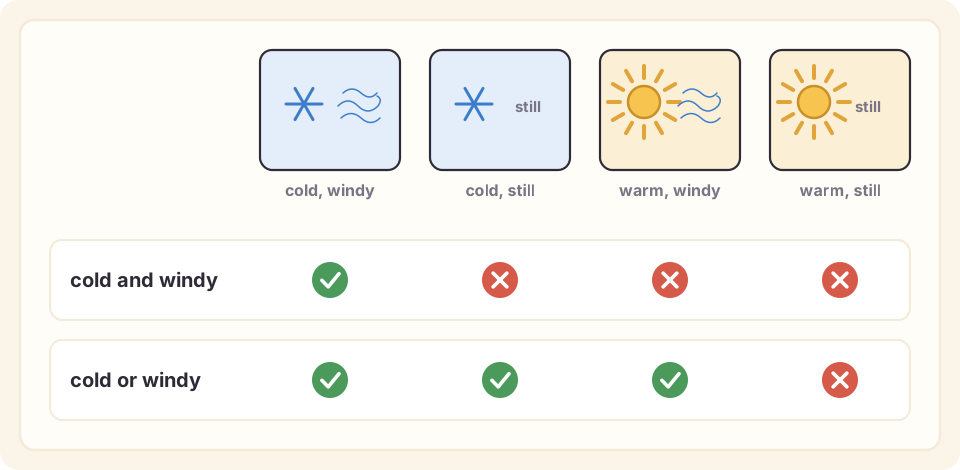
"And" can join two claims into one bigger claim: "It is cold and it is windy." Let's call this an and-claim. When is it true?
Only when both parts are true. If it is cold but still, the and-claim is false. If it is windy but warm, it is false. If it is neither, it is false.
Joining claims with "or"
"Or" joins two claims too: "It is cold or it is windy." Let's call this an or-claim. It is true when at least one part is true. It is only false when both parts are false: a warm, still day.
Two kinds of "or"
But what about the canteen? On Tuesday, "soup or salad" meant one, not both. Everyday "or" comes in two kinds:
- Both-allowed or: "Bring a pen or a pencil." If you bring both, nobody minds. The or-claim is true if one part, or both, is true.
- Only-one or: "Soup or salad." "The coin landed heads or tails." Here "or" means exactly one, and both together are ruled out.
When logicians say "or" without saying more, they mean the both-allowed kind. If they want the other, they say it: "soup or salad, but not both".
When an "or" matters, ask: "Can it be both?" Many arguments go wrong because one person means one kind of "or" and the other person hears the other kind.
Saying "not" to "and" and "or"
In the last lesson we found the negation of a claim: the claim that is true exactly when it is false. Here is how negation works with the two new words:
- The negation of "it is cold and windy" is "it is not both cold and windy": at least one part is false.
- The negation of "it is cold or windy" is "it is neither cold nor windy": both parts are false.
So if a sign says "no food or drink", it doesn't only rule out having both together. It means neither food nor drink.
Try it at home
- "The shop sells bread and milk." Is it true for a shop that sells only bread?
- "You can pay by card or in cash." Which kind of "or" is this?
- Write the negation: "Ali is tall and fast."
Words to know
- and-claim - two claims joined by "and"; true only when both parts are true
- or-claim - two claims joined by "or"; true when at least one part is true
- both-allowed or - "or" that is still true when both parts are true
- only-one or - "or" that means exactly one part, never both
Big idea
"and" needs both parts true; "or" needs at least one. Everyday "or" sometimes means "only one", so ask whether both are allowed. The negation of "and" is "not both"; the negation of "or" is "neither".