The Expert Says
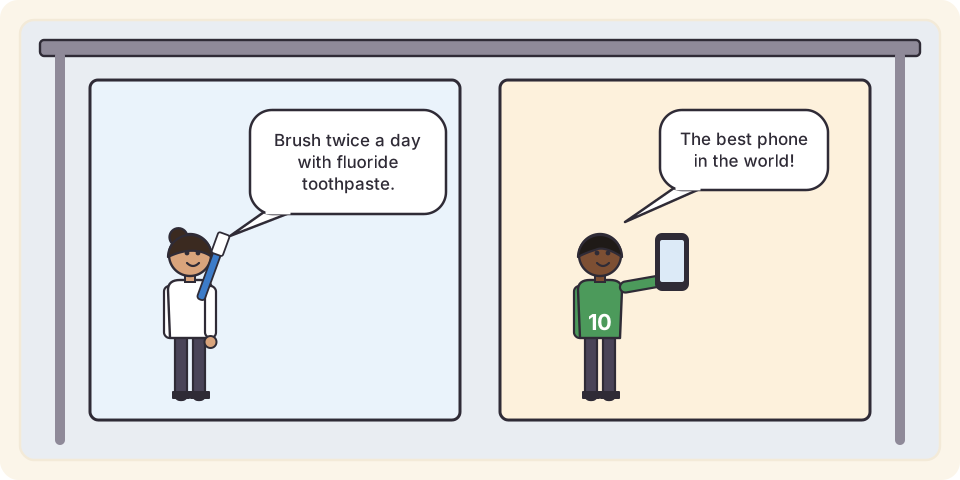
Two adverts are on the bus shelter. In one, a dentist in a white coat says: "Brush your teeth twice a day with a toothpaste that has fluoride." In the other, a famous football player smiles and says: "This is the best phone in the world."
Both adverts use the same kind of reason: someone who should know says so. Is that a good reason?
Why "the expert says" is often a good reason
Nobody can check everything themselves. You can't test every medicine, measure the distance to the Sun, or read every history book. So we rely on people who have studied these things. That is not lazy: it is how most of what anyone knows was learned. An argument like this one is usually strong:
A dentist says fluoride toothpaste helps prevent holes in teeth.
Dentists study teeth for years.
So fluoride toothpaste probably helps prevent holes in teeth.
Arguing from what an expert says is called an appeal to authority. When the authority is a real one, it is a good, though not certain, reason. Experts can be wrong, so this is an argument from "most", like the ones in Most and Nearly All: what experts in a field agree on is usually right.
When it becomes a trick
The football player is an expert, but at football. Nothing about being good at football makes someone know which phone is best. The advert borrows his fame from one field and spends it in another. This is a false appeal to authority, and it is a fallacy.
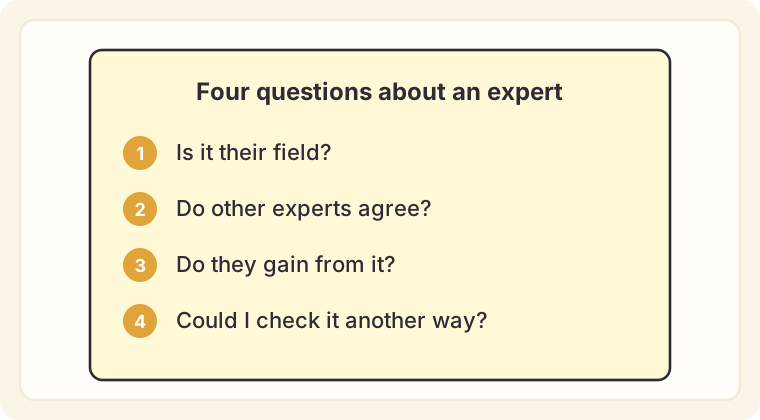
Here are four questions to ask whenever someone says "an expert says...":
- Is it their field? A dentist on teeth, yes. A footballer on phones, no.
- Do other experts agree? One expert against all the others is weak evidence. What most experts in a field agree on is much stronger.
- Do they gain from you believing it? The footballer is paid to say it. That doesn't make it false, but it is a reason to check.
- Could you check it another way? If a claim can be tested, a test beats anyone's word.
The opposite mistake
Some people go too far the other way: "Experts are often wrong, so I won't believe any of them." But "often wrong" is not "usually wrong". Ignoring all experts means trusting your own guess instead, about things you have never studied. That is rarely better. The skill is to trust the right experts about the right things, and to know why.
Try it at home
Use the four questions:
- "A famous singer says this diet will make you healthy."
- "Almost every doctor in the world agrees that smoking is bad for your health."
- "My uncle is a car mechanic, and he says this car's engine is in good shape."
Words to know
- appeal to authority - using what an expert says as a reason; a good reason when it is a real expert on their own field
- false appeal to authority - quoting someone as an expert outside their field, or as if their word settled things on its own
Big idea
Trusting experts is usually a good reason, because nobody can check everything. Ask whether it is their field, whether other experts agree, whether they gain from it, and whether you could check it another way.