Reasons That Work Together
Two arguments, both with more than one reason.
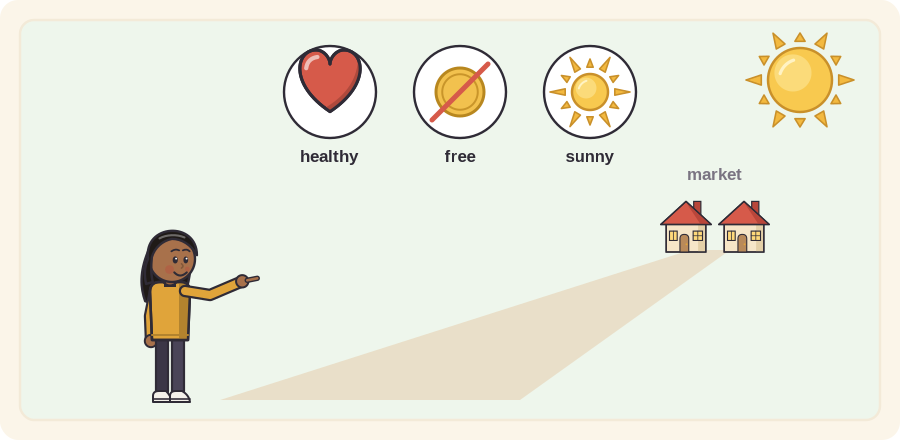
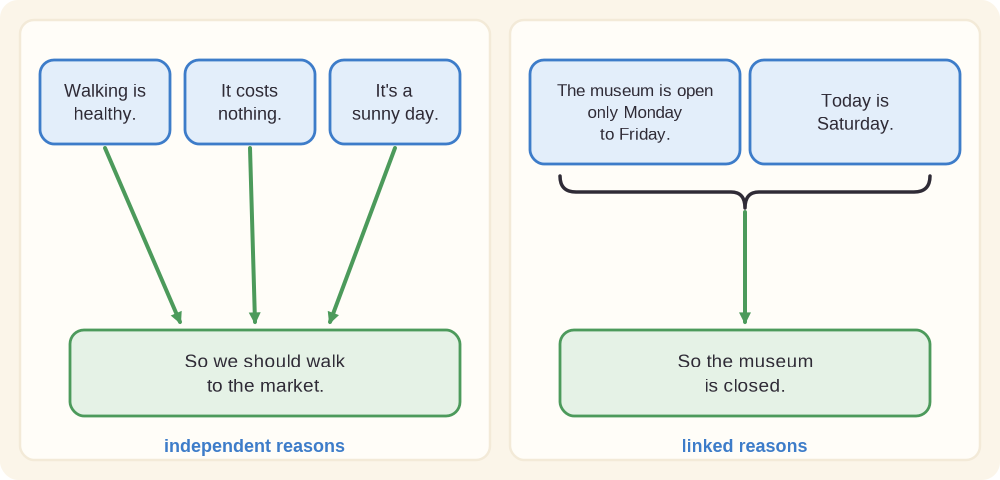
Priya wants her family to walk to the market: "Walking is healthy. It costs nothing. And it's a lovely sunny day."
Tom wants to visit the museum, and his dad says: "The museum is open only from Monday to Friday. Today is Saturday. So the museum is closed."
Both have several reasons. But the reasons do very different jobs.
Reasons that stand alone
Cover up one of Priya's reasons, say "it costs nothing". Do the others still give some support for walking? Yes: walking is still healthy, and it's still a sunny day. Cover up any one, and the others still help.
Reasons like these are independent reasons. Each one supports the conclusion on its own. Together they make the case stronger, the way more people pulling a rope pull harder.
Reasons that only work as a team
Now cover up one of Tom's dad's reasons. "Today is Saturday" on its own says nothing about the museum. "The museum is open only from Monday to Friday" on its own doesn't say whether it is open today. Neither reason gives any support by itself. Together, the conclusion follows.
Reasons like these are linked reasons: they only support the conclusion when they are taken together, like two halves of a key.
Two kinds of map
The two kinds are drawn differently. Independent reasons each get their own arrow to the conclusion. Linked reasons are joined by a bracket, and one arrow goes from the bracket.
Why it matters
It matters when a reason turns out to be false.
- If one of Priya's independent reasons is false (say, it starts to rain), the argument gets weaker, but the other reasons still stand.
- If one of Tom's dad's linked reasons is false (say, the museum is open on Saturdays too), the whole argument collapses: the other reason can't hold it up alone.
So when you want to question an argument, ask first what kind of reasons it has. Knocking down one independent reason only dents an argument. Knocking down one linked reason breaks it. And when you build your own argument, a few independent reasons make it harder to knock over.
Hidden premises from the first lesson are usually linked to a stated reason: "the sky is grey" only works together with "grey skies often bring rain".
Try it at home
- Independent or linked? "We should get a cat: cats are quiet, they don't need walks, and my sister loves them."
- Independent or linked? "All the shops in this street close at noon on Sunday. It's Sunday afternoon. So the bakery is closed."
- Draw both as maps.
Words to know
- independent reasons - reasons that each support the conclusion on their own
- linked reasons - reasons that support the conclusion only when taken together
Big idea
Some reasons stand alone and some only work as a team. Losing an independent reason weakens an argument; losing a linked reason breaks it.