Proof by Impossibility
Someone has eaten the last slice of cake in the café kitchen. The manager suspects Ben, the waiter. Ben says calmly: "Let's suppose I did eat it. Then I was in the kitchen at three o'clock, when the cake went missing. But at three o'clock I was at the bus stop - the bus driver saw me and the camera on the bus filmed me. I can't be in two places at once. So I didn't eat it."
Ben did something clever. To show a claim is false, he pretended it was true.
Pretend, then follow
Here is the shape of Ben's argument:
- Pretend the claim is true: "Ben ate the cake."
- Follow what would have to be true then: "Ben was in the kitchen at three."
- Bump into something impossible: Ben was also at the bus stop at three. Nobody can be in two places at once.
- Conclude that the claim is false: "Ben did not eat the cake."
This is called proof by impossibility. Its old Latin name is reductio ad absurdum: "leading back to the absurd". Logicians also call it proof by contradiction, because step 3 usually finds two claims that can't both be true.
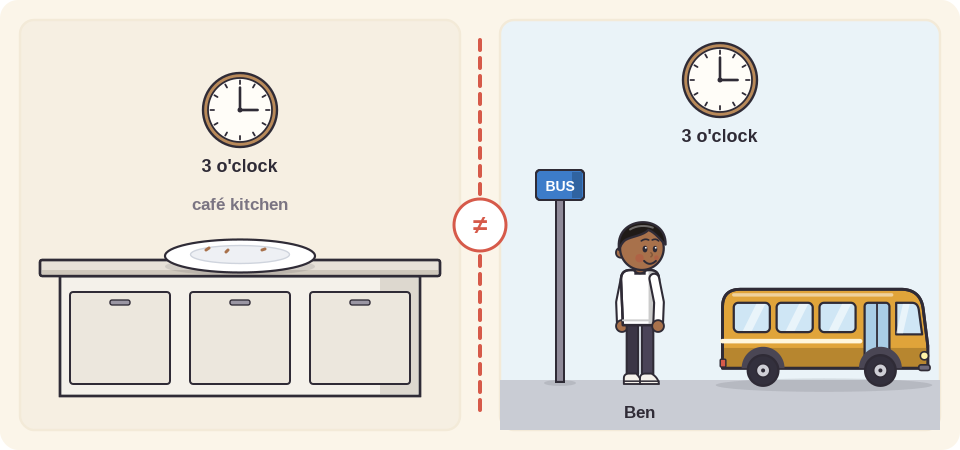
Why does this work? If a claim leads, step by valid step, to something impossible, then the claim can't be true. A true claim never leads to an impossible one by steps that follow (that's what "follows" means).
A famous one: no biggest number
Here is a proof by impossibility that people have known for thousands of years. Is there a biggest whole number?
- Pretend there is one. Call it "the biggest number".
- Follow: add 1 to it. You get a whole number too.
- Bump into something impossible: that new number is bigger than the biggest number. A number bigger than the biggest number? That can't be.
- Conclude: there is no biggest whole number.
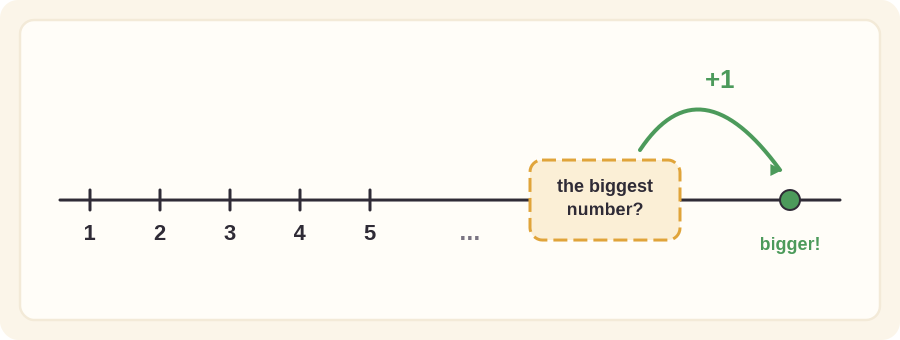
Notice that nobody counted forever to check. The proof shows the answer just by following the pretend claim to its end.
Use it carefully
Proof by impossibility is only as good as its steps. Each step must follow from the one before (using the moves from The Four Moves and Crossing Off). And the thing it bumps into must really be impossible, not just surprising or unusual. "Then you would have had to run very fast" is not impossible. "Then you would have been in two places at once" is.
You can use it in everyday talk too: "If we really had no money left, how did we just buy ice creams?"
Try it at home
- Your friend says "Nobody in our class has a birthday in June." You know that Sara's birthday is 3 June. Write it as a proof by impossibility.
- Is there a smallest number bigger than zero? Try pretending there is one, and think about half of it.
Words to know
- proof by impossibility (reductio ad absurdum, proof by contradiction) - showing a claim is false by pretending it is true and following it to something impossible
Big idea
To show a claim is false, pretend it is true and follow it, one valid step at a time. If you reach something impossible, the claim must be false.