When the Circles Say No
Two children are looking at a sleepy animal under a garden bench.
"All cats have tails," says Omar. "And that animal has a tail. So it's a cat."
His sister giggles. The animal stands up and wags its tail. It's the neighbour's dog.
Drawing Omar's argument
In the last lesson we checked syllogisms by drawing both reasons on one picture. Let's do that with Omar's:
All cats have tails.
The animal has a tail.
So the animal is a cat.
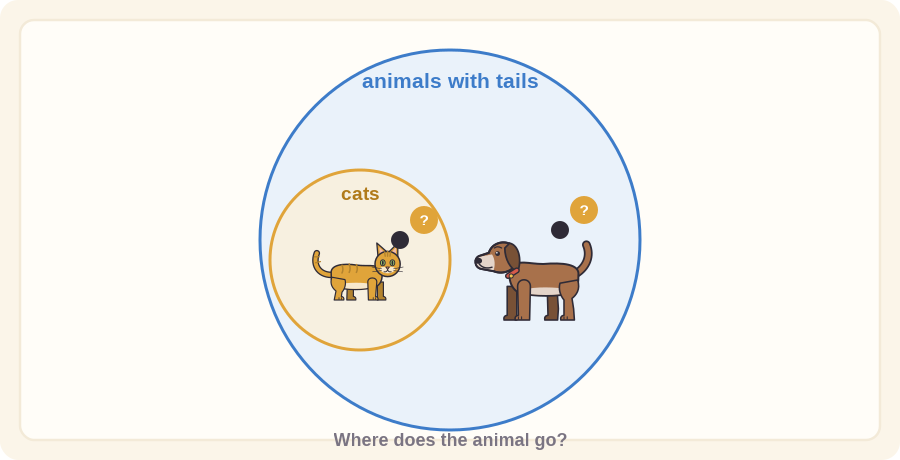
- "All cats have tails": the cat circle goes inside the circle of tailed animals.
- "The animal has a tail": a dot for the animal goes somewhere inside the tailed circle.
But where inside? The reasons don't say. The dot could be inside the cat circle, or it could be in the part of the tailed circle outside the cats.
The rule
If you can draw the reasons in a way that makes the conclusion false, the conclusion does not follow.
That is the counterexample test from Level 1, done with circles. A dog with a tail fits both reasons and isn't a cat. The drawing found it for us.
Omar's mistake should look familiar. "All cats have tails" means "if it's a cat, it has a tail". Omar went from "has a tail" to "is a cat": that is going backwards, or affirming the consequent, from The Four Moves.
Two groups in a third
Here is another one that sounds right:
All cats are mammals.
All dogs are mammals.
So all cats are dogs.
That one is easy to laugh at. But the same shape hides in serious-sounding talk: "All good scientists ask lots of questions. All toddlers ask lots of questions. So all toddlers are good scientists." Draw the cat one: the cat circle and the dog circle are both inside mammals, but nothing in the reasons says where they sit inside mammals. They can be apart.
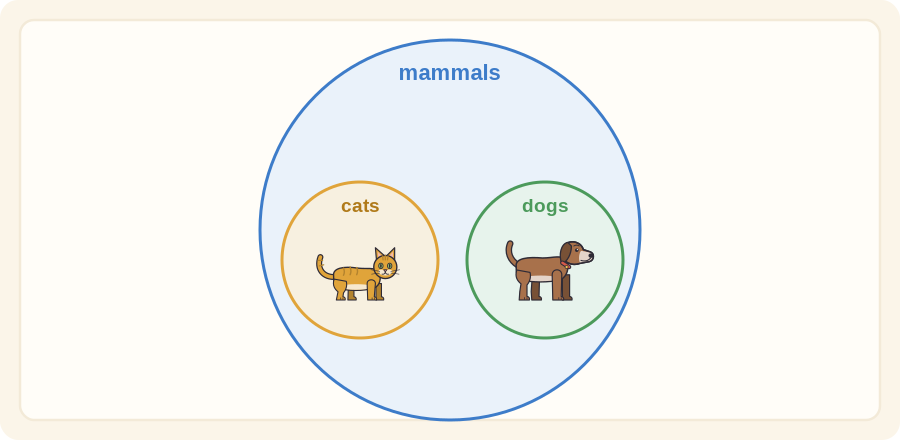
The middle group, mammals, appears in both reasons, but it doesn't link them: both reasons only say that something is inside mammals. Being in the same big group doesn't make two things the same. For a link, one reason has to say something about all of the middle group, like "all birds have feathers" did in the robin argument.
How to check any syllogism
- Draw the first reason.
- Add the second reason. Wherever the reasons don't say exactly where a circle or dot goes, try every place it could go.
- If even one way of drawing makes the conclusion false, it doesn't follow.
Try it at home
Draw each one and say whether it follows:
- All roses are flowers. Some flowers are red. So some roses are red.
- All teachers in my school drive. Mr Lee drives. So Mr Lee is a teacher in my school.
- No birds are fish. Some pets are birds. So some pets are not fish.
Words to know
No new words in this lesson: it uses circle diagrams, syllogisms and counterexamples together.
Big idea
To test a syllogism, try to draw the reasons so that the conclusion is false. If you can, the drawing is a counterexample, and the conclusion doesn't follow.