Drawing All and Some
Mrs Okafor's school has a football club and a music club. She tells the parents four things:
- All the football players are in Year 6.
- No football player is in the music club.
- Some music club members play the piano.
- Some music club members don't play the piano.
Each of these claims is about two groups of people. In Level 1 we drew "all dogs are animals" as a small circle of dogs inside a big circle of animals. That idea works for every claim like these, and it turns words into a picture you can check at a glance.
One circle per group
Draw a circle for each group. Anything inside the circle belongs to the group; anything outside doesn't. Logicians call these circle diagrams (they are also called Euler diagrams, after the mathematician Leonhard Euler, who used them in letters he wrote in the 1760s to teach a young German princess). Here is how each of the four claims looks.
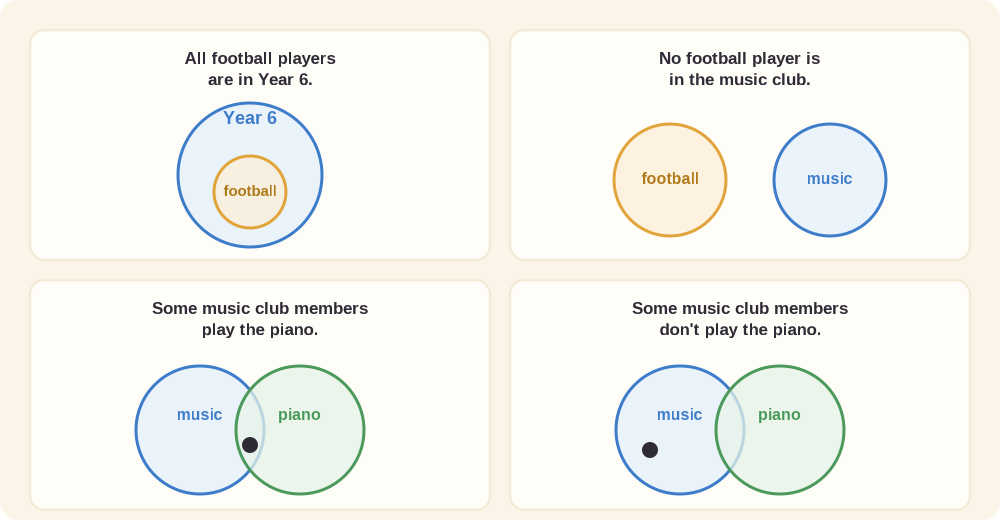
- All football players are in Year 6: the football circle sits completely inside the Year 6 circle. There is nowhere for a football player to be except inside Year 6.
- No football player is in the music club: the circles are apart. Nobody is in both.
- Some music club members play the piano: the circles overlap, and a dot in the shared part shows that something really is there.
- Some music club members don't play the piano: a dot in the music circle, outside the piano circle.
Why the dot?
Two overlapping circles on their own only say that something could be in both groups. The dot says that something is. "Some music club members play the piano" is a claim that at least one person is in both groups, so it needs the dot.
Opposites in pictures
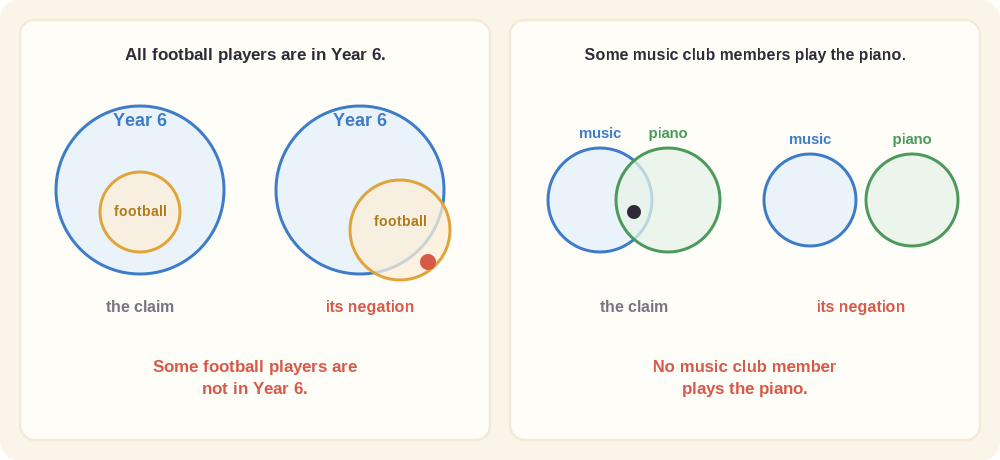
In Saying the Opposite we saw that the negation of "all" is "not all" and the negation of "some" is "none". The drawings show why:
- "All football players are in Year 6" is false as soon as there is one dot in the football circle outside Year 6. That is "some football players are not in Year 6".
- "Some music club members play the piano" is false only if the shared part is empty, and then "no music club member plays the piano" is true.
Try it at home
Draw each claim with two circles (and a dot if you need one):
- All tomatoes are fruits.
- No fish are birds.
- Some books in your house have pictures.
- Some of your friends don't like football.
Words to know
- circle diagram (an Euler diagram) - a drawing of groups as circles: inside for "all", apart for "no", a dot in the shared part for "some"
Big idea
Every claim with "all", "some" or "no" about two groups can be drawn with two circles: one inside the other, apart, or overlapping with a dot. The drawing shows exactly what the words say.