Crossing Off
Grandma can't find her keys. "They're either in my bag or in my coat pocket," she says. She tips out her bag: no keys. "So they must be in my coat." She puts her hand in her coat pocket, and there they are.
Grandma used one of the most useful moves in reasoning. Detectives use it, doctors use it, and you use it every time you look for something.
The crossing-off move
Here is Grandma's argument:
The keys are in my bag or in my coat.
The keys are not in my bag.
So the keys are in my coat.
Use the test from Level 1. Pretend both reasons are true, and try to imagine the keys somewhere other than the coat. You can't: there were only two places, and one has been crossed off. The conclusion follows.
We'll call this the crossing-off move: list the possibilities in an or-claim, cross off all but one, and conclude it is the one left. Logicians call it the disjunctive syllogism ("disjunction" is their word for an or-claim).
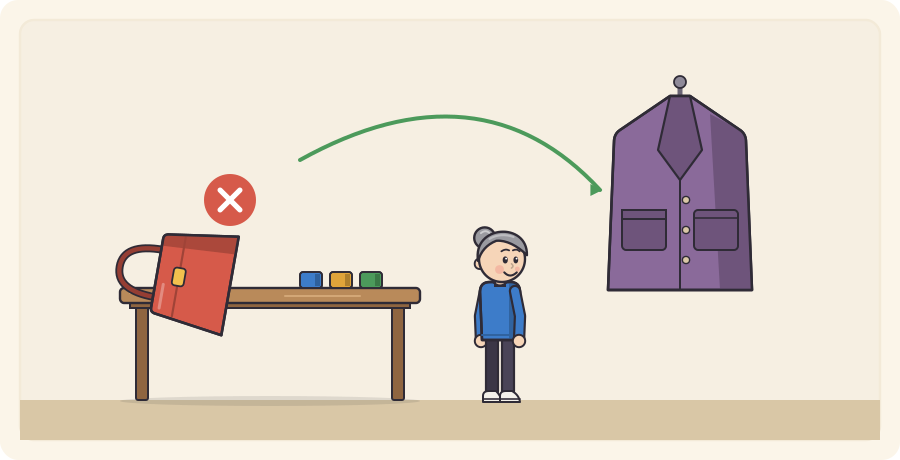
It works with more than two possibilities too. If the keys are in the bag, the coat or the car, and they aren't in the bag or the coat, they are in the car.
When it goes wrong
The next week Grandma loses her keys again. "Bag or coat," she says. Not in the bag. Not in the coat either! Now both reasons can't be true. Her or-claim was false: the keys were on the kitchen table all along.
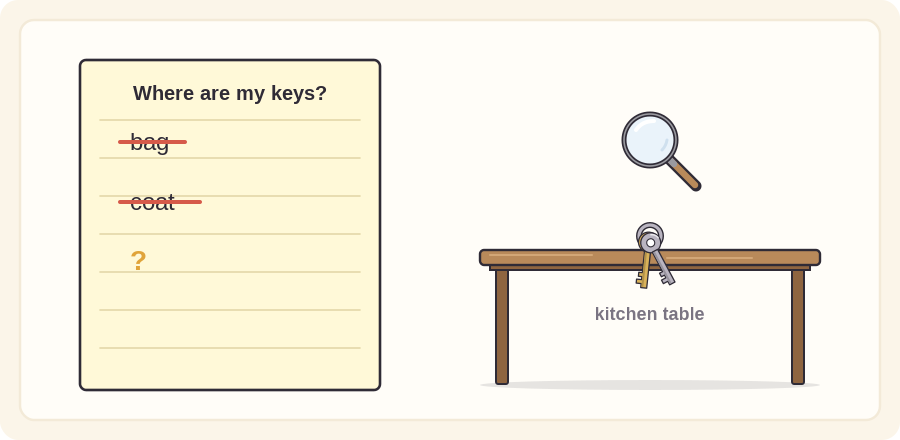
This is the false dilemma from Level 1: being offered only two choices when there are more. Now we can say exactly what goes wrong. The crossing-off move is valid; the problem is that one of its reasons, the either-or, is false. So the argument is valid but not sound (in Level 1 we saw that a sound argument is valid and has true reasons).
So when someone uses the crossing-off move on you ("Either you're with us or you're against us. You're not with us..."), don't attack the move. Check the list. Has it left anything out?
A trap: crossing in
There is a move that looks similar but doesn't work:
The keys are in my bag or in my coat.
The keys are in my bag.
So the keys are not in my coat.
With keys, it seems fine, because one set of keys can only be in one place. But the shape doesn't follow on its own. Try: "Ali is good at maths or good at music. Ali is good at maths. So Ali is not good at music." Ali can be good at both! Remember from the last lesson that an or-claim is usually both-allowed. Finding one possibility true doesn't cross the other one off.
Try it at home
- "The match is on Saturday or Sunday. It isn't on Saturday." What follows?
- "We can take the bus or walk. We can take the bus." Does "so we can't walk" follow?
- Next time you lose something, write the list of places first. Did the thing turn up in a place that was on your list?
Words to know
- crossing-off move (the disjunctive syllogism) - "it's here or there; it isn't here; so it's there": it always follows
Big idea
Crossing off possibilities until one is left always follows. If the conclusion is still wrong, the either-or was false: a possibility was missing from the list.