Two Steps with All
Lily is reading a book about birds with her dad. "Do robins have feathers?" she asks. Her dad doesn't need to look it up:
All robins are birds.
All birds have feathers.
So all robins have feathers.
He has linked two "all" claims together and got a third one out of them. This is one of the oldest patterns in logic. The Greek thinker Aristotle studied it about 2,400 years ago.
The syllogism
An argument made of two reasons and a conclusion, each one an "all", "some" or "no" claim about groups, is called a syllogism (from a Greek word for "reckoning together"). A syllogism talks about three groups. Here:
- robins and feathered things appear in the conclusion;
- birds appears in both reasons but not in the conclusion.
The group that appears in both reasons is the middle group. It is the link that joins the two reasons together, like a bridge between two banks. Without it, the reasons would be about different things and nothing could follow.
Checking with circles
To check a syllogism, draw both reasons on one picture, then look: is the conclusion already in the drawing?
- "All robins are birds": the robin circle goes inside the bird circle.
- "All birds have feathers": the bird circle goes inside the feathered-things circle.
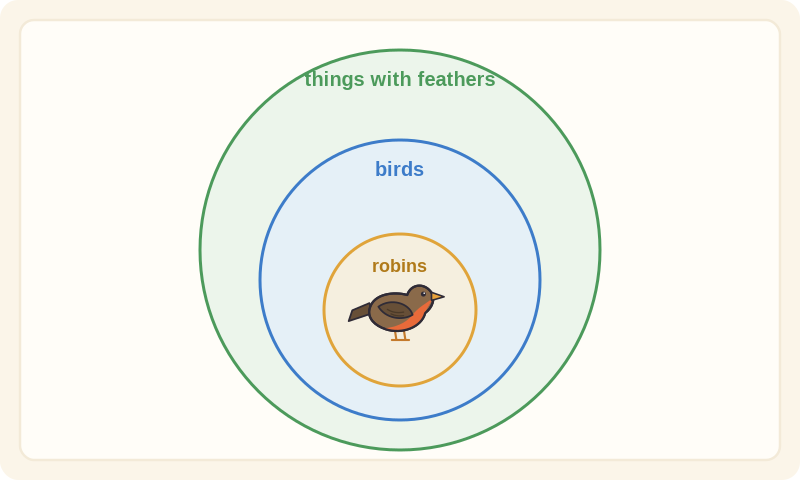
Now look at the robin circle. It is inside birds, which is inside feathered things, so it is inside feathered things. There is no way to draw the two reasons without the conclusion being drawn too. That is what "it follows" means.
A syllogism with "no"
Syllogisms don't only use "all". Here is one with "no":
No fish have fur.
All sharks are fish.
So no sharks have fur.
Draw it: the fish circle and the furry-things circle are apart. The shark circle goes inside the fish circle. Then the shark circle is apart from the furry circle too. The conclusion is in the drawing, so it follows.
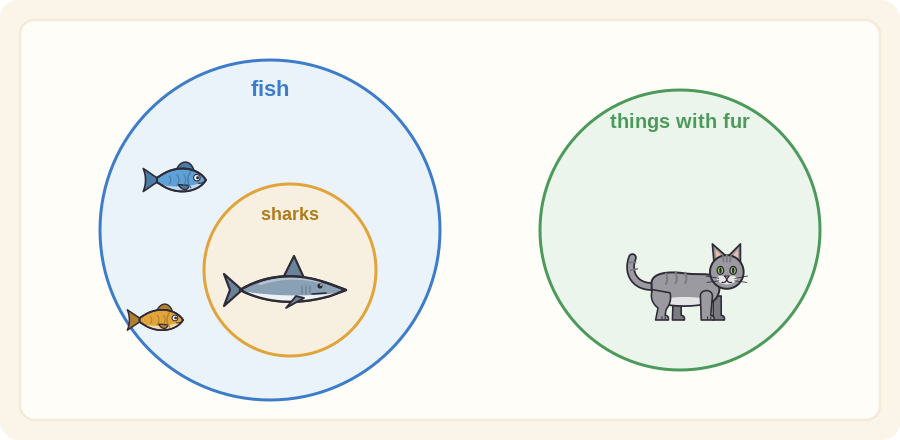
The circles also show why the middle group matters: the conclusion is about sharks and fur, but everything is decided by where the fish circle sits.
Try it at home
Draw both reasons on one picture and say whether the conclusion follows:
- All squares are rectangles. All rectangles have four corners. So all squares have four corners.
- No reptiles are mammals. All snakes are reptiles. So no snakes are mammals.
- Find the middle group in each.
Words to know
- syllogism - an argument with two reasons and a conclusion, each an "all", "some" or "no" claim about groups
- middle group - the group in both reasons of a syllogism that links them
Big idea
A syllogism links two claims about groups through a middle group. Draw both reasons with circles: if the conclusion is already in the drawing, it follows.