Only If and Unless
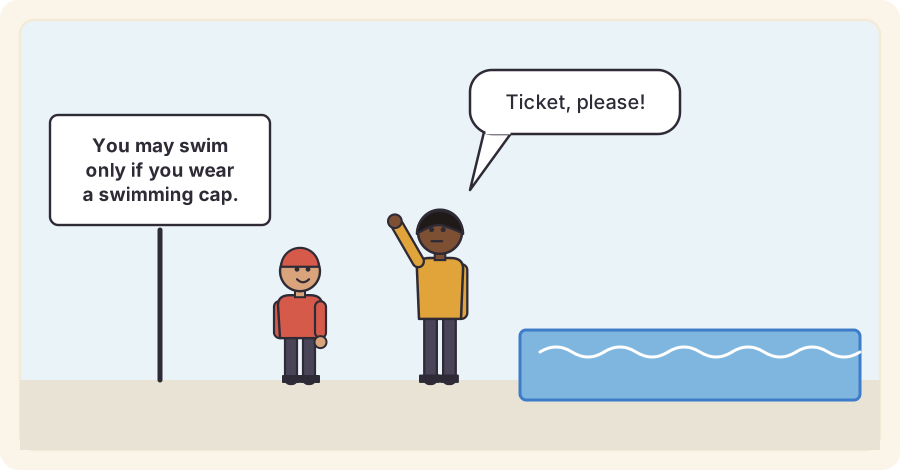
A sign at the swimming pool says: You may swim only if you wear a swimming cap. Mia puts on her cap and walks straight to the water. The lifeguard stops her: "Ticket, please!"
"But the sign says I can swim if I wear a cap!" says Mia. Does it?
"If" and "only if" are different
Read the sign again. It doesn't say "you may swim if you wear a cap". It says "you may swim only if you wear a cap".
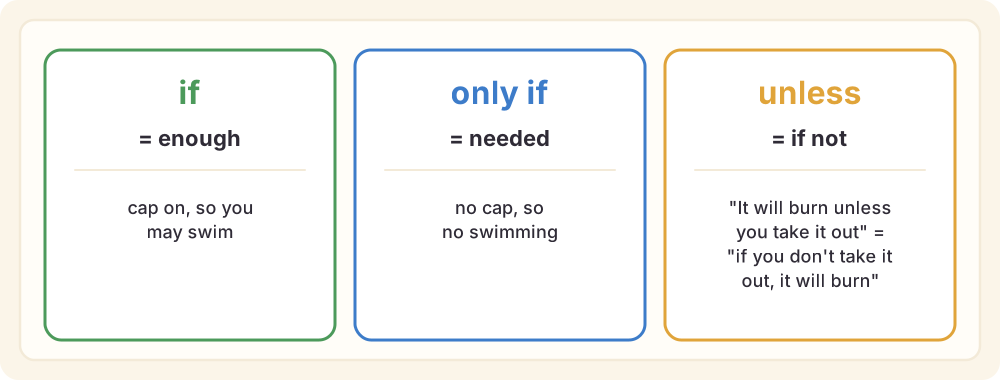
- "You may swim if you wear a cap" would make the cap enough: cap on, and you may swim, nothing else asked.
- "You may swim only if you wear a cap" makes the cap needed: no cap, no swimming. It doesn't say the cap is all you need.
So the sign is a rule about what is needed. A ticket can be needed too, and so can a shower first. Mia mixed up "only if" with "if".
A handy way to remember it: "only if" points to what is needed. "You can vote only if you are on the list" - being on the list is needed. "The plant grows only if it gets light" - light is needed, but water is needed too.
"If and only if"
Sometimes people want to say both at once: the thing is needed and enough. Then they say if and only if: "A shape is a triangle if and only if it has exactly three straight sides." Three sides is enough to be a triangle, and you can't be a triangle without them. You will see "if and only if" in maths and in rules that are meant to be exact.
"Unless"
"Unless" is another small word that hides an "if". Listen:
The cake will burn unless you take it out now.
This means: if you don't take it out now, the cake will burn. "Unless" means "if not".
Notice what the sentence does not say. It doesn't promise that taking the cake out now will save it: it may have burnt already. It only warns what happens if you don't.
Turning them into plain "if"
When a sentence with "only if" or "unless" confuses you, say it again with a plain "if":
- "You may swim only if you wear a cap" becomes "if you don't wear a cap, you may not swim".
- "The cake will burn unless you take it out" becomes "if you don't take it out, it will burn".
Both new sentences start from what is missing. That is the clue: "only if" and "unless" are both about what happens without something.
Try it at home
- "You'll get pocket money only if you tidy your room." You tidied your room. Must you get pocket money?
- Say with a plain "if": "We'll miss the train unless we run."
- Look for "only if" and "unless" on signs and in rules this week. Which things are needed, and which are enough?
Words to know
- only if - names something needed: "you may swim only if you wear a cap" means no cap, no swimming
- if and only if - names something that is both needed and enough
- unless - means "if not": "it will burn unless you take it out" means if you don't take it out, it will burn
Big idea
"if" points to what is enough, "only if" to what is needed, and "unless" means "if not". When in doubt, rewrite the sentence with a plain "if".